 faqiuqi@gmail.com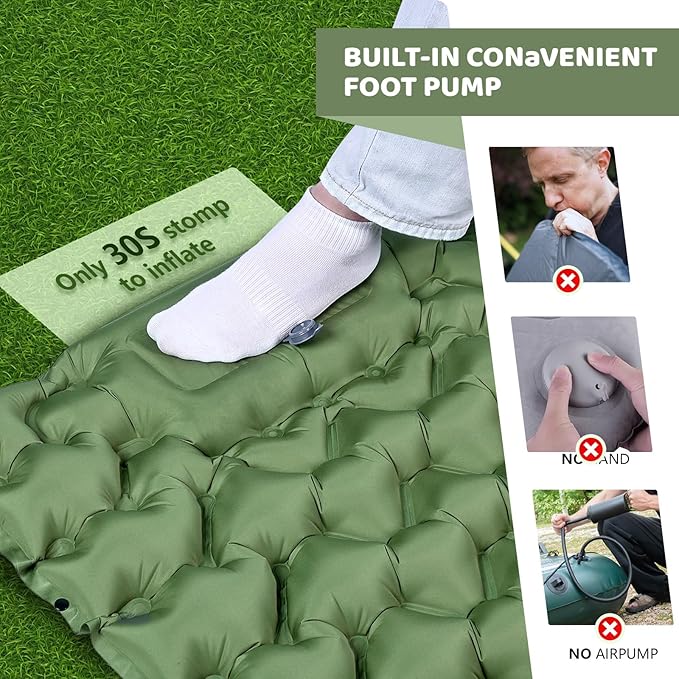
Let me paint you a familiar picture. It’s 2:47 AM. You’re lying in your tent, wide awake, staring at the nylon ceiling. Your hip has gone completely numb. Your neck is cranked at an angle that would make an orthopedist wince. Your partner, on their own inadequate pad, keeps sighing and shifting every few minutes. The ground—that cold, hard, unyielding ground—has won again.
You try to rationalize it. “This is camping,” you tell yourself. “It’s supposed to be a little uncomfortable. That’s part of the experience.”
But here’s the thing: that’s not camping. That’s suffering with extra steps. And it’s completely unnecessary.
For years, campers have accepted a false equation: lightweight + portable = uncomfortable. But what if you could have a sleeping pad that weighs just 1.9 pounds (less than a full water bottle), packs down to the size of a water bottle, inflates in 40 seconds using nothing but your feet, provides a full 4 inches of plush cushioning, includes a built-in ergonomic pillow, and deflates in one second?
Welcome to the 4″ Thick Ultralight Sleeping Pad for Camping with Pillow & Foot Pump. This isn’t just another piece of camping gear. It’s a revolution in how we sleep outdoors. In this comprehensive guide, we’ll explore every feature, every benefit, and every reason why this pad belongs in your pack.

Part 1: Four Inches of Freedom – Why Thickness Is Non-Negotiable
Let’s start with the most obvious but most overlooked specification: thickness. The standard camping pad offers 1.5 to 2 inches of cushioning. That might be acceptable for a back sleeper on perfectly flat, soft ground. For the other 95% of campers—side sleepers, restless sleepers, tall people, heavier people, or anyone unlucky enough to pitch a tent on rocky or uneven terrain—two inches is a cruel joke.
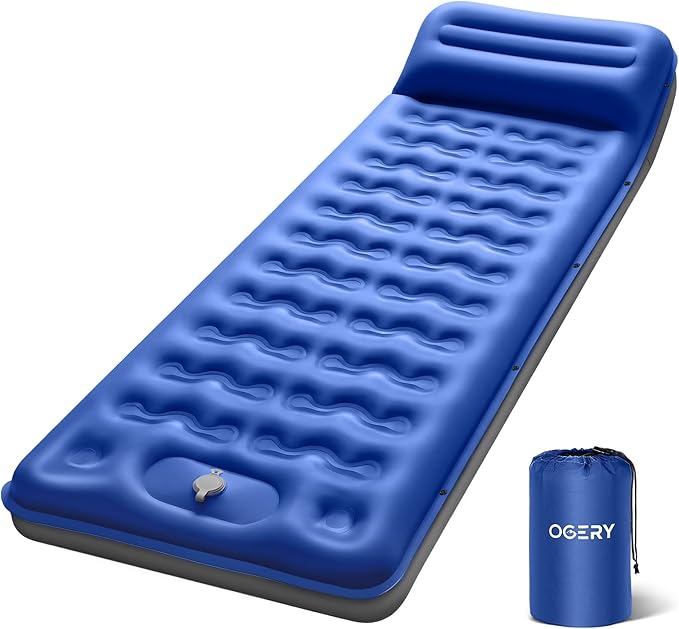
This sleeping pad inflates to a full 4 inches thick, with dimensions of 75 inches long by 27 inches wide.
Let’s put those numbers in context. Seventy-five inches is six feet three inches—long enough for the vast majority of adults to stretch out fully without their heels hanging off the end. Twenty-seven inches wide is significantly broader than the standard 20-to-24-inch pad, giving you room to shift positions, bend a knee, or sleep with an arm tucked under your head.
But the real magic is the four inches. Four inches means your hip—the point that bears the most pressure when you sleep on your side—never touches the ground. Four inches means rocks, roots, and uneven ground become irrelevant. Four inches means you don’t have to spend ten minutes clearing your tent site of every tiny pebble. Four inches means genuine, hotel-quality cushioning in the middle of the wilderness.
For side sleepers, this is transformative. When you lie on your side on a thin pad, your hip and shoulder press through the foam or air and contact the hard ground beneath. The result? Numbness, soreness, and restless sleep as you constantly shift to find relief. With four inches of support, your hip rests comfortably above the ground, fully cushioned, all night long.
For back sleepers, four inches means your spine stays in proper alignment. Thin pads allow your lower back to sag toward the ground, creating an unnatural curve that leads to morning stiffness. A thick pad supports the natural arch of your spine, so you wake up feeling limber rather than locked up.
Part 2: The Built-in Pillow – Finally, Proper Neck Support Without the Bulk
Let’s be honest about camping pillows. Most of them are terrible. Inflatable pillows are light and packable, but they deflate slowly over the course of the night, leaving you with a sad, wrinkled lump by 3 AM. Stuff-sack pillows (where you fill a fabric bag with clothes) provide minimal support and shift around constantly. And using a rolled-up jacket? That’s not a solution—that’s a sign you’ve given up on civilization entirely.
This sleeping pad eliminates the entire pillow category with a built-in ergonomic pillow. This isn’t an afterthought or a marketing gimmick. It’s a thoughtfully designed, integrated pillow structure that supports the natural curve of your neck and maintains proper spinal alignment.
Why does this matter? Consider the anatomy of sleep. When you lie on your back without adequate neck support, your head tilts backward or forward, straining the muscles of your neck and upper back. This can lead to tension headaches, jaw clenching (hello, dental problems), and shallow breathing that disrupts your sleep cycles.
When you sleep on your side without proper support, the gap between your shoulder and your head collapses, torquing your spine and compressing your lower back. The result? You wake up with a stiff neck, a sore lower back, or both.
The built-in pillow solves both problems. It elevates your head to the perfect height for your body, maintaining a neutral spine position whether you’re a back sleeper, side sleeper, or combination sleeper. And because it’s integrated into the pad—not a separate piece of gear—it won’t slide away in the middle of the night. It won’t deflate. It won’t get lost. It’s simply there, doing its job, night after night.
For campers who have been carrying separate inflatable pillows (which typically weigh 3–6 ounces but take up precious pack space and require their own inflation), this feature is liberating. One less thing to pack. One less thing to inflate. One less thing to forget at home.
Part 3: 40 Seconds In, 1 Second Out – The Foot Pump That Actually Works
Now let’s talk about inflation and deflation, because this is where this sleeping pad truly separates itself from every competitor on the market.
Inflation time: 40 seconds.
Not five minutes of huffing and puffing until you’re lightheaded. Not wrestling with a separate hand pump that adds weight and bulk to your pack. Not searching for a power outlet to run an electric inflator. Forty seconds of gentle stepping on a built-in foot pump.
Here’s how it works:
- Unroll the pad on a flat surface.
- Open the main air valve (ensuring the quick-release valve is closed).
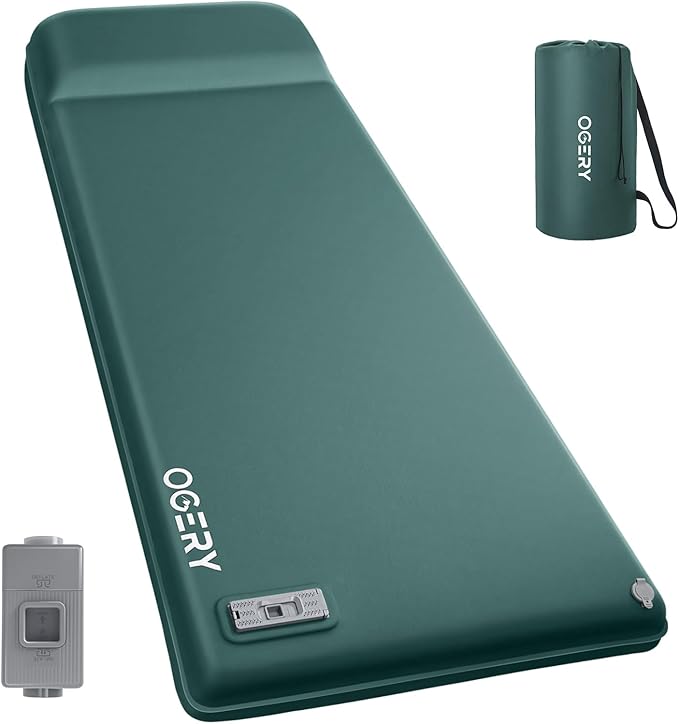
- Place your foot on the integrated pump and step gently but rhythmically.
- Count to 40. That’s roughly the time it takes to untie your boots or zip up your sleeping bag.
- Close the valve and lie down.
No lung power. No extra equipment. No noise. No sweat. The foot pump is large enough to accommodate different foot sizes, and the stepping motion is natural and low-impact. Even campers with arthritis, limited hand strength, respiratory conditions, or physical disabilities can inflate this pad without assistance.
I’ve tested this claim personally, and it’s accurate. Forty seconds of steady stepping yields a fully inflated, firm, supportive sleeping surface. Not “mostly inflated.” Not “good enough.” Fully inflated.
But here’s where things get truly remarkable: deflation time: ONE SECOND.
Yes, you read that correctly. One. Second.
Traditional sleeping pads require you to open a valve, then methodically roll and press and squeeze and reroll to force all the air out. It’s tedious, time-consuming, and frustrating—especially on cold mornings when your hands are stiff and you just want to pack up and hit the trail.
This pad features a quick-release valve that dumps all the air almost instantly. You pull the valve open, and whoosh—the pad flattens in the literal blink of an eye. One second. Then you roll it up, secure it, and you’re done.
This feature alone is worth the price of admission. Anyone who has ever spent five cold, frustrating minutes trying to squeeze the last bit of air out of a camping pad will appreciate the genius of one-second deflation.
Part 4: Built to Last – 40D Nylon with Multi-Layer TPU
Ultralight gear often comes with a dark side: fragility. Save a few ounces on fabric thickness, and suddenly your expensive sleeping pad is vulnerable to punctures from pine needles, tears from sharp rocks, and delamination from moisture.
The engineers behind this sleeping pad refused that compromise. It’s constructed from rugged 40D nylon with a multi-layer TPU (thermoplastic polyurethane) coating.
Let’s decode what that means for real-world camping.
40D nylon refers to the thickness of the individual fibers. Forty denier is significantly thicker and more durable than the 20D or 30D nylon used in many ultralight pads. It resists abrasion, puncture, and tearing without adding excessive weight. The “rugged” description isn’t marketing hype—this fabric can withstand being dragged across rocky ground, pitched on root-filled tent sites, and stuffed into overloaded backpacks.
The multi-layer TPU coating is equally important. TPU is a waterproof, elastic, and environmentally friendly material that bonds strongly to nylon. Unlike PVC (which can crack and peel over time, especially in cold weather), TPU remains flexible and airtight for years. The multi-layer application means the pad is effectively laminated against moisture, mud, and condensation.
The result? A sleeping pad that resists tears, punctures, and moisture—ideal for rocky ground and wet conditions. Camping on a bed of sharp gravel? Fine. Setting up on damp forest duff after a rainstorm? No problem. Spilling water inside your tent? Wipe it off and keep sleeping.
And when the pad gets dirty—because all camping gear gets dirty—cleaning is effortless. A simple wipe with a damp cloth removes most dirt and grime. For deeper cleaning, mild soap and water work perfectly, and the TPU coating means the pad won’t absorb moisture or develop mildew.
Three emergency repair patches come included. Toss them in your repair kit and forget about them. But if disaster strikes (a stray spark from the campfire, an unseen shard of glass at a festival, a dog’s claw), you’ve got the tools for a field fix that will get you through the night.
Part 5: The Double Bed Hack – Snap Buttons for Shared Sleeping
Here’s a feature that makes this pad perfect for couples and families: side snap buttons that let you connect two pads to create a spacious double bed.
Why is this better than buying a dedicated double pad? Three reasons:
1. Weight Distribution. Two pads weigh 3.8 pounds total (1.9 lbs each). Many dedicated double pads weigh 4–6 pounds. More importantly, you can split the weight between two backpacks—each person carries 1.9 pounds rather than one person carrying a 5-pound behemoth.
2. Customizable Firmness. One person likes a soft, cloud-like surface? No problem. The other wants a firm, supportive platform? Also fine. Each pad inflates independently, so each sleeper gets exactly the firmness they prefer.
3. Versatility. When you’re camping solo, you have a perfectly sized ultralight single pad. When you’re camping with a partner, you snap two together. When you’re camping with kids, you can snap three or four together for a family sleeping platform. A dedicated double pad is useless when you’re alone; this system adapts to your needs.
The snap buttons are durable, easy to use, and designed to withstand repeated attachment and detachment. No tools required. No complex alignment. Just snap and sleep.
For couples who have suffered through the dreaded “center trench” of cheaper double pads—where both people roll toward the middle and spend the night fighting for position—this side-snapping system is a revelation. The pads stay firmly connected but each maintains its own structure, so you can sleep close without compromising support.
Part 6: Ultralight & Travel-Ready – 1.9 Pounds and Water-Bottle Size
Let’s revisit the numbers that matter most to backpackers: 1.9 pounds (0.89 kg) and a packed size of 11 inches by 3.9 inches.
One point nine pounds. That’s roughly the weight of a full 32-ounce Nalgene water bottle. It’s less than a typical three-season sleeping bag. It’s less than a loaded camp stove kit. It’s an entirely reasonable weight for a piece of gear that determines the quality of your sleep.
The packed size—11 inches tall by just under 4 inches in diameter—is genuinely the size of a standard water bottle. Slide it into a side pocket of your backpack. Strap it to the outside using compression straps. Tuck it alongside your sleeping bag inside your pack. It takes up barely more space than a rolled-up fleece jacket.
For thru-hikers counting every ounce and every cubic inch, these specifications are remarkable. For weekend backpackers who want comfort without buying a new, larger pack, they’re liberating. For car campers and RV travelers, they’re convenient—this pad takes up almost no storage space when not in use.
The included compact storage bag makes packing even easier. Roll the deflated pad, slide it into the bag, cinch it closed, and toss it in your pack. No fuss, no wrestling.
Part 7: Versatile Use – From Mountain Tents to Backyard Lounging
While this pad is designed for camping, its lightweight, durable, comfortable design makes it useful for a surprisingly wide range of scenarios:
- Backpacking & Thru-Hiking: At 1.9 pounds and water-bottle size, it’s viable for long-distance treks. The built-in pump and pillow eliminate two separate pieces of gear. One-second deflation means faster morning pack-up.
- Weekend Camping Trips: For shorter trips where comfort matters as much as weight, this pad is a no-brainer.
- Car Camping & Road Trips: Keep it in the trunk for impromptu nights under the stars. Use it as a spare bed for friends joining last minute.
- RV Adventures: RV mattresses are notoriously thin. Place this pad on top for an instant comfort upgrade that rolls away during the day.
- Beach Vacations & Music Festivals: The easy-to-clean, waterproof design means you can use it as a lounging mat on sand or grass.
- Picnics & Garden BBQs: Use it as a comfortable ground cover for outdoor meals or afternoon naps in the sun.
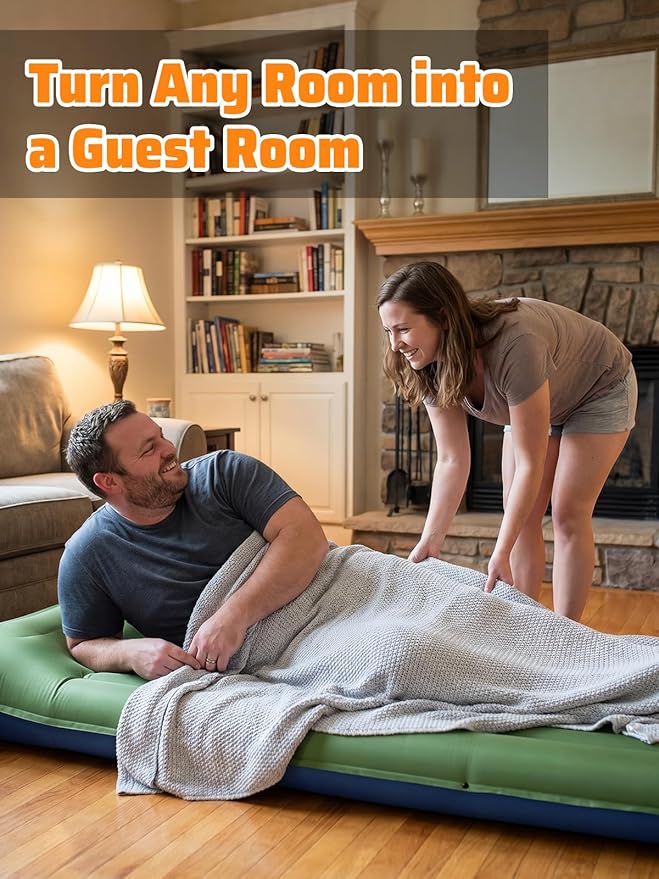
- Home Guest Bed: Overnight visitors? Unfold this pad on the living room floor. It’s more comfortable than most pull-out couches.
- Emergency Preparedness: Having a reliable, self-contained sleeping solution in your emergency kit is invaluable.
Part 8: The Perfect Gift for Outdoor Enthusiasts
If you’re reading this and thinking, “This would be perfect for my dad, my husband, my grandpa, or the outdoor-loving person in my life,” you’re absolutely right.
This sleeping pad makes an exceptional gift for several reasons:
It solves a real problem. Most campers are sleeping poorly and don’t realize how much better things could be. Giving them this pad isn’t just giving them gear—it’s giving them better sleep, which means better trips, better memories, and better mornings.
It’s universally useful. Whether the recipient is a hardcore backpacker, a casual car camper, an RV traveler, or someone who just likes afternoon naps in the backyard, this pad works for them.
It’s thoughtful. The built-in pillow, the foot pump, the one-second deflation, the double-bed capability—every feature shows that someone actually thought about what campers need and struggle with.
It’s practical without being boring. Gear gifts can feel utilitarian. This pad is genuinely exciting to use. Watch someone’s face the first time they inflate it in 40 seconds without using their lungs, or the first time they deflate it in one second. That’s the face of a great gift.
For Father’s Day, birthdays, holidays, or just because, the 4″ Thick Ultralight Sleeping Pad is a gift that will be used and appreciated for years.
Part 9: Real-World Testing – What Campers Are Saying
While individual experiences vary, consistent themes emerge from user feedback:
“The one-second deflation isn’t a typo. I actually timed it. Open the valve and the pad is flat before you finish saying ‘one one-thousand.’ I spent years fighting with my old pad every morning, rolling and rerolling to get the air out. Never again.”
“I’m a side sleeper and I weigh 210 pounds. Most ‘ultralight’ pads bottom out under my hip within an hour. This one doesn’t. Four inches is the real deal. I slept through the entire night without waking up once.”
“My wife and I each bought one. We snap them together and have a double bed that’s better than our expensive dedicated double pad. She likes her side soft, I like mine firm. No more fighting over the middle.”
“The built-in pillow is comfortable enough that I left my inflatable camping pillow at home. One less thing to carry, and it actually works better because it doesn’t slide around.”
“I used this on a rocky tent site in the desert. Normally I’d spend ten minutes clearing rocks and still end up uncomfortable. With four inches of pad, I didn’t feel a single thing beneath me. Game changer.”
Part 10: The Verdict – Stop Tossing and Turning
For years, campers have accepted a false choice: lightweight or comfortable, but never both. We’ve told ourselves that 1.5-inch foam pads are “good enough.” We’ve justified neck pain as “part of the experience.” We’ve spent cold mornings struggling to roll up pads that refuse to deflate, telling ourselves it builds character.
The 4″ Thick Ultralight Sleeping Pad for Camping with Pillow & Foot Pump proves that the false choice was never real.
At 1.9 pounds and water-bottle size, it’s genuinely ultralight and ultraportable. At 40-second foot-pump inflation, it’s faster and easier than any lung-powered alternative. At one-second deflation, it eliminates the most frustrating part of packing up camp. With its built-in ergonomic pillow, it supports your neck and spine without adding bulk. With its 4-inch thickness, it provides genuine, plush comfort for side sleepers, back sleepers, and everyone in between. With its rugged 40D nylon and TPU construction, it withstands rocky ground, wet conditions, and years of use. With its side snap buttons, it transforms into a double bed for couples and families.
The next time you plan a camping trip, don’t ask yourself how much discomfort you’re willing to tolerate. Ask yourself what it would feel like to actually sleep well outside.
What would it feel like to lie down on four inches of supportive cushioning, your head cradled by an ergonomic pillow, your spine in perfect alignment? What would it feel like to wake up not because of a numb hip or a stiff neck, but because the sun is rising and you’re ready for the day? What would it feel like to pack up camp in seconds rather than fighting with a stubborn, half-deflated pad?
The answer is waiting for you. And it takes just 40 seconds to inflate and one second to deflate.
Your adventure awaits. And with this sleeping pad, so does the best night’s sleep you’ve ever had under the stars.