 faqiuqi@gmail.com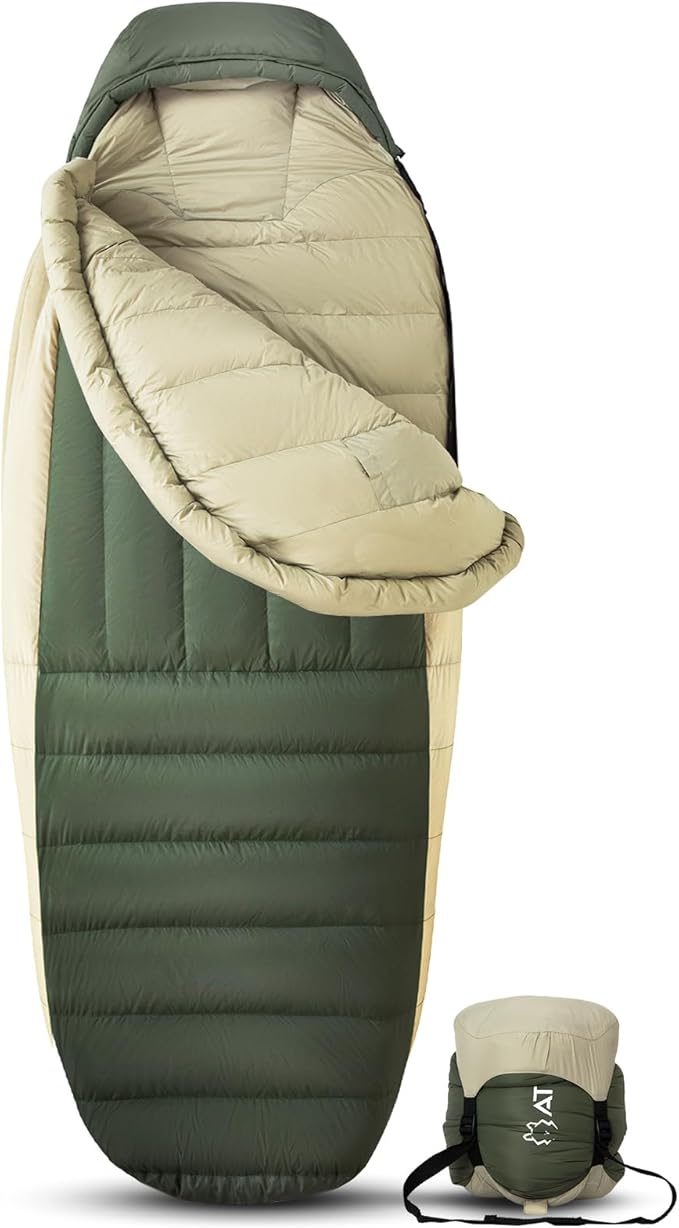
There is a moment, just before dawn, when winter camping reveals its true nature. The temperature has bottomed out. Your breath hangs in the air like smoke. And inside your sleeping bag, you become acutely aware of every single gap in your thermal defense.
A draft sneaks in through an unzipped collar. A cold spot spreads across your shoulders where the down has shifted away. Your feet, pressed against a narrow footbox, feel like blocks of ice. You curl into a fetal position, trying to conserve heat, but the bag fights your every movement.
You survive the night. But you do not sleep.
For years, cold-weather sleeping bags have forced campers to choose between two equally unpleasant options: a narrow, restrictive “mummy” bag that maximizes heat efficiency at the cost of comfort, or a roomy rectangular bag that offers freedom to move but bleeds warmth like a sieve. Side sleepers, tall adults, and restless tossers have been particularly underserved—expected to either squeeze into tapered coffins or shiver in loose, inefficient envelopes.
The ATEPA Down Sleeping Bag was designed to end that compromise.
With 850 grams of premium 700FP RDS-certified down, ISO-tested temperature ratings, an XL extra-wide cut, 3D vertical baffle construction, and precision-engineered details like dual YKK anti-snag zippers and an ergonomic trapezoidal footbox, this bag delivers something rare: legitimate cold-weather performance without the claustrophobia.
Let us explore why the ATEPA bag might be the last three-season (and mild winter) sleeping bag you ever need to buy.
Part One: Real Cold Weather Performance – ISO Tested, Field Proven

The outdoor industry is full of optimistic temperature ratings. A bag might say “20°F” on the box, but anyone who has spent a 25°F night in that bag knows the truth: you will be awake, shivering, and questioning your life choices by 3 AM.
ATEPA refuses to play that game. This bag has been ISO-tested (International Organization for Standardization) to provide reliable, honest performance metrics. The results:
- Comfort Rating: 30.2°F (-1°C) – The temperature at which a standard woman can sleep comfortably in a relaxed position.
- Limit Rating: 17.6°F (-8°C) – The temperature at which a standard man can sleep in a curled position without feeling cold.
- Extreme Rating: (not listed but typically below limit) – Survival only, not comfort.
What do these numbers mean for you? If you are a cold sleeper, expect cozy comfort down to about 30°F. If you sleep warm, you can push this bag into the upper teens with proper base layers and a good sleeping pad. For three-season camping—spring, summer, fall—this bag is more than adequate. For mild winter conditions in lower elevations or southern climates, it will serve admirably.
The secret to this performance lies inside the bag: 850 grams of 700FP (fill power) down, certified by the Responsible Down Standard (RDS) . Fill power measures the loft—the fluffiness—of down. Higher fill power means more warmth for less weight. 700FP is considered high-quality, premium down, striking an excellent balance between thermal efficiency and affordability. With 850 grams (nearly two pounds) of this down packed into the bag, the warmth-to-weight ratio is exceptional.
Unlike synthetic fills, which degrade over time and lose loft when compressed, down maintains its insulating properties for decades if cared for properly. Down is also naturally breathable, wicking moisture away from your body while trapping warm air in countless tiny clusters. The result is a bag that feels alive—adapting to your movements, regulating your temperature, and keeping you dry from the inside out.
The 3D baffle construction is equally critical. Baffles are the internal walls that keep down from shifting around. Cheap bags use simple sewn-through construction, which creates cold spots at every stitch line. ATEPA uses three-dimensional vertical baffles that create continuous chambers of loft, allowing down to expand fully while staying in place. Your shoulders, torso, and feet each receive consistent insulation coverage—no clumping, no bare spots, no midnight surprises.
Part Two: XL Extra Wide Design – Freedom for Side Sleepers and Tall Adults
Let us talk about the single biggest complaint campers have about cold-weather bags: they are too narrow.
Traditional mummy bags achieve their impressive warmth-to-weight ratios by tapering severely at the shoulders and feet. The theory is sound—less internal volume means less air for your body to heat. But the practice is miserable for anyone who sleeps on their side, moves during the night, or simply has broad shoulders.
The ATEPA bag flips this logic on its head. With dimensions of 82.68 inches long by 37.4 inches wide, this is an XL-wide bag that provides significantly more shoulder and leg room than standard mummy bags while still maintaining heat efficiency. To put that in perspective:
- A standard mummy bag is typically 72-78 inches long and 30-32 inches wide at the shoulders.
- The ATEPA bag is over 4 inches wider at the shoulders and 5-10 inches longer.
- The interior circumference allows for natural sleeping positions—on your back with arms at your sides, on your side with knees slightly bent, or even on your stomach with arms outstretched.
For side sleepers, this extra width is transformative. Side sleeping requires room to draw your knees up slightly toward your chest—a position that mummy bags actively resist. The ATEPA’s generous cut accommodates fetal-position sleeping without compressing the down on your hip and shoulder, which are the two points where cold spots typically develop.
For tall adults up to 6’1″, the 82.68-inch length means your head and feet both have room without pressing against the ends of the bag. Compression at the feet is a major source of cold—when down is compressed, it loses its insulating loft. The ATEPA’s length ensures that your toes float freely inside a fully lofted footbox.
The ergonomic 3D trapezoidal foot box deserves special mention. Traditional sleeping bags pinch your feet together at an unnatural angle, forcing your toes to point straight up or compressing them sideways. The trapezoidal shape follows the natural splay of your feet when you relax, allowing your ankles and toes to rest in a neutral, comfortable position. This is not a luxury; it is a biomechanical necessity for restorative sleep. And because the footbox is fully insulated and shaped rather than sewn flat, your feet stay warm without feeling bound.
Part Three: Stable Thermal Retention System – No Cold Spots, No Drafts
A sleeping bag is only as warm as its weakest seam. Many bags feel cozy when you first climb in, but as you shift during the night, the down migrates, creating thin spots that leak heat. Or the hood fails to seal properly, allowing cold air to cascade down your neck. Or the zipper draft tube gaps open, turning your bag into a bellows that pumps warm air out with every movement.
ATEPA has addressed each of these failure points with a Stable Thermal Retention System built around professional-grade 3D vertical baffle construction.
Unlike horizontal baffles (which run across the bag like stripes), vertical baffles run along the length of the bag, parallel to your body. This orientation has two advantages. First, it prevents down from settling toward the sides of the bag, which is a common problem with horizontal baffles. Second, it allows you to shift the down manually if needed—shake it toward your feet on cold nights, or away from your torso on warmer nights—without the down migrating uncontrollably.
The vertical baffles are three-dimensional, meaning they have side walls that create a box-like chamber. Down inside a 3D baffle can achieve its full loft height without being compressed by the outer shell. In contrast, sewn-through construction (where the inner and outer layers are stitched together directly) creates flat, uninsulated lines of stitching that act as thermal bridges—direct conduits for cold to travel from the outside to your body.
ATEPA’s thermal architecture, combined with an insulated hood, creates a 360° thermal seal that reduces heat loss by an estimated 30% compared to conventionally constructed bags. The hood is shaped to fit around your head with only your face exposed, and it can be cinched tight using the drawcord to trap warm air around your ears and neck—two areas where heat escapes rapidly.
The result is a bag with no cold spots and no drafts. Just consistent, even warmth from the top of your head to the tips of your toes.
Part Four: Weather-Resistant & Durable Shell – Protection Against the Elements
Down has one weakness: moisture. When down gets wet, it clumps together, loses its loft, and ceases to insulate. A wet down bag on a cold night is not just uncomfortable—it can be dangerous.
The ATEPA bag addresses this vulnerability with a high-density 20D 400T Nylon shell. Let us decode those numbers.
- 20D refers to the denier, a measure of fiber thickness. 20D is lightweight (ideal for backpacking) but significantly more durable than ultralight 10D or 15D fabrics. It resists snagging on zippers, tent poles, and rough groundsheets.
- 400T refers to the thread count—400 threads per square inch. This is an exceptionally dense weave, tight enough to prevent down from poking through (a problem known as “down migration” or “feathering”) while still allowing the fabric to breathe.
The shell is treated with a water-resistant coating (not specified as DWR, but implied) that repels tent condensation, morning dew, and light mist. It is not waterproof—you should never submerge the bag or pitch your tent in a puddle—but it provides ample protection for normal camping conditions. A light drizzle bouncing off your tent fly? No problem. Humid air inside a single-wall tent? The shell will shed moisture before it soaks through.
The down-proof technology is equally important. Even high-quality down has tiny quills and feather fragments that can work their way through loose weaves. Over time, this “leaking” reduces the bag’s fill weight and creates a mess inside your tent. ATEPA’s tight weave and proprietary coating lock every gram of down inside the bag where it belongs.
For wetter conditions, ATEPA recommends pairing this bag with a waterproof compression sack or a pack liner. But for three-season use and light winter camping, the shell provides all the weather resistance you need.
Part Five: Precision-Engineered Details – The Difference Between Good and Great
Any sleeping bag can keep you warm if you stuff enough down into it. What separates a truly excellent bag from a merely adequate one is the quality of its details—the small, thoughtful features that you appreciate at 2 AM when you are half-asleep and fumbling with zippers.
Dual-Sided YKK Anti-Snag Zippers
YKK is the gold standard in zippers for a reason. Their zippers operate smoothly, resist jamming, and last for decades. ATEPA uses dual-sided YKK zippers, meaning you can operate the zipper from inside the bag or outside, with either hand. The “anti-snag” design incorporates a protective strip that prevents the zipper teeth from catching on the shell fabric—a common frustration that has ruined countless nights of sleep.
The dual zipper sliders also allow for independent thermal regulation. If your feet are too warm, open the bottom zipper a few inches. If your chest needs ventilation, open the top zipper slightly. You can fine-tune the bag’s internal temperature without letting in a massive draft.
Ergonomic Trapezoidal Footbox
We touched on this earlier, but it bears repeating: the footbox is shaped like a trapezoid, not a rectangle or a mummy taper. This follows the natural position of your feet when you are lying on your back—slightly splayed, toes pointing outward. By accommodating this natural alignment, the footbox reduces pressure points, improves circulation, and keeps your feet warmer (good circulation equals warm feet).
Dedicated Internal Pocket
Electronics behave strangely in cold weather. Battery life plummets. Screens become sluggish. And if you are relying on your phone for navigation, emergency communication, or simply as an alarm clock, a dead battery can ruin your trip.
The ATEPA bag includes a dedicated internal pocket positioned near your chest or shoulder. This pocket uses your body heat to keep your phone, headlamp batteries, or GPS unit warm enough to function properly. It is a small touch, but for winter campers and high-altitude hikers, it is essential.
Professional-Grade Storage System
Here is where ATEPA demonstrates genuine care for the longevity of their product. The bag comes with not one but three sacks:
- Compression sack – For backpacking. This sack uses straps to compress the bag down to a minimal size for transport. Use this on the trail, but never for long-term storage.
- Mesh storage sack – For long-term storage at home. The mesh allows the down to breathe and stay lofted, preventing permanent compression damage. Never store a down bag in its compression sack for more than a few days.
- Storage sack – A basic stuff sack for organization.
Many manufacturers provide only a compression sack, leaving consumers unaware that long-term compression destroys down loft. ATEPA provides the mesh sack specifically to maximize loft retention and ensure long-term gear integrity. This is the mark of a company that expects you to use their product for years, not just one season.
Part Six: Versatility – Single or Double? Three-Season or Mild Winter?
The ATEPA bag is marketed as both a single and double bag. How does that work?
The generous XL width (37.4 inches) is wide enough for one person to sprawl luxuriously. But it is also wide enough for two people to sleep side by side—provided both are slim or comfortable with close quarters. For couples camping, the bag can serve as a double bag without modification. For solo campers, the extra width provides unmatched freedom of movement.
In terms of seasonality, the ISO Comfort 30.2°F rating places this bag firmly in the three-season category (spring, summer, fall). It will handle most spring and fall nights with ease, and summer nights will find you leaving the zipper partially open for ventilation. For mild winter camping—temperatures down to about 20°F for warm sleepers, or 25°F for average sleepers—the bag remains viable, especially when paired with a high-R-value sleeping pad and thermal base layers.
For deep winter camping (temps below 15°F), ATEPA offers higher-fill-power or heavier-fill bags. But for the vast majority of campers, backpackers, and hikers, this bag covers the conditions they actually encounter.
Part Seven: Ethical Sourcing – RDS-Certified Down
In recent years, consumers have become rightly concerned about where down comes from. Live-plucking and force-feeding are unacceptable practices that have no place in the outdoor industry.
ATEPA uses RDS-certified down (Responsible Down Standard). RDS certification requires:
- No live-plucking or force-feeding
- Respect for animal welfare throughout the supply chain
- Traceability from farm to finished product
- Independent third-party audits
When you buy an ATEPA bag, you can sleep warm and sleep well, knowing that the down inside was sourced ethically.
Part Eight: Comparison to Synthetic Bags – Why Down Wins for Cold Weather
Synthetic insulation has its place: it works when wet, it is less expensive, and it is easier to clean. But for cold-weather performance, down is objectively superior.
- Warmth-to-weight ratio: Down is significantly warmer per ounce than any synthetic fill. The ATEPA’s 850g of 700FP down provides the same warmth as nearly 1500g of synthetic insulation.
- Compressibility: Down compresses to a fraction of the volume of synthetic. The ATEPA bag, when fully compressed, fits in a sack roughly the size of a small melon. A synthetic bag of equivalent warmth would be twice as large.
- Longevity: Down lasts for decades if cared for properly. Synthetic insulation begins to lose loft after 1-3 years of regular use.
- Breathability: Down is naturally moisture-wicking, keeping you drier than synthetic fills, which can trap sweat against your body.
The only downside—moisture vulnerability—is mitigated by the ATEPA’s water-resistant shell and your own good practices (ventilate your tent, use a waterproof pack liner, never set up camp in a puddle).
Part Nine: Who Is the ATEPA Down Sleeping Bag For?
This bag is designed for a wide range of outdoor enthusiasts:
- Three-season backpackers who want a single bag for spring, summer, and fall trips.
- Side sleepers who have suffered through narrow mummy bags long enough.
- Tall adults up to 6’1″ who need extra length.
- Couples who want a double bag without buying a dedicated double (just be honest about the snug fit).
- Eco-conscious campers who value RDS-certified down.
- Anyone camping in temperatures from 25°F to 50°F who wants reliable, ISO-tested performance.
- Backpackers who prioritize warmth-to-weight ratio – at 850g of down, this bag is competitive with much more expensive options.
It is less ideal for:
- Deep winter campers (below 15°F) – look for a bag with 800+ FP and more fill weight.
- Ultralight gram-counters who need sub-2-pound bags – this bag is comfortable, not featherweight.
- Wet-weather specialists who regularly camp in rain forests or coastal fog – consider a synthetic bag for those conditions.
Part Ten: Care and Longevity – Making Your ATEPA Bag Last 20 Years
A down sleeping bag is an investment. With proper care, the ATEPA bag will serve you for decades. Here is how:
Storage: Always store the bag in the mesh sack, loosely stuffed or hung in a closet. Never leave it compressed in the stuff sack for more than a few days.
Cleaning: Wash the bag infrequently—only when it becomes visibly dirty or loses loft. Use a front-loading washing machine (top-loaders with agitators can damage baffles). Use a specialized down wash like Nikwax Down Wash. Dry on low heat with clean tennis balls to re-loft the down. This is a multi-hour process; be patient.
Drying after trips: If the bag gets damp, dry it thoroughly before storage. Hang it indoors or lay it flat in a warm, dry room. Never store a damp down bag—it will mildew and rot.
Repairs: Small tears in the shell can be repaired with nylon patch tape. For major damage, contact ATEPA or a professional gear repair service.
Zipper care: Keep the YKK zipper clean. If it becomes sticky, clean it with a soft brush and lubricate with zipper wax.
Conclusion: Warm, Wide, and Worry-Free
The ATEPA Down Sleeping Bag represents a thoughtful evolution in camping sleep systems. It rejects the false choice between warmth and comfort, delivering ISO-tested cold-weather performance in an XL-wide cut that accommodates side sleepers, tall adults, and restless movers. The 850 grams of 700FP RDS-certified down, 3D vertical baffles, weather-resistant 20D 400T nylon shell, and precision details like dual YKK zippers and a trapezoidal footbox add up to a bag that feels luxurious without being fragile or impractical.
For three-season campers, backpackers, and hikers who have accepted restless nights as the price of admission, the ATEPA bag offers a different deal: sleep warm, sleep wide, and wake up ready for the trail.
The dawn will still come early. The temperature will still drop overnight. But this time, you will be ready—curled comfortably inside a bag that moves with you, seals out the cold, and delivers the rest your body needs.
Stop shivering. Stop squeezing. Start sleeping.
The ATEPA Down Sleeping Bag is waiting for your next adventure.