 faqiuqi@gmail.com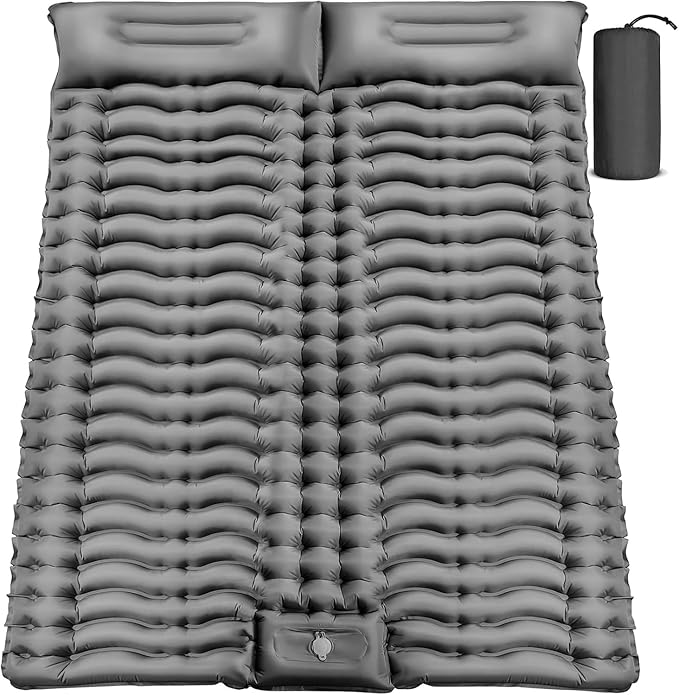
You have hiked twelve miles. Your legs are screaming. The campfire has died down to embers, and the stars are putting on a show that would make a planetarium jealous. You unroll your sleeping bag, lie down on your sleeping pad, and… ow. A rock digs into your hip. A root presses against your shoulder blade. The cold creeps up from the ground, leaching heat from your spine. You toss. You turn. You try to find that one position where the pressure isn’t excruciating. By 2 AM, you give up on sleep entirely and just wait for dawn.
This scenario is tragically familiar to millions of campers, backpackers, and hikers. For decades, the outdoor industry has treated sleep as an afterthought—a necessary evil between adventures. Thin foam mats, leaky air mattresses, and pads that weigh more than your tent have been the standard. But what if it did not have to be this way? What if you could carry a sleeping pad that is thick enough to block every root and rock, wide enough for two people, light enough for a solo backpacking trip, and inflates without puffing until you are dizzy?
Enter the Yuzonc Double Camping Sleeping Pad. With a staggering 4 inches of thickness, a built-in foot pump, an integrated pillow, and a packed size smaller than a water bottle, this gray, two-person inflatable mat is rewriting the rules of outdoor sleep. In this comprehensive guide, we will explore how 40D nylon and TPU construction withstands the harshest environments, why the foot pump saves your lungs and your sanity, and how this pad turns a tent into a five-star bedroom under the stars.

Chapter 1: The 4-Inch Revolution – Thickness as a Feature, Not a Luxury
Let us start with the number that jumps off the specification sheet: 4 inches. That is 100 millimeters of air cushion between your body and the cold, hard ground. To put this in perspective:
- Standard foam sleeping pads (like the classic “blue foam”): 0.5 to 0.75 inches
- Entry-level self-inflating pads: 1.5 to 2 inches
- Premium backpacking air pads: 2.5 to 3 inches
- The Yuzonc double pad: 4 inches
Why does thickness matter for outdoor sleep? Three reasons: pressure point relief, thermal insulation, and psychological comfort.
Pressure Point Relief: When you lie on a thin pad, your heavier body parts (hips, shoulders, heels) compress the pad completely, making contact with the ground. This creates localized pressure that cuts off circulation and wakes you up every 45-90 minutes. A 4-inch pad provides enough vertical give that even your bony hip socket floats above the terrain. The air cells within the pad disperse your weight across a larger surface area, mimicking the feel of a spring or memory foam mattress at home.
Thermal Insulation (R-Value): The ground is a heat sink. It will pull warmth from your body all night long. A thicker pad means more trapped air, and trapped air is an excellent insulator. While Yuzonc does not publish an official R-value (the industry standard for thermal resistance), a 4-inch air pad typically achieves an R-value of 4-6, sufficient for three-season camping (spring, summer, fall) and even mild winter conditions. You will not feel the cold seeping up through your sleeping bag.
Psychological Comfort: Never underestimate the power of feeling safe and comfortable. When you lie down on a pad that feels substantial—that does not bottom out when you move—your nervous system relaxes. You sleep deeper. You dream more. You wake up actually rested, ready for the next day’s adventure rather than dragging yourself out of the tent.
Chapter 2: A Bed for Two – The Dimensions of Togetherness
The Yuzonc double pad measures 80.7 inches by 53.2 inches when fully inflated. Let us translate that into human terms:
- Length (80.7 inches / 6.7 feet): Taller than 99% of the population. A six-foot-two man can lie fully stretched with room to spare. Even if you sleep with your arms above your head, your heels will not hang off the edge.
- Width (53.2 inches / 4.4 feet): Standard double mattress width is 54 inches. This is essentially a true double bed for the outdoors.
For two adults, this means 27 inches of width per person—slightly narrower than a twin bed (39 inches) but significantly wider than two separate standard sleeping pads (20 inches each). You can lie side by side without touching unless you want to. You can bring a child or a large dog into the sleeping space without anyone falling off the edge.
For solo campers who value luxury, the double pad offers palatial space. You can spread out your gear, change clothes without kneeling on dirt, or simply starfish across the entire surface in glorious solitude.
The real magic happens for couples. Sharing a double pad eliminates the dreaded “middle gap”—that cold, uncomfortable trench that forms when two separate pads drift apart during the night. You stay warm together. You stay connected. You do not wake up with your face in the dirt because your pad slid off the tent floor.
Chapter 3: Material Matters – 40D Nylon and TPU Coating
Outdoor gear lives or dies by its fabric. The Yuzonc pad is constructed from 40D nylon with TPU (thermoplastic polyurethane) coating. Let us decode what this means for you.
Denier (D) Explained: Denier is a unit of measurement for fiber thickness. Lower denier = thinner, lighter, less durable. Higher denier = thicker, heavier, more durable. Standard sleeping pads use 20D to 30D nylon for ultralight applications (saving grams but sacrificing toughness) or 75D to 100D for heavy-duty car camping (durable but bulky). The 40D sweet spot offers the best of both worlds: light enough for backpacking (the complete pad weighs only 49 ounces, as we will discuss) yet strong enough to resist punctures from pine needles, small rocks, and tent stakes.
TPU Coating: Unlike PVC (polyvinyl chloride), which is heavy, stiff, and environmentally problematic, TPU is lightweight, flexible, and free of phthalates and heavy metals. The TPU coating serves two purposes:
- Air impermeability: Nylon fabric is naturally porous. The TPU layer seals the microscopic holes, ensuring that the air you pump in stays in all night.
- Abrasion resistance: When you place the pad on rocky ground or drag it across the tent floor, the TPU coating takes the abuse instead of the nylon fibers. Small scratches do not become catastrophic tears.
Easy Cleaning: Outdoor gear gets dirty. Mud, dust, pine sap, and spilled coffee are inevitable. The Yuzonc pad’s smooth TPU surface resists staining and can be wiped clean with a damp cloth or a mild soap solution. You do not need special cleaners or complicated washing instructions.
Designed for Harsh Environments: Whether you are camping in the desert (sharp rocks, abrasive sand), the forest (twigs, pine needles), or the mountains (uneven talus fields), the 40D/TPU construction is up to the task. This is not a fragile pool toy. This is a backcountry tool.
Chapter 4: Foot Pump Freedom – No More Lightheaded Inflation
If you have ever tried to inflate a sleeping pad with your mouth at 8,000 feet of elevation, you know the struggle. After 30 seconds of puffing, you are lightheaded. After a minute, your lips are numb. After two minutes, you are questioning all of your life choices that led to this moment. Hand pumps are better but add weight and bulk to your pack. Electric pumps are laughably impractical in the wilderness.
The Yuzonc pad solves this problem with a built-in foot pump. No extra parts to carry. No batteries to die. No lung power required. Simply:
- Unroll the pad and locate the foot pump chamber (usually at the foot end, integrated into the pad’s design).
- Open the air intake valve.
- Stomp on the pump chamber with your foot—repeatedly, rhythmically, for about 30 to 60 seconds.
- Watch the pad rise beneath you.
Why the foot pump is superior:
- Effortless: Stomping uses your large leg muscles, which are far stronger than your diaphragm. Even a child can generate enough pressure to fully inflate the pad.
- Hygienic: Your mouth never touches the valve. No moisture from your breath enters the pad (moisture can promote mold growth inside the pad over time).
- Fast: 30-60 seconds for a double pad is remarkably quick. By the time your camping partner has unrolled their sleeping bag, you are already lying down.
- Fail-safe: There are no small plastic parts to break or lose. The foot pump is simply a chamber of the pad itself.
For comparison, inflating a similar-sized double pad with a hand pump typically takes 2-3 minutes and leaves your arm sore. Mouth inflation takes 3-5 minutes and leaves you gasping. The foot pump is objectively better.
Chapter 5: One-Second Deflation and No-Leak Valve
What goes up must come down—especially when it is time to pack up camp. The Yuzonc pad features an upgraded air release valve with a double-layer design. When you are ready to deflate:
- Open the main valve completely.
- The air rushes out in approximately one second.
- Roll or fold the pad to expel any remaining air.
- Close the valve and pack it away.
The double-layer valve prevents leakage: Many camping pads suffer from slow leaks at the valve interface. A tiny misalignment or a speck of dirt can allow air to escape over several hours, turning your 4-inch pad into a 1-inch pancake by morning. The Yuzonc double-layer design creates a redundant seal. Even if the first layer is compromised, the second layer holds. This engineering detail is the difference between waking up rested and waking up on the ground.
Chapter 6: Ultralight and Ultra-Portable – The 49 oz Miracle
Now for the number that will surprise you: the Yuzonc double pad weighs only 49 ounces (approximately 3.06 pounds or 1.39 kilograms). For a double pad with 4 inches of thickness, a built-in pillow, and a foot pump, this is remarkably light.
Packed dimensions: 12.8 inches by 2 inches by 4.7 inches. That is roughly the size of a 1-liter Nalgene bottle or a small loaf of bread. It slides easily into a backpack’s sleeping bag compartment, straps to the outside of a daypack, or tucks into a pannier for bikepacking trips.
Weight distribution: At 49 ounces for two people, each person effectively carries 24.5 ounces (1.53 pounds). Compare this to carrying two separate backpacking pads:
- Two standard air pads: typically 16-20 ounces each = 32-40 ounces total (heavier!)
- Two foam pads: typically 10-14 ounces each = 20-28 ounces total (lighter but far less comfortable)
The Yuzonc pad is competitive with carrying two separate ultralight pads but offers dramatically more comfort, thickness, and the togetherness of a shared sleeping surface.
Built-in pillow: You do not need to carry a separate camping pillow (typically 3-7 ounces). The Yuzonc pad has an integrated pillow chamber at the head end. You inflate it using the same foot pump mechanism (or by mouth for fine-tuning). This saves weight, packing space, and the hassle of a pillow sliding away from you during the night.
Chapter 7: Air Cell Technology – Why It Feels Like a Real Mattress
The Yuzonc pad is not simply a giant balloon. Inside, it features a network of air cells—individual interconnected chambers that serve two purposes:
- Structural integrity: The air cells prevent the pad from becoming a waterbed-like blob. When you move, the air redistributes within the cells rather than sloshing to the lowest point. You stay centered and stable.
- Pressure dispersion: The cell pattern is designed to support the natural curves of the human body. Your heavier parts (hips, shoulders) compress some cells, while your lighter parts (head, legs) sit on more fully inflated cells. This gradient support is exactly how a high-end home mattress works.
The result: whether you sleep on your back, your stomach, or your side, the pad conforms to your body without letting you “bottom out” (touch the ground). Side sleepers, who typically struggle the most with camping pads, will find the 4-inch thickness sufficient to keep their hips elevated and aligned.
Chapter 8: Perfect for Families and Group Camping
The Yuzonc double pad is marketed for two adults, but its utility extends far beyond couples:
Parent and Child: A toddler or young child can sleep safely next to a parent without the risk of rolling off a narrow pad. The generous width (53.2 inches) provides plenty of room for a parent to lie on one side and a child on the other, with a buffer zone in between.
Teenager Sleepovers: Camping with multiple kids? Two double pads can sleep four people in a standard 4-person tent more comfortably than four separate narrow pads. The kids stay warmer by sharing body heat, and the unified surface reduces the “gear avalanche” effect when someone gets up in the dark.
Base Camp Luxury: For car camping trips where weight is not a concern (you drive to the campsite), the Yuzonc double pad transforms a basic tent into a glamping experience. Bring two pads for a 4-person tent, or use one pad as a “couch” for lounging during rainy afternoons.
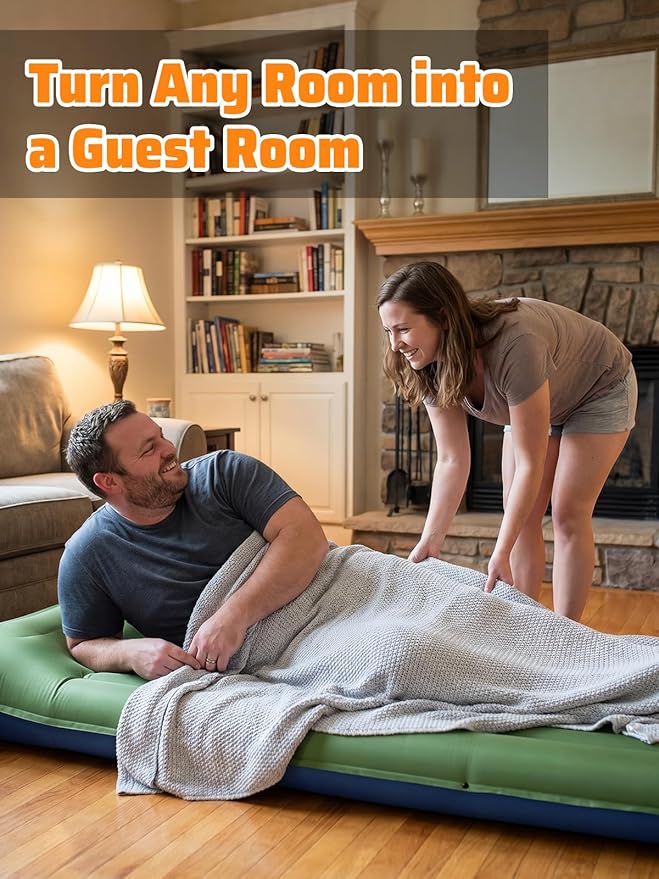
Therapy and Relaxation: Beyond camping, the pad is useful for yoga, stretching, or as a spare guest bed for overnight visitors. Its compact packed size means you can keep it in your car trunk or closet for spontaneous use.
Chapter 9: Real-World Testing – What Users Are Saying
*”I am a side sleeper with chronic hip pain. I have tried six different camping pads over the years, including expensive ‘luxury’ models. The Yuzonc double pad is the first one that allowed me to sleep through the night without waking up to turn over. The 4-inch thickness is not a gimmick—it actually works.”* – Mark, backpacker and side sleeper.
“My wife and I used to fight over the middle gap between our two separate pads. With the Yuzonc, we actually cuddle while camping. It sounds silly, but it has improved our trips dramatically. Plus, the foot pump is a party trick—everyone wants to try it.” – Sarah and Tom, couple campers.
*”I took this pad on a 5-day backcountry canoe trip. It rained every single day. The TPU coating wiped clean easily, and the pad never developed any mold or mildew smell. It deflated quickly each morning and fit in my 50-liter pack alongside my other gear. Highly recommend.”* – James, wilderness guide.
Chapter 10: Care, Maintenance, and Longevity
To get the most from your Yuzonc double camping pad:
Storage: Store the pad unrolled and partially inflated (or completely deflated) in a cool, dry place. Avoid long-term storage in a compressed state, which can stress the internal air cells. Avoid direct sunlight (UV degrades nylon and TPU over time).
Cleaning: Wipe with a damp cloth and mild soap (like Dr. Bronner’s or dish soap). Do not submerge the pad in water (water can enter the foot pump intake). Do not use harsh solvents (acetone, bleach, etc.) which will damage the TPU coating.
Field Repairs: The pad comes with a patch kit (check your packaging). For small punctures, clean the area, apply the adhesive patch, and let it cure for 24 hours before reinflating. For larger tears, contact Yuzonc customer service.
Avoiding Damage: Clear the tent floor of sharp objects before placing the pad. Do not inflate the pad beyond its intended pressure (it should feel firm but not drum-tight—overinflation stresses the seams). Do not use the pad as a floatation device on water (it is an air mattress, not a life preserver).
Conclusion: Redefining Outdoor Sleep
The Yuzonc Double Camping Sleeping Pad is not a compromise. It is not “good enough for camping.” It is a genuine sleep system that rivals what you have at home—yet it packs down to the size of a water bottle and weighs just 49 ounces.
Four inches of thickness keeps you off the cold, hard ground. The 40D nylon and TPU coating withstands the abuse of the backcountry. The built-in foot pump saves your lungs and your sanity. The double-wide dimensions let you share the experience with someone you love. The integrated pillow eliminates one more thing to pack.
Whether you are a solo ultralight backpacker who craves luxury, a couple seeking connection under the stars, or a parent introducing your child to the joys of camping, the Yuzonc pad delivers. You will hike farther because you know a good night’s sleep awaits. You will wake up earlier because you are actually rested. You will buy fewer cups of camp coffee because you do not need the caffeine just to function.
Camping should not require suffering. The Yuzonc double pad proves it.
Order yours today. Your back, your hips, and your sleeping partner will thank you.