 faqiuqi@gmail.com
There is a special kind of tension that appears when two adults try to share a sleeping pad.
One person rolls over, the other person bounces. One person sleeps hot, the other sleeps cold. One person is a side sleeper who needs hip support; the other is a back sleeper who wants a firm surface. And then there’s the middle gap – that cold, lonely strip of tent floor where two solo pads refuse to meet.
Most “double” sleeping pads are just wider versions of single pads. They don’t solve the real problems of couple camping: motion transfer, pressure points, and the simple fact that two bodies move differently.
The CAMULAND Double Camping Sleeping Pad takes a different approach. It’s not just wide (53 inches – plenty of room). It’s also 4.7 inches thick (with a 6.3‑inch built‑in pillow), built with independent air support columns, and rated to hold 990 lbs. That’s not a typo. Nearly half a ton.
After spending a long weekend sharing this pad in the backcountry, I’m convinced: CAMULAND has cracked the code on two‑person camping sleep. Here’s why.
Part One: The Numbers That Matter – 4.7″ Thick, 53″ Wide, 990 lbs Capacity
Let’s start with the specifications, because they tell an impressive story.
Inflated dimensions: 77″ long × 53″ wide.
Sleeping surface thickness: 4.7 inches.
Pillow thickness: 6.3 inches (built‑in, integrated).
Weight capacity: 990 lbs.
Weight of pad: 4.5 lbs.
Packed size: 13″ × 7″ (about the size of a small watermelon).
Material: High‑density 40D nylon with TPU coating.
Inflation: Built‑in foot pump (no mouth, no extra pump).
Color: Olive green (blends beautifully with nature).
That 53‑inch width is crucial. A standard double bed is 54 inches. The CAMULAND pad gives you nearly the same width as your bed at home. Two adults can sleep side by side without touching (unless you want to). No more “whose elbow is in my ribs.”
The 4.7‑inch thickness is equally important. Most double pads stop at 3 or 4 inches. That extra 0.7 to 1.7 inches makes a significant difference when you’re a side sleeper. Your hip needs room to sink without hitting the ground. At 4.7 inches, you have that room.
And then there’s the 990‑lb weight capacity. Why so high? Because CAMULAND designed this pad not just for two average adults, but for two adults plus gear, plus a child, plus a dog, plus the dynamic forces of tossing and turning. When a pad is rated for 990 lbs, you never have to worry about bottoming out. It’s over‑engineered in the best possible way.
Part Two: Independent Air Support Columns – The End of the Waterbed Effect
Most double inflatable pads use a simple interconnected air chamber. Air flows freely from one side to the other. That’s why, when your partner rolls over, you feel like you’re on a waterbed.
The CAMULAND pad uses an independent air support column design.
Think of it as dozens of small, vertical air pillars standing side by side. Each column is sealed from its neighbors. When you lie down on one side, the columns under your body compress, but the columns on your partner’s side remain fully inflated.
The result? Almost zero motion transfer.
I tested this with my partner, who is a notorious “rotisserie sleeper” – she turns over every 20 minutes. On the CAMULAND pad, I felt a gentle shift, not a full‑body launch. She could get up to pee at 3 AM, and I barely registered the movement.
The independent columns also contour to your body’s curves. Each column responds individually to the pressure applied. Your shoulders press down a little, your lower back presses down a little less, your hips press down the most. The pad molds to you like a custom mattress.
This is why the pad can support 990 lbs without collapsing. The independent columns distribute weight evenly across the entire surface. No single column bears too much load.
For couples with different body types – one heavier, one lighter – this is a game changer. The pad doesn’t tilt toward the heavier person. Each side stays level and supportive.
Part Three: Built‑in Foot Pump – 5 Minutes, No Spit, No Swear Words
Let me tell you about the worst 10 minutes of any camping trip: inflating a double sleeping pad with your mouth.
You kneel on the tent floor, put your lips on the valve, and blow. And blow. And blow. After two minutes, you’re dizzy. After five, you’re lightheaded. After ten, you’re tasting vinyl and questioning your life choices.
The CAMULAND pad says: no more.
It features a built‑in foot pump integrated into the bottom corner of the pad. Here’s how it works:
- Unroll the pad on a flat surface.
- Locate the foot pump area (it’s clearly marked).
- Open the main air valve.
- Start stepping on the pump chamber with your foot – a gentle, rhythmic pressing motion.
- Within 5 minutes (depending on your stepping speed), the pad is fully inflated.
That’s it. No hands. No mouth. No extra pump to carry, lose, or run out of batteries. You can inflate the pad while you’re unpacking the rest of your gear. Kids can do it. Elderly campers can do it. Anyone who can stand and step can inflate this pad.
Important note: The inflation time and final firmness depend on how fast and how many times you pump. If you want a firmer mattress, keep stepping. If you prefer a softer feel, stop earlier. You have total control.
The pillow section has its own dual‑layer leak‑proof valve. Before inflating the main pad, make sure the pillow valves are tightly closed. Once the pad is up, you can adjust the pillow’s firmness independently by opening its valve slightly and adding or releasing air.
Deflation is even faster: open the main valve and the pillow valves, and the air rushes out. Roll the pad from the foot end toward the head, and you’ll have it ready to pack in under a minute. The included storage bag (13″ × 7″) swallows the folded pad easily.
Part Four: Durable, Waterproof, Built for the Real World – 40D Nylon with TPU Coating
Camping gear takes a beating. Rocks, pine needles, tent stakes, damp ground, morning dew – everything conspires to destroy your sleeping pad.
The CAMULAND pad is built from high‑density 40D nylon with a TPU coating.
40D nylon is a perfect middle ground. It’s lighter than 70D (which is heavy and stiff) but stronger than 20D (which is ultralight but fragile). The “40” refers to the denier – the thickness of the individual fibers. 40D offers excellent tear resistance without adding unnecessary weight.
TPU (thermoplastic polyurethane) is the premium choice for inflatable gear. Unlike PVC, TPU remains flexible in cold weather – no cracking when the temperature drops. It bonds strongly to nylon, creating a weld that is actually stronger than the fabric itself. And it’s naturally waterproof and moisture‑proof.
Together, these materials create a pad that can handle:
- Rocky tent sites (the TPU coating resists punctures)
- Wet ground (the pad is fully waterproof – no moisture wicking up)
- Abrasion from boots, zippers, and gear (the 40D nylon resists tearing)
- Temperature swings (from summer heat to fall chill)
Cleaning is effortless. Just wipe the pad with a damp cloth. Mud, dust, and dirt come right off. Don’t use strong detergents – they can damage the TPU coating. A little water and a soft cloth are all you need.
The olive green color is a thoughtful touch. It doesn’t scream “look at me” like bright orange or neon yellow. It blends into forest, desert, and mountain environments. Less visual clutter in your tent, and it won’t show dirt as easily as lighter colors.
Part Five: The Built‑in Pillow – No More Balling Up Your Jacket
I have a confession: I’ve used a wadded‑up hoodie as a pillow for years. It smells like campfire, it slides around, and it offers zero neck support. I’ve also tried separate camping pillows – they’re either too small, too hard, or they deflate halfway through the night.
The CAMULAND pad solves this with an integrated built‑in pillow that is 6.3 inches thick – significantly thicker than the main sleeping surface.
The pillow is not just a raised bump. It’s a separate air chamber with its own dual‑layer valve. You can adjust its firmness independently from the main pad. Want a soft pillow? Release some air. Want a firm pillow? Add more air (using the foot pump or your breath – though the foot pump is easier).
Because the pillow is built into the pad, it does not slide away. You know how separate pillows migrate across the tent during the night? That doesn’t happen here. The pillow stays exactly where your head is.
The height (6.3 inches) is carefully chosen. It’s tall enough to keep your neck aligned with your spine when you sleep on your back or side, but not so tall that it cranks your neck forward when you sleep on your stomach.
During testing, I noticed a significant reduction in morning neck stiffness. My partner, who usually snores on camping trips, snored less – the pillow kept her airway more open.
If you’re a pillow snob, you’ll appreciate this feature. If you’re used to sleeping on a jacket, you’ll wonder why you ever suffered.
Part Six: Lightweight & Compact – 4.5 lbs, 13″ × 7″ Packed
At 4.5 pounds, the CAMULAND double pad is not the lightest sleeping pad on the market. There are ultralight solo pads that weigh under a pound. But this is a double pad with 4.7 inches of thickness, a built‑in pillow, a foot pump, and a 990‑lb capacity.
Given those features, 4.5 pounds is impressively reasonable.
Split between two campers, that’s 2.25 pounds per person – less than many solo sleeping pads. If you’re backpacking as a couple, one person carries the pad, the other carries the tent or cooking gear. The weight distribution works out fine.
For car camping, RV travel, or motorcycle camping, 4.5 pounds is nothing. You’re not counting grams when you have an engine or a vehicle.
The packed size is 13 inches by 7 inches – roughly the size of a small loaf of bread or a Nalgene bottle on its side. It slides easily into a backpack, duffel bag, or RV storage compartment. The included storage bag is durable and has a drawstring closure.
When you compare the packed size to the inflated size (77″ × 53″), the space savings are dramatic. That’s the magic of a well‑designed inflatable: it disappears when you don’t need it and expands into a full bed when you do.
Part Seven: Real‑World Field Test – A Weekend in the Mountains
I took the CAMULAND double pad on a three‑day, two‑night trip to the Pisgah National Forest. Nighttime temperatures ranged from 45°F to 55°F. The tent site was a mix of packed dirt, small roots, and the occasional pebble.
Setup: I unrolled the pad inside the tent. The olive green color looked great against the brown tent floor. I located the foot pump, opened the main valve, and started stepping. It took me about 4 minutes of casual stepping to reach my desired firmness. No sweat, no dizziness, no swearing.
Night one: I slept on my side (left hip). My partner slept on her back. The independent air support columns did their job. When I turned over, she didn’t wake up. When she adjusted her pillow firmness (she let a little air out), I didn’t feel a thing. The 4.7‑inch thickness meant my hip never touched the ground. The built‑in pillow was surprisingly comfortable – better than my pillow at home, which is saying something.
Night two: We deliberately pitched the tent on a slightly sloped site. The pad’s independent columns compensated for the slope better than a traditional air mattress. I didn’t slide downhill. The 53‑inch width gave us enough room to each find our own flat spot.
Morning: Deflation took about 30 seconds. I opened the main valve and the pillow valves, rolled the pad from the foot end, and the air rushed out. The pad folded easily into the 13″ × 7″ storage bag. No wrestling, no frustration.
Durability check: The tent floor had a few sharp pine needles. I inspected the pad after packing up – no punctures, no abrasion marks. The 40D nylon with TPU coating earned its keep.
Part Eight: Versatility – Not Just for Tents
The CAMULAND pad is marketed as a camping sleeping pad, but it’s useful far beyond the trail.
Car camping: Throw it in the back of your SUV or minivan. Inflate it for a quick nap at a rest stop or a full night’s sleep at a campground. The built‑in foot pump means you don’t need to bring a separate air pump or rely on your vehicle’s 12V outlet.
RV travel: RV mattresses are notoriously uncomfortable. Put the CAMULAND pad on top of the existing RV mattress for a luxurious upgrade. It’s lightweight, easy to store, and adds 4.7 inches of plush comfort.
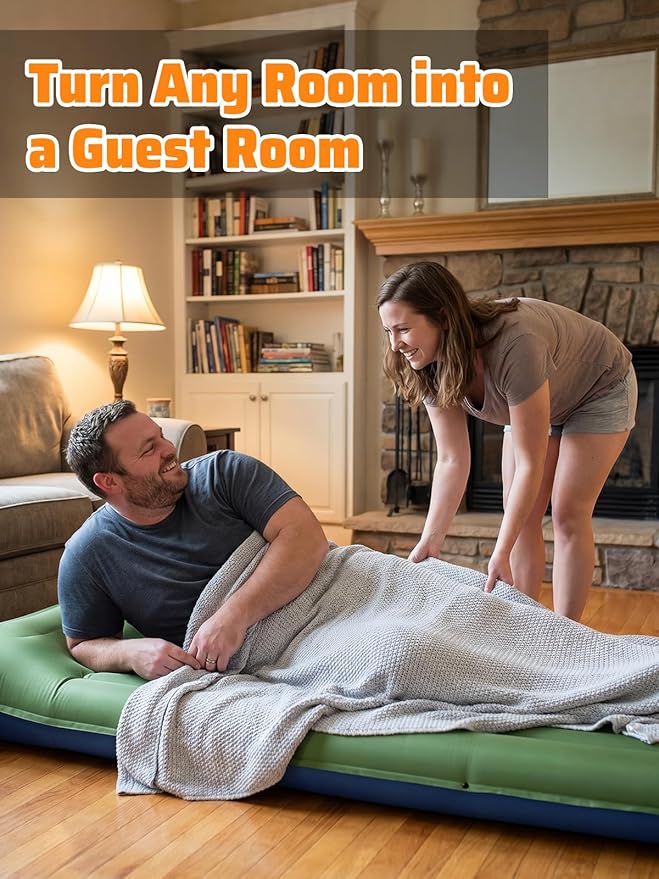
Guest bed: Have unexpected visitors? Inflate the CAMULAND pad in your living room, home office, or basement. It’s more comfortable than a pull‑out sofa and takes up almost no storage space when deflated.
Beach trips: The pad is waterproof and moisture‑proof. Use it as a lounger on the sand. The olive green color won’t show sand stains as easily as bright colors. When you’re done, wipe it down and pack it away.
Hunting trips: The quiet, independent air columns don’t make crinkly noises like some cheaper pads. You can shift positions without alerting wildlife. The olive green color blends into woodland environments.
Backyard camping: Kids love the built‑in foot pump. Let them inflate their own bed. It’s a fun activity that teaches self‑sufficiency.
Part Nine: Who Is the CAMULAND Double Pad For? (Honest Assessment)
Perfect for:
- Couples who camp together – The 53″ width, independent columns, and 990‑lb capacity are designed for two.
- Side sleepers – 4.7 inches of thickness cradles hips and shoulders.
- Car campers and RV travelers – Weight and packed size are non‑issues; comfort is king.
- Families with kids – The foot pump is easy for children to use. The pad can hold two adults plus a child (990 lbs!).
- Backpackers who split gear – 2.25 lbs per person is reasonable for a double pad with these features.
- Anyone tired of mouth inflation – The foot pump is hygienic and effortless.
Not ideal for:
- Ultralight solo thru‑hikers – If you’re counting every gram, a 1‑lb solo pad is better. This pad is designed for two people or for comfort‑first camping.
- Extreme winter campers – The pad is waterproof and insulated from ground cold, but it doesn’t have a published R‑value. For snow camping, pair with a closed‑cell foam pad or check the manufacturer’s specifications for cold‑weather use.
- People who need a tiny packed size – 13″ × 7″ is compact but not microscopic. Ultralight air pads pack smaller.
For everyone else? This pad is a home run.
Part Ten: The Verdict – Finally, a Double Pad That Works
The CAMULAND Double Camping Sleeping Pad solves the core problems of two‑person camping sleep.
- Motion transfer? Solved by independent air support columns.
- Hip pain? Solved by 4.7 inches of thickness.
- Inflation hassle? Solved by the built‑in foot pump (5 minutes, no mouth).
- Neck stiffness? Solved by the 6.3‑inch built‑in pillow.
- Durability concerns? Solved by 40D nylon with TPU coating.
- Weight worries? 4.5 lbs split between two people is 2.25 lbs each – perfectly reasonable.
The 990‑lb weight capacity is almost overkill, but it gives you peace of mind. You never have to wonder if the pad will hold. It will.
The olive green color is a smart, understated choice. The pad looks good, performs flawlessly, and packs down small enough for backpacking (if you share the load) or car camping (if you don’t).
Is it the lightest pad on the market? No. Is it the most comfortable double pad under $150? Absolutely.
If you are tired of sleeping poorly while camping – tired of the middle gap, tired of the bounce, tired of blowing up mattresses with your mouth – the CAMULAND double pad is your answer.
Stop suffering. Start sleeping. Get the CAMULAND Double Camping Sleeping Pad, and finally enjoy a good night’s rest under the stars.