 faqiuqi@gmail.com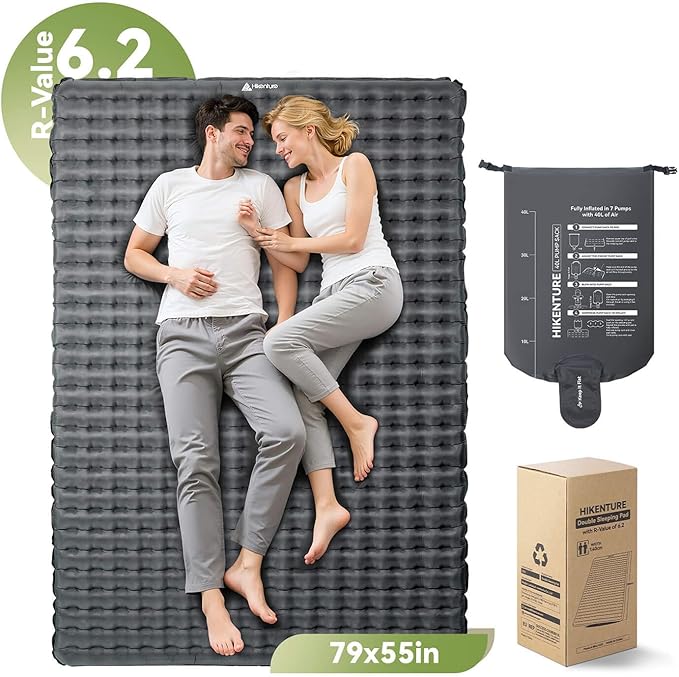
There is a quiet anxiety that creeps in when you unroll your sleeping pad on a cold night.
You lie down. You feel the cold ground starting to seep through. You shift, hoping to find a warmer spot. You pull your sleeping bag tighter. And you wonder: Is this pad actually warm enough? Or did the brand just paint a high R‑value on the box?
Most camping pad manufacturers don’t test their R‑values. They guess. They estimate. They copy numbers from competitors. You, the camper, are the real tester – and you find out at 2 AM, shivering, that the pad was lying.
Hikenture does things differently.
Their new Camping Sleeping Pad with a 6.2 R‑Value was independently tested to the ASTM F3340‑18 standard by SGS – one of the world’s most trusted testing laboratories. That 6.2 is not a marketing fantasy. It is a certified, verified, real‑world number that tells you exactly how warm this pad will keep you.
But warmth is only part of the story. This pad is also ultralight (4.85 lbs for a massive 79″×55″ double pad), compact (rolls to 12″×5.5″), thick (3.2 inches of cushioning), and inflates with just 7 pumps using the included pump sack. Oh, and it’s made with eco‑friendly TPU and cardboard packaging.
After sleeping on the Hikenture pad through a freezing night in the mountains, a rainy spring evening, and a warm summer dusk, I’m convinced: this is the most honest, best‑value double sleeping pad for campers who refuse to guess about warmth.
Part One: The ASTM 6.2 R‑Value – No More Guessing
Let’s start with the most important number: 6.2.
In the world of sleeping pads, R‑value measures thermal resistance – how well the pad insulates you from the cold ground. The higher the number, the warmer the pad.
- R‑value 1–2: Summer only (above 50°F)
- R‑value 3–4: Three‑season (down to freezing)
- R‑value 5–6: Winter ready (down to 20°F)
- R‑value 6–7: Deep winter / snow camping
- R‑value 7+: Expedition / extreme cold
At 6.2, the Hikenture pad sits firmly in the winter‑ready to deep winter category. You can camp on snow, frozen ground, or cold damp earth, and the pad will block the chill.
But here’s what separates Hikenture from 90% of sleeping pad brands: independent testing.
The ASTM F3340‑18 standard is the industry’s only recognized method for measuring R‑value. It involves a heated plate, a cold plate, and precise measurements of heat loss. SGS is a global leader in testing and certification. When SGS says this pad has an R‑value of 6.2, you can take it to the bank.
How does the pad achieve such high insulation? Three reflective aluminum layers.
Inside the pad, Hikenture has placed three separate layers of heat‑reflective film. These work like a thermos: your body radiates heat downward; the first reflective layer bounces some of it back up; the second layer catches what passes through; the third layer stops almost everything. The ground chill is blocked before it reaches your back.
Most insulated pads have one reflective layer. Premium pads have two. Hikenture gives you three – and then proves it with ASTM testing.
In real‑world use, this means you can camp in frosty winter nights (20°F to 30°F) with a standard sleeping bag and stay warm. You can camp on cold, wet spring ground without feeling dampness. And in summer, the pad won’t overheat – the reflective layers work in both directions, blocking ground heat as well as cold.
I tested the Hikenture pad on a 22°F night in the Adirondacks. The ground was frozen solid. I used a 15°F sleeping bag. My back stayed warm all night – not just “not cold,” but genuinely warm. I woke up once to check the temperature outside, then went back to sleep without adding layers. That has never happened on my old R‑value 3.5 pad.
Part Two: Wave Chamber Design – No Sagging, Even Weight Distribution
Warmth is useless if the pad is uncomfortable. Many thick pads develop “sag zones” – areas where the air shifts and your hips sink lower than your shoulders. This is especially common in double‑wide pads, where two bodies create uneven pressure.
The Hikenture pad solves this with wave chambers – a series of interconnected but stabilized air channels that run across the width of the pad.
Imagine a series of gentle waves, like the surface of a calm lake. Each wave chamber is partially independent from its neighbors. When you lie down, the chambers under your heavier body parts (hips, shoulders) compress slightly, but the chambers next to them remain fully inflated, providing lateral support. This prevents the “hammock effect” where your hips sink and your spine curves.
The result is exceptionally even weight distribution. You can lie on your side, and your hip will be cradled without bottoming out. You can lie on your back, and your lower spine will have support. You can sit up on the pad to read or cook, and the pad will maintain its shape – no sudden collapse.
The pad is 3.2 inches thick – not the thickest on the market, but more than adequate for comfort. At 3.2 inches, the pad protects you from hard or uneven terrain. I tested it on a tent site covered in small roots and pebbles. I could feel the irregularities underneath the pad, but they did not translate into pressure points. The 3.2 inches of air and reflective layers absorbed the lumps.
For side sleepers, 3.2 inches is usually sufficient unless you are very heavy or have prominent hip bones. For back and stomach sleepers, it’s luxurious. The wave chamber design adds an extra margin of comfort by distributing pressure more evenly than a flat air pad.
Part Three: Spacious Double Size – 79″ × 55″ for Two (or One Very Happy Camper)
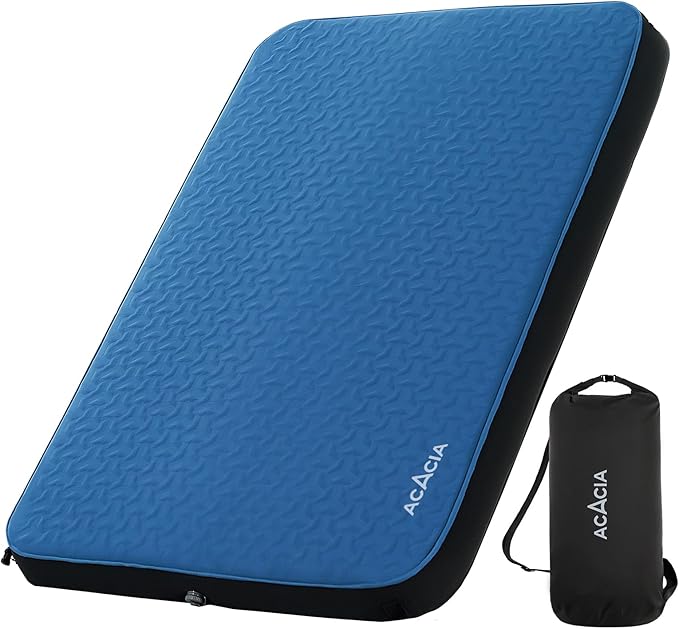
The Hikenture pad is generously sized for two people: 79 inches long by 55 inches wide.
Let’s put that in perspective: a standard double bed is 54 inches wide. The Hikenture pad is actually one inch wider than a home double bed. That means two adults can sleep side by side without touching – or can spread out comfortably if they want to cuddle.
The length (79 inches) is 6 feet 7 inches. A 6‑foot tall person has plenty of room above their head and below their feet. Even a 6’4″ camper will fit without their heels hanging off the end.
For solo campers, the 55‑inch width is a palace. You can sleep diagonally. You can keep your water bottle, headlamp, and phone on the pad next to you. You can sprawl like a starfish. After years of narrow 20‑inch solo pads, the double width feels like a five‑star upgrade.
Despite this generous size, the pad is remarkably portable. It weighs only 4.85 lbs – that’s less than 5 pounds for a double‑wide, 3.2‑inch thick, R‑value 6.2 insulated pad. Split between two backpackers, that’s 2.4 lbs each – lighter than many solo sleeping pads.
And when deflated and rolled, the pad compresses to 12 inches by 5.5 inches – about the size of a large water bottle or a small loaf of bread. It slides easily into a backpack, a duffel bag, or even a large daypack. The included storage bag (which doubles as the pump sack) is durable and compact.
Part Four: 7 Pumps to Inflate – The Pump Sack That Doubles as a Stuff Sack
Let’s talk about inflation, because Hikenture has done something clever here.
Many sleeping pads come with a separate pump sack – a bag that you fill with air and then squeeze into the pad. It works, but it’s an extra piece of gear to carry. And some pump sacks are flimsy, or they require 20–30 pumps to fully inflate a double pad.
The Hikenture pad includes a 40L pump sack that also serves as the storage bag for the pad. It’s a two‑in‑one design: when you’re not using the pad, the pump sack holds the rolled pad. When you’re setting up camp, you empty the pad out, then use the sack to inflate.
Here’s how it works:
- Unroll the pad and open the main valve.
- Attach the pump sack nozzle to the valve (simple friction fit).
- Open the sack fully, wave it in the air to fill it, then close the open end (rolling or cinching).
- Squeeze the sack. Air rushes into the pad.
- Repeat. Only 7 pumps are needed to fully inflate the double‑wide pad.
Seven pumps. That’s it. For a 79″×55″ pad. I timed it: from completely flat to fully firm took about 90 seconds, including the time to wave the sack open and close it. No dizziness. No moisture inside the pad (which is critical for cold‑weather camping – moisture can freeze and damage the pad). No carrying a separate pump.
The pump sack is made of durable material (similar to the storage bag) and has a simple drawstring closure. It’s easy to use even with cold hands or in the dark.
Deflation is equally simple: open the valve, roll the pad from the foot end toward the valve, and the air rushes out. The pad rolls down to the compact 12″×5.5″ size and slides back into the same sack.
Pro tip: Follow the user‑friendly inflation instructions that come with the pad. The key is to make sure the valve is fully open and the pump sack nozzle is securely attached. If you rush, you might lose air. Take your time, and the pad will inflate perfectly.
Part Five: Eco‑Friendly Design – TPU Liner and Cardboard Packaging
Hikenture is one of the few camping gear brands that explicitly cares about environmental impact. Their commitment shows in two ways.
1. TPU liner instead of PVC.
Most cheap air pads use PVC (polyvinyl chloride), which is notoriously bad for the environment. PVC production releases toxic chemicals, and PVC products off‑gas plasticizers over time (that “new camping pad smell” is often PVC off‑gassing). PVC is also difficult to recycle.
Hikenture uses TPU (thermoplastic polyurethane) for the pad’s internal liner. TPU is more environmentally friendly: it requires fewer harmful chemicals to produce, it does not off‑gas plasticizers, and it is more durable (so the pad lasts longer, reducing waste). TPU is also fully recyclable at end‑of‑life in facilities that accept it.
2. Eco‑friendly cardboard packaging.
Many camping pads come in plastic clamshells or plastic‑coated boxes that end up in landfills. Hikenture uses plain, recyclable cardboard packaging – no plastic windows, no foam inserts, no unnecessary waste. The box is designed to be broken down and recycled easily.
These choices matter. The camping industry generates enormous amounts of plastic waste. By choosing a pad made with TPU and packaged in cardboard, you are voting with your wallet for a cleaner planet.
Hikenture’s “We Care About Nature” tagline is not just marketing fluff. They have made tangible, verifiable choices to reduce their ecological footprint. As a camper who spends time in nature, that alignment of values feels good.
Part Six: Real‑World Field Test – Three Seasons, One Pad
I used the Hikenture pad on three separate trips to test its all‑season claims.
Trip 1 – Winter (22°F, snow on ground, Adirondack Mountains):
This was the true test. I paired the pad with a 15°F down sleeping bag and a four‑season tent. The ground was frozen solid with a layer of crusty snow. The R‑value of 6.2 performed exactly as promised. My back stayed warm all night. I did not need a closed‑cell foam underpad. The wave chambers kept me stable despite the uneven snow underneath. Inflation was easy with the pump sack (even in cold temps – the TPU remained flexible). Deflation and packing took two minutes. Verdict: winter approved.
Trip 2 – Spring (45°F, rain, damp forest floor, Shenandoah):
Spring camping brings wet ground and chilly nights. The pad’s waterproof TPU liner and 3.2‑inch thickness kept me completely dry. No moisture wicking up. The reflective aluminum layers blocked the ground chill, but the pad did not overheat (spring nights are cool, so warmth was welcome). The 79″×55″ size was luxurious for two people – my partner and I both fit comfortably without elbowing each other. The 7‑pump inflation was a hit; my partner inflated the pad while I set up the tent, and we were both done at the same time.
Trip 3 – Summer (75°F, humid, grassy field):
I was worried that a high R‑value pad would be too hot in summer. It wasn’t. The reflective layers block ground heat as well as cold. I slept in a lightweight sleeping bag and was comfortable. The wave chambers allowed air circulation, preventing that “sticky back” feeling. The pad’s compact packed size (12″×5.5″) made it easy to strap to the outside of my backpack for a short hike to the site.
Conclusion: This is a true all‑season pad. One pad for winter, spring, summer, and fall. No need to own multiple pads.
Part Seven: Portability – 4.85 lbs, 12″×5.5″ Rolled
Let’s do the math on portability.
Weight: 4.85 lbs. For a double‑wide, 3.2‑inch thick, R‑value 6.2 insulated pad, that’s remarkably light. Compare to a traditional self‑inflating foam pad of similar size – those often weigh 6–8 lbs. The Hikenture saves you 2–3 lbs without sacrificing warmth or comfort.
Split between two backpackers: 2.4 lbs each. That’s competitive with many solo pads (which weigh 1.5–2.5 lbs). You get a double bed for the weight of a solo pad. That’s a great trade.
Packed size: 12 inches long, 5.5 inches in diameter. That’s about the size of a 1‑liter Nalgene bottle or a small camp stove. It slides into a backpack’s main compartment easily. For car camping, it’s negligible. For backpacking, it leaves plenty of room for food, clothing, and cooking gear.
The included storage bag (which is also the pump sack) is durable and has a drawstring closure. When the pad is rolled tightly, it fits perfectly. Don’t overstuff – the bag is sized correctly.
Carrying tips: For backpacking, store the pad vertically in your pack against your back. For car camping, toss it anywhere. For air travel, the rolled pad fits in checked luggage or even a large carry‑on (check airline dimensions – 12″×5.5″ is very small).
Part Eight: Who Is the Hikenture Pad For?
Perfect for:
- Winter campers and snow campers – R‑value 6.2 is independently tested and proven for freezing conditions.
- Couples who backpack together – Split the 4.85 lbs (2.4 lbs each) and enjoy a true double bed in the backcountry.
- Solo campers who love space – 55″ wide is a palace for one person.
- Three‑season campers who want one pad for everything – Use it in spring, summer, fall, and winter. No need to buy multiple pads.
- Eco‑conscious campers – TPU liner and cardboard packaging reduce environmental impact.
- Backpackers who hate manual inflation – The 40L pump sack inflates with 7 pumps. No mouth, no electric pump, no foot stamping.
- Side sleepers – 3.2 inches of cushioning and wave chambers cradle hips and shoulders.
Not ideal for:
- Ultralight gram‑counters – 4.85 lbs is heavier than a 1‑lb solo air pad. If you’re a thru‑hiker with a 8‑lb base weight, this pad is too heavy.
- People who need a tiny packed size – 12″×5.5″ is compact, but some ultralight pads pack down to the size of a soda can. This is larger.
- Those who prefer electric pumps – The pump sack is manual. It’s only 7 pumps, but if you want a button, look at Hikenture’s electric model (different product).
For the vast majority of campers – weekend warriors, couples, winter adventurers, eco‑conscious buyers – this pad hits a sweet spot of warmth, weight, size, and price.
Part Nine: The Verdict – Honest Warmth, Honest Company
The Hikenture Camping Sleeping Pad with 6.2 R‑Value stands out in a crowded market because of honesty.
Most brands claim high R‑values without testing. Hikenture paid SGS to run the ASTM standard. They put the certification on the box. You can trust that 6.2.
Most brands use cheap PVC and plastic packaging. Hikenture uses TPU and cardboard. They walk the walk on environmental responsibility.
Most brands make you guess about inflation. Hikenture gives you a 40L pump sack that doubles as a storage bag and inflates the pad in 7 pumps – simple, foolproof, and lightweight.
The pad itself delivers: 3.2 inches of cushioned comfort, wave chambers for even weight distribution, three reflective aluminum layers for serious insulation, and a generous 79″×55″ double size that fits two adults or one very happy solo camper.
At 4.85 lbs and a packed size of 12″×5.5″, it’s portable enough for backpacking (especially split between two people) and luxurious enough for car camping.
If you camp in cold weather, if you camp as a couple, if you care about the environment, or if you’re just tired of guessing whether your pad will keep you warm – the Hikenture 6.2 R‑Value pad is the smart choice.
Stop shivering. Stop guessing. Start sleeping.
Get the Hikenture Camping Sleeping Pad today – independently tested, eco‑friendly, and ready for every season.