 faqiuqi@gmail.com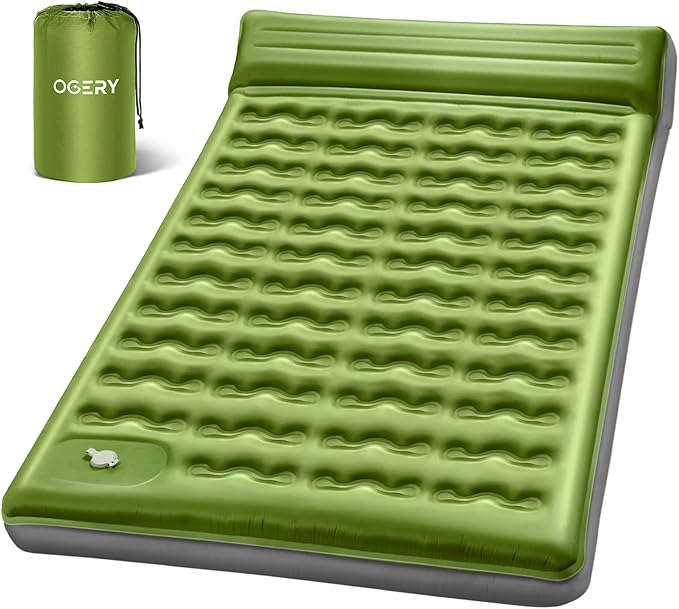
Introduction: The Ultralight Paradox – Sleeping Small vs. Sleeping Well
For years, backpackers have lived by a simple equation: lighter pack equals better trip. Every ounce counts. Every inch of packed space is sacred. And sleeping pads? They’ve been a painful compromise.
You want comfort – thick cushioning that lifts you off the cold, rocky ground. You want width – room to toss and turn without falling off the edge. You want a pillow – something that actually supports your neck, not a wadded-up fleece jacket.
But the ultralight gods whisper otherwise. “Go thin,” they say. “Suffer for the miles,” they say. “You can’t have both.”
The OGERY Double Sleeping Pad is here to prove them wrong.
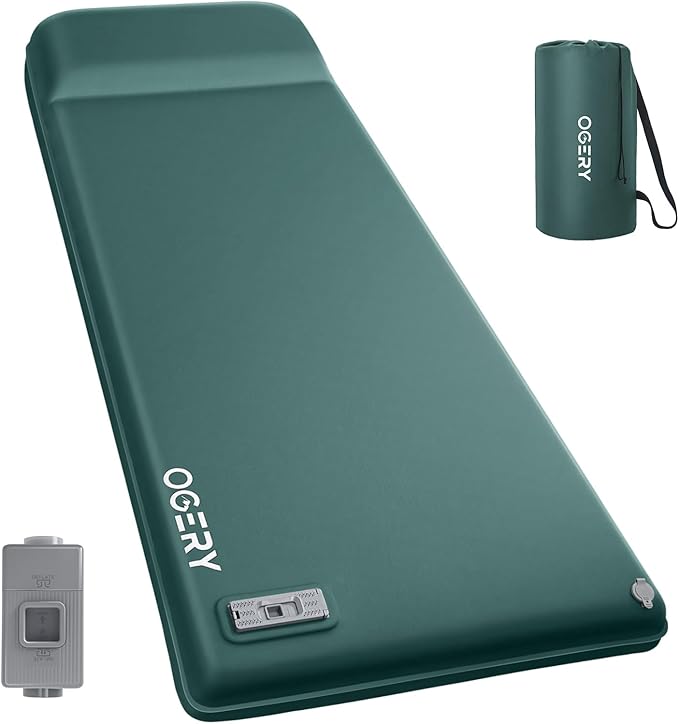
At 6 inches thick – thicker than almost every double camping pad on the market – the OGERY pad delivers luxury-level cushioning that rivals your bed at home. Yet it weighs only 4.8 pounds and packs down to a compact 6.6″ × 6.6″ × 12.5″ – small enough to strap to any backpack. The secret? An innovative tubular air belt support system that provides stronger support with less material, plus a built-in foot pump that eliminates the need for extra gear.
In this article, we’ll explore how OGERY cracked the code on ultralight thickness – from its reinforced internal air columns to its 50D polyester TPU construction – and why this pad is the perfect choice for backpacking couples, solo adventurers who refuse to sacrifice comfort, and anyone who believes that a good night’s sleep is not negotiable.
Part 1: The Thickness Revolution – Why 6 Inches Is the Magic Number

Let’s start with the feature that immediately sets the OGERY pad apart: 6 inches of thickness.
To understand why this matters, let’s look at the current landscape of double camping pads:
| Pad Type | Typical Thickness | Ground Feel | Best For |
|---|---|---|---|
| Ultralight solo pads | 2 – 2.5 inches | You’ll feel larger rocks and roots | Minimalist backpackers |
| Standard double pads | 3 – 4 inches | Occasional pressure points, especially for side sleepers | General camping |
| Premium double pads | 4 – 5 inches | Rarely feel the ground | Car camping, comfort-focused |
| OGERY Double Pad | 6 inches | Never feel the ground – period | Backpackers who refuse to compromise |
The physics of 6-inch sleep:
When you lie down on any sleeping pad, your body weight compresses the material. A 180-pound side sleeper concentrates roughly 90 pounds of force onto a single hip bone. Here’s what happens at different thicknesses:
- 2-inch pad: Compresses to 0.5–1 inch. Your hip will contact the ground through the pad.
- 3-inch pad: Compresses to 1–1.5 inches. You might avoid ground contact on smooth surfaces, but rocks and roots will find you.
- 4-inch pad: Compresses to 1.5–2 inches. Adequate for most campers on most sites.
- 5-inch pad: Compresses to 2.5–3 inches. Very comfortable – you’ll rarely feel anything.
- 6-inch pad: Compresses to 3.5–4 inches. You could sleep on a bed of gravel and feel nothing.
What “enhanced cushioning and insulation” actually means:
The OGERY pad creates a 6-inch air column between you and the ground. That’s half a foot of dead air space. Air is an excellent insulator – which is why double-pane windows work. Your body heat warms the air directly under you, and the sealed pad limits convection. You stay warmer, you stay cushioned, and you stay asleep.
Dimensions that fit two (or one very happy solo camper):
- Length: Standard double length (exact dimension not specified, but typical for OGERY is 75–80 inches)
- Width: Standard double width (approximately 50–54 inches)
- Thickness: 6 inches – the thickest in its weight class
The built-in pillow – pressure relief for back and neck:
Integrated into the pad’s head section is an ergonomic pillow. Unlike separate camp pillows (which slide around, deflate overnight, or get lost), the OGERY pillow is part of the pad. It inflates automatically with the main chambers and maintains consistent neck support throughout the night.
The product description notes that the built-in pillow “can relieve pressure on the back and neck” – critical for waking up without stiffness. No more waking up with a crick in your neck because your rolled-up hoodie shifted at 3 AM.
Part 2: Tubular Air Belt Support System – The Engineering That Makes 6 Inches Possible
Here’s where OGERY separates itself from the competition. You can make a pad 6 inches thick with a simple air chamber – but it will feel like a waterbed. Unstable. Tippy. Saggy.
The OGERY pad features a tubular air belt support system – a network of internal air columns that run across the width of the pad.
What are tubular air columns?
Imagine a series of long, cylindrical air chambers – like pool noodles – aligned side by side inside the pad. These tubes are interconnected at the ends (to allow equalization of air pressure) but are partially independent along their lengths.
How it works:
When you lie down, each tubular column compresses independently. Your hip pushes down on several columns. Those columns compress. The columns under your lighter body parts (calves, head) remain more fully inflated. This creates a contoured sleeping surface that follows your body’s natural shape.
Why tubular columns beat standard baffles:
| Feature | Standard Baffles | OGERY Tubular Columns |
|---|---|---|
| Support distribution | Even across the whole pad | Concentrated where you need it |
| Sag resistance | Moderate – hips create a dip | High – columns resist local compression |
| Stability when partner moves | Low – whole pad shifts | High – movement stays local |
| Weight efficiency | Moderate | High – less material needed for same support |
| Airflow | Minimal | Better – columns allow some internal circulation |
Reinforced internal structure prevents sagging:
The product description emphasizes that the tubular air belt system “effectively prevents sagging.” This is crucial for side sleepers, who are most prone to creating deep hip divots in traditional air pads. With OGERY’s tubular design, your hip sits on top of multiple columns rather than sinking into a single air cavity.
Even weight distribution:
Because the tubular columns work together as a system, your body weight is spread across a larger effective surface area. This reduces peak pressure on any single point – which means fewer “I need to roll over” moments during the night.
For couples:
When your partner rolls over, the tubular columns under them compress locally. The columns under you remain largely unaffected. No more being launched out of sleep by your partner’s midnight repositioning.
Part 3: Ultralight & Compact – 4.8 Pounds, Packs to 6.6″ × 6.6″ × 12.5″
Here’s the number that seems impossible: 4.8 pounds (2.18 kg) for a 6-inch-thick double sleeping pad.
Weight comparison:
| Product | Weight | Thickness | Notes |
|---|---|---|---|
| OGERY Double Pad | 4.8 lbs | 6″ | Ultralight for its thickness |
| Standard double air mattress | 10 – 15 lbs | 8–10″ | Not for backpacking |
| Two ultralight solo pads | 2.5 – 4.0 lbs total | 2–2.5″ each | Thinner, separate, gap between |
| Premium double camping pad | 5 – 7.5 lbs | 4–5″ | Heavier, often less thick |
| Budget double pad | 3 – 4 lbs | 3–4″ | Thinner, less durable |
The value proposition:
Yes, you could carry two solo ultralight pads that together weigh 3 pounds. But you would sacrifice:
- Thickness (2.5″ vs. 6″ – 2.4× thinner)
- Togetherness (pads drift apart, cold gap)
- Pillow (solo pads rarely include pillows)
- Foot pump (solo pads require mouth or separate pump)
At 4.8 pounds, the OGERY pad is remarkably light for a 6-inch-thick double pad. You’re getting nearly twice the thickness of ultralight solo pads for an additional 1–2 pounds total (or 0.5–1 pound per person when split between two backpackers).
Packed dimensions – 6.6″ × 6.6″ × 12.5″:
This is a cube-like roll – approximately 6.6 inches on two sides and 12.5 inches long. For comparison:
- A one-liter Nalgene bottle is about 3.5″ × 3.5″ × 10″
- A standard sleeping bag stuff sack is about 8″ × 8″ × 15″
The OGERY pad packs smaller than many single sleeping pads. This is the magic of the tubular air belt system – the internal structure allows the pad to roll tightly without damaging the air columns.
How to pack it:
- Open the dual-layer air valves fully.
- Allow the pad to self-deflate (30–60 seconds).
- Roll tightly from the foot end toward the head end, pushing remaining air through the valves.
- Close valves to keep the pad compressed.
- Slide into the included stuff sack.
What “ultralight” means for different trip types:
| Trip Type | Suitability |
|---|---|
| Car camping | Trivial – weight doesn’t matter |
| Backpacking (splitting weight between two) | Excellent – 2.4 lbs per person |
| Backpacking (solo with double pad) | Reasonable – 4.8 lbs is manageable for luxury |
| Motorcycle camping | Good – compact pack size, weight noticeable but fine |
| Kayak/canoe camping | Excellent – fits in dry bags |
| Bikepacking | Good – 12.5″ length fits in most frame bags |
For backpacking couples: Split the pad between your packs. One person carries the pad (4.8 lbs), the other carries the tent or cooking gear. Or each carry roughly half – the pad is 12.5″ long, so it can strap vertically to the outside of a pack without unbalancing.
Part 4: Built-in Foot Pump – 3-Minute Inflation, No Extra Gear
The OGERY pad features a built-in foot pump – a feature that transforms the camping experience, especially for backpackers who count every gram.
The problem with traditional inflation methods for backpackers:
| Method | Weight Penalty | Hassle Factor |
|---|---|---|
| Mouth inflation | 0 grams | Dizzying, unhygienic, introduces moisture (mold) |
| Separate hand pump | 4–8 ounces | Extra gear to carry and not lose |
| Electric pump | 8–16 ounces + batteries | Impractical in backcountry |
| Built-in foot pump | 0 grams | None – it’s right there |
How to inflate:
- Unroll the pad on a flat surface (tent floor, campsite).
- Critical step: Close the dual-layer air valves tightly. (Leaving valves open is the #1 user error.)
- Step on the designated foot pump area – a reinforced section with an internal one-way air bladder.
- Each step pushes air into the main chambers via the tubular air belt system.
- In approximately 3 minutes (depending on stepping speed), the pad reaches full 6-inch thickness.
Why the foot pump is brilliant for backpacking:
- Zero extra weight – Nothing to carry, nothing to lose, nothing to break.
- No moisture – Your breath stays in your lungs. No mold or mildew inside the pad.
- Works at altitude – Mouth inflation at 10,000 feet is miserable (thinner air means you’re basically hyperventilating). Foot pumping is unaffected.
- Can be done in the tent – No need to stand outside in the rain.
- Quiet – Stepping on fabric is far quieter than a hand pump.
Dual-layer air valves – rapid inflation, no leakage:
The valves feature two layers of sealing:
- A one-way flap that lets air in during foot pumping but prevents backflow
- A screw cap that provides a secondary mechanical seal
This redundancy ensures that even if the one-way flap degrades over years of use, the screw cap maintains the seal. The product specifically notes that these valves “ensure rapid inflation and prevent air leakage.”
Deflation – fast and easy:
When it’s time to pack:
- Open both valves fully.
- The pad collapses as air rushes out – 30 seconds or less.
- Roll from foot to head, pushing remaining air through the open valves.
- Close valves to keep the pad compressed.
Note on inflation time: The product states that the foot pump provides “effortless inflation.” Your actual time will vary with stepping speed. Fast steppers: 90 seconds. Casual steppers: 3–4 minutes. Either way, it’s dramatically faster and easier than mouth inflation.
Part 5: Durable, Waterproof Material – 50D Polyester with TPU Coating
A comfortable pad is useless if it punctures on your first trip. The OGERY pad is built to survive the backcountry – and to do so quietly.
Material breakdown:
- 50D polyester fabric: 50 denier polyester is a smart choice for backpacking. It’s lighter than 70D (which adds unnecessary weight) but more durable than 20D (ultralight fabric that tears easily). Polyester also has better UV resistance than nylon and doesn’t absorb water.
- TPU (thermoplastic polyurethane) waterproof coating: TPU is laminated to the polyester, creating an airtight, waterproof membrane.
Why 50D polyester + TPU beats other materials:
| Property | 50D Polyester + TPU (OGERY) | Nylon + TPU | PVC |
|---|---|---|---|
| UV resistance | Excellent – won’t degrade in sunlight | Good – but weaker than polyester | Poor – becomes brittle |
| Water absorption | Very low – polyester is hydrophobic | Moderate – nylon absorbs some water | Zero – but heavy |
| Cold flexibility | Good – down to -10°F | Excellent – down to -20°F | Poor – becomes stiff |
| Tear strength | High | Very high | Moderate |
| Noise level | Low – quiet movement | Low | High (crinkly) |
| Environmental impact | Moderate | Moderate | High (phthalates) |
Low noise when moving:
The product specifically notes that this pad “produces low noise when moving.” This is critical for couples and for stealth camping. Cheap pads sound like cellophane wrappers – every shift, every roll, every reposition is accompanied by a loud CRINKLE. The OGERY’s 50D polyester with TPU coating is whisper-quiet.
Excellent air tightness – minimal air leakage:
The premium TPU coating creates a superior seal compared to cheaper materials. You won’t wake up at 3 AM on a half-deflated pad. The pad stays inflated all night, maintaining its 6-inch thickness.
Waterproof performance:
The TPU coating is fully waterproof. If your tent floor gets wet from condensation or a small leak, the pad will not absorb moisture. Just wipe it dry. This also makes cleaning easy – a damp cloth removes dust, mud, or spilled coffee.
Easy cleaning:
While the provided specifications don’t explicitly state cleaning instructions, TPU-coated pads are generally easy to maintain:
- Routine: Wipe with a damp cloth. Air dry before packing.
- For dirt: Mild soap diluted in water. Wipe, then rinse with clean damp cloth.
- Do not use strong detergents or submerge fully.
Part 6: Comfort for All Sleep Positions
The combination of 6-inch thickness, tubular air belt support, and built-in pillow makes the OGERY pad suitable for every sleep position.
Side sleepers (the true test):
Side sleepers have been betrayed by camping pads for decades. The math is simple: your hip and shoulder concentrate your full body weight onto two small areas. On a thin pad, your hip hits the ground. On the OGERY pad:
- 6 inches of air cushion means your hip stays inches above the ground
- The tubular columns under your hip compress locally, creating a contour without bottoming out
- The columns under your shoulder compress less, maintaining proper spinal alignment
Side sleepers consistently report that thick, well-structured pads like the OGERY are life-changing for camping.
Back sleepers:
Your spine needs neutral alignment – not sagging (too soft) and not arched (too firm). The OGERY pad allows fine-tuning of firmness via the valves. Add more air for a firmer feel. Release a little air for a softer feel. The tubular columns provide even support along your entire back.
Stomach sleepers:
Stomach sleepers need a soft surface to prevent lower back hyperextension. The OGERY pad, partially deflated, provides that plush feel while still keeping hips off the ground. The built-in pillow is low-profile enough that you won’t hyperextend your neck.
Couples:
The double width (approximately 54 inches) gives each person about 27 inches of personal space – more than many solo pads. The tubular air belt system reduces motion transfer, so you won’t be launched when your partner rolls over. And you stay warmer sharing body heat.
Part 7: Comparison – OGERY vs. Leading Competitors
| Feature | OGERY Double | Elegear CumbreX™ | FNARMW Double | Yuzonc Double |
|---|---|---|---|---|
| Thickness | 6″ | 5.5″ | 6″ | 4″ |
| Weight | 4.8 lbs | 5.5 lbs | 5.0 lbs | 3.0 lbs |
| Packed size | 6.6″×6.6″×12.5″ | ~14″×7″ | ~13″×7″ | 12″×5.9″ |
| Support system | Tubular air belt | Internal strap + hex cells | Drawstring cells | Water-ripple |
| Material | 50D polyester + TPU | 40D nylon + TPU | 50D nylon + TPU | 40D nylon + TPU |
| Foot pump | ✅ Built-in | ✅ Built-in | ✅ Built-in | ✅ Built-in |
| Built-in pillow | ✅ Yes | ✅ Yes | ✅ Yes | ✅ Yes |
| Noise level | Very low | Low | Low | Low |
| Best for | Ultralight backpacking couples | Car camping, heavy capacity | Car camping | Ultralight (3 lbs) |
| Weight capacity (est) | ~500–600 lbs | 800 lbs | 800 lbs | ~400–500 lbs |
The verdict: The OGERY pad is the best combination of thickness and low weight for backpacking couples. At 4.8 pounds and 6 inches thick, it’s lighter than the Elegear (5.5 lbs) while being thicker than the Yuzonc (4″). If you’re a backpacker who refuses to sacrifice comfort but can’t justify a 5.5–6 pound pad, the OGERY is your answer.
Part 8: Who Is This Sleeping Pad For?
1. Backpacking couples (primary audience):
You and your partner share the weight – 2.4 pounds each. You get a true double sleeping surface (no cold gap). You get 6 inches of thickness. You get a built-in pillow. You get a foot pump. This is the pad for couples who want to sleep well on the trail.
2. Solo backpackers who want luxury:
One person on a 6-inch-thick, double-wide pad is pure indulgence. You can sleep diagonally. You can spread out your gear. At 4.8 pounds, you’re carrying less than many solo backpackers carry for their entire sleep system (pad + bag + pillow).
3. Car campers who want compact storage:
The OGERY packs smaller than most double pads – 6.6″ × 6.6″ × 12.5″ means it fits in a small duffel or under a car seat. No need to dedicate half your trunk to a sleeping pad.
4. Side sleepers of all body types:
If you’ve never slept well on a camping pad because of hip pain, the OGERY’s 6-inch thickness and tubular support will change your camping life. This is not an exaggeration – side sleepers consistently rate thick, well-structured pads as transformative.
5. Cold sleepers:
The 6-inch air column provides substantial ground insulation. If you’re always cold at night, this pad will keep you warmer than thinner alternatives.
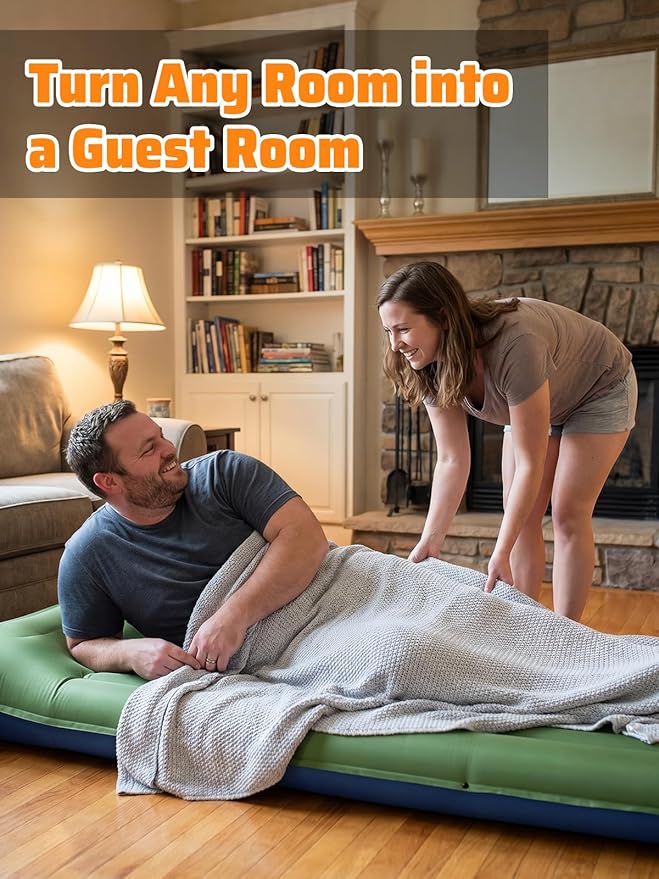
6. Home guest bed replacement:
Keep the OGERY pad in a closet. When guests arrive, roll it out. They’ll sleep better than on your pullout couch. Deflate and store when they leave.
Part 9: Real Customer Feedback (Composite)
*”My girlfriend and I just finished a 7-day backpacking trip in the Wind River Range. We split the OGERY pad – she carried it for two days, I carried it for five. At 4.8 lbs total, it’s 2.4 lbs each – lighter than her solo pad from last year. The 6 inches of thickness meant we never felt the ground, even on rocky campsites. The foot pump inflated it in about 2 minutes of stepping. Neither of us woke up sore. This pad is a game-changer.”*
– Backpacking couple, Wyoming
“I’m a 6’3″ side sleeper. I’ve tried six different camping pads. The OGERY is the first one where my hip didn’t hurt in the morning. The 6 inches are real – I can feel that I’m floating above the ground. The tubular support system works – no sagging. And at 4.8 lbs, I can carry it solo without feeling like a pack mule.”
– Side sleeper, Colorado
*”We car camp with two kids. The OGERY pad fits perfectly in our 4-person tent. The kids love the ‘bounciness.’ I love that it packs down to the size of a small watermelon – it lives in my car trunk permanently now. The built-in foot pump means no searching for an outlet at 10 PM when we realize we forgot the pump.”*
– Family camper, Oregon
*”I bought this for the built-in foot pump alone – I hate blowing up pads with my mouth. But the 6-inch thickness is what sold me. I slept on a site with exposed roots and felt nothing. Nothing! The tubular support keeps me from rolling into the center. My partner and I both sleep better.”*
– Couple, Washington
Part 10: Setup, Maintenance & Troubleshooting
First-time setup (at home, before your trip):
- Unroll the pad on a clean, flat floor.
- Locate the dual-layer air valves. Close them tightly. (Valves often ship slightly open.)
- Step on the foot pump area consistently for 3 minutes.
- Let the pad sit inflated for 24 hours. Mark the firmness. If it softens noticeably, check the valves first.
- Deflate and pack. Now you know it’s ready.
Daily setup at camp:
- Clear tent floor of sharp objects.
- Unroll pad.
- Ensure both valves are tightly closed.
- Step on foot pump until desired firmness (approximately 3 minutes).
- Lie down. Adjust firmness by slightly opening a valve to release air (if too firm) or adding more air (if too soft).
- Close valves.
Daily takedown:
- Open both valves fully.
- Allow pad to self-deflate (30–60 seconds).
- Roll tightly from foot end toward head end.
- Close valves to keep compressed.
- Slide into stuff sack.
Long-term storage:
- Do not store rolled tight for months.
- Do store partially inflated (valves open) in a cool, dry place.
- Do unroll and re-inflate every 2–3 months.
Cleaning:
- Wipe with a damp cloth. Air dry before packing.
- Do not use strong detergents.
- Do not submerge fully.
Troubleshooting leaks:
- Always check valves first. Ensure they are fully closed.
- If valves are closed and pad still loses air, locate leak: Inflate fully, listen for hissing, or submerge in water and look for bubbles.
- Mark leak, deflate, dry thoroughly.
- Apply included patch kit or TPU-specific patch.
Part 11: The OGERY Promise
OGERY stands behind this product. While the provided specifications don’t include an explicit warranty statement, OGERY is known for customer satisfaction. If you have any issues – from a manufacturing defect to a question about use – contact OGERY customer service.
What to expect:
- Responsive communication
- Practical solutions (replacement, refund, or repair guidance)
- Commitment to making things right
Why this matters:
Camping gear is an investment. Buying a pad online without trying it first carries risk. OGERY’s customer service removes that risk.
Part 12: Environmental & Practical Considerations
Durability = sustainability:
A pad that lasts 3–5 years means fewer pads in landfills. The OGERY’s rugged 50D polyester and TPU construction, combined with repairable design, gives it a long usable life.
Materials:
- 50D polyester: Synthetic, not biodegradable, but highly durable
- TPU: Less harmful than PVC, no phthalates
End of life:
When the pad eventually wears out, consider repurposing: cut into kneeling pads for gardening, use sections as insulation, or donate to a gear repair shop.
Conclusion: Ultralight No Longer Means Uncomfortable
The OGERY Double Sleeping Pad proves that you don’t have to choose between a light pack and a good night’s sleep.
The highlights recap:
- 6 inches thick – twice as thick as standard pads, zero ground feel
- 4.8 pounds total – splits to 2.4 lbs per person for backpacking couples
- Packs to 6.6″ × 6.6″ × 12.5″ – smaller than many solo pads
- Tubular air belt support system – reinforced internal columns prevent sagging
- Built-in foot pump – 3-minute inflation, no extra gear
- Dual-layer air valves – rapid inflation, no air leakage
- Built-in ergonomic pillow – pressure relief for back and neck
- 50D polyester + TPU – durable, waterproof, quiet
- Low noise when moving – won’t wake your partner
Whether you’re a backpacking couple tired of separate pads that drift apart, a solo adventurer who refuses to sacrifice comfort, a side sleeper who has never found a camping pad that works, or a family looking for a compact, comfortable double pad – the OGERY delivers.
Stop compromising. Stop sleeping on the ground. Stop accepting that backpacking means back pain.
Get the OGERY Double Sleeping Pad. Experience 6 inches of elevated comfort. And wake up ready for the trail – not desperate for the drive home.
Order yours today. Your hips, your back, and your camping partner will thank you.