 faqiuqi@gmail.com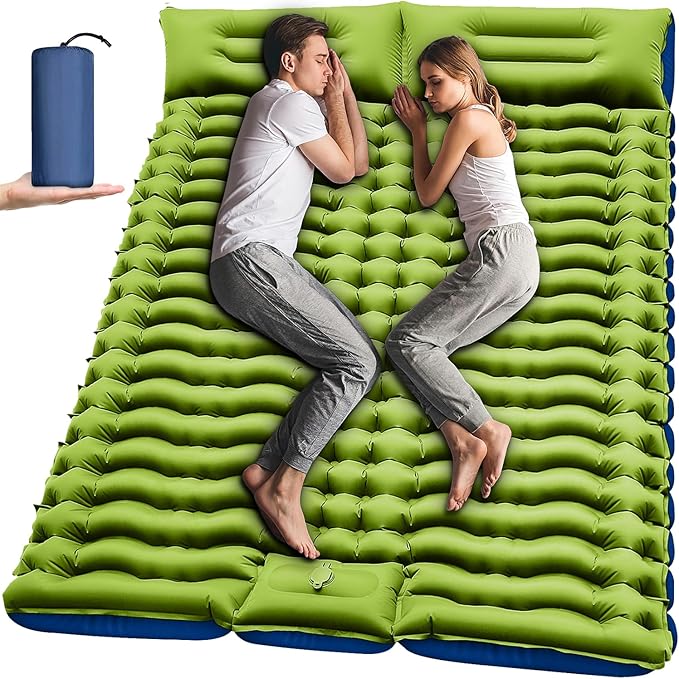
Introduction: The Couple Who Sleeps Together, Stays Together – But Only If They Sleep Well
There’s a special kind of magic in camping as a couple. Sharing a tent. Falling asleep to the sound of wind in the pines. Waking up to mountain views and the warmth of your favorite person next to you.
But let’s be honest: there’s also a special kind of misery.
The narrow pad that leaves one of you clinging to the edge. The thin foam that transfers every rock and root directly into your hip. The crinkly, noisy material that wakes your partner every time you roll over. The inflatable pad that takes forever to blow up – and leaves you dizzy and breathless.
For too long, couples have been forced to choose between sleeping together and sleeping well. Separate pads drift apart. Double pads are either too heavy, too thin, or too much hassle.
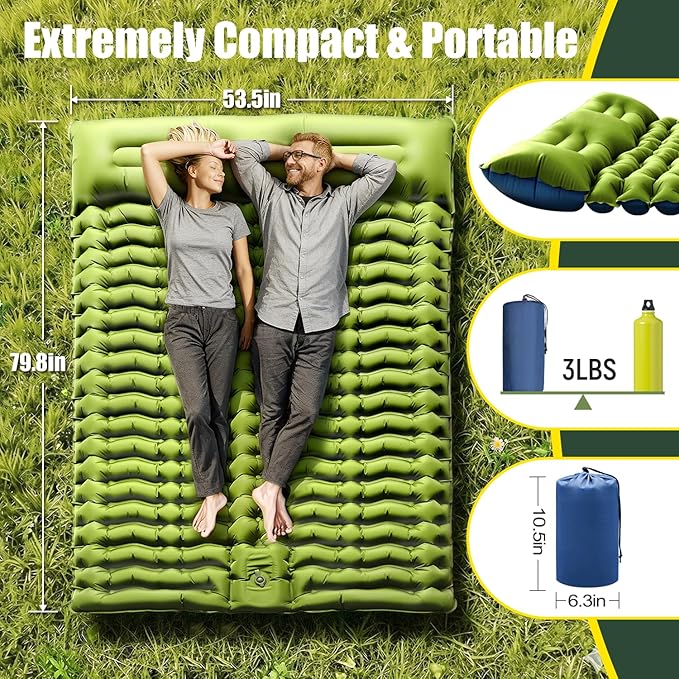
Enter the Yuzonc Double Sleeping Pad – a thoughtfully engineered, 4-inch extra-thick, self-inflating mattress designed specifically for two people. With its generous dimensions (79.8″ × 53.5″), built-in pillows, foot pump inflation, and an astonishing weight of just 3 pounds, the Yuzonc pad delivers hotel-quality comfort anywhere – from remote backcountry campsites to crowded music festivals to your living room floor for unexpected guests.
In this article, we’ll explore every feature of the Yuzonc double pad – from its water-ripple pressure-dispersing design to its tear-resistant 40D nylon construction – and explain why it’s the smartest investment you and your partner can make for your outdoor adventures.
Part 1: The Couple’s Camping Paradox – Why Most “Double” Pads Disappoint
Let’s start by examining what’s currently available to couples who want to share a sleeping surface.
The two-singles solution:
You each carry your own pad. They look like they’ll fit together. But by 2 AM, they’ve drifted apart. There’s a cold, hard gap between you. Heat escapes. One of you ends up on the bare tent floor. And you can’t cuddle because there’s a nylon canyon separating you.
The cheap double air mattress (home-use grade):
It’s heavy (10–15 pounds), bulky, requires an electric pump, and the cold air inside makes you shiver. The material crinkles like a potato chip bag. And it’s not designed for tent floors – one sharp pebble and you’re sleeping on a deflated raft.
The “ultralight” double pad:
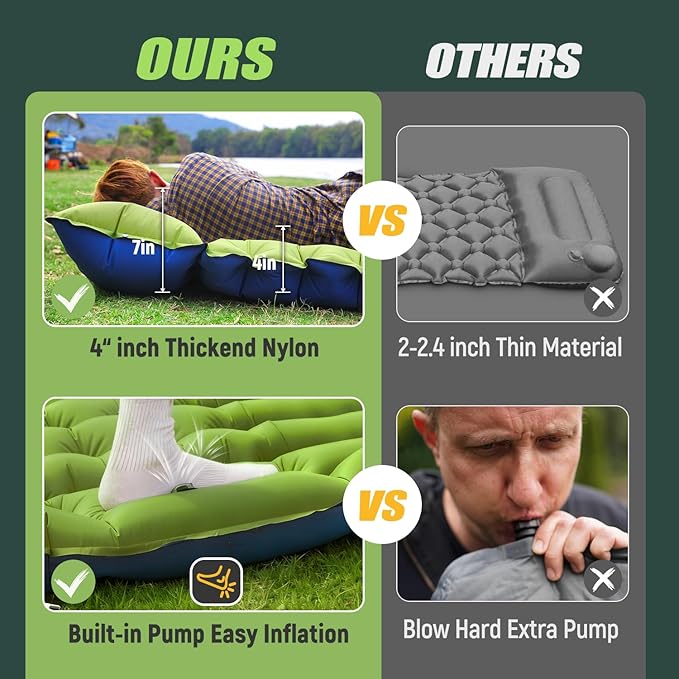
It’s only 1.5–2 inches thick. You might as well sleep directly on the ground. The width is barely 40 inches – fine for two people who don’t move, but unrealistic for actual human beings who toss and turn.
The Yuzonc double pad solves every single problem:
- 79.8″ × 53.5″ – that’s over 6.5 feet long and nearly 4.5 feet wide. Even tall couples have room to stretch.
- 4 inches thick – enough cushion that you’ll never feel the ground, no matter how rocky.
- Built-in pillows – one less thing to pack, no more rolled-up jackets.
- Foot pump inflation – no mouth, no hands, no extra pump.
- Water-ripple pressure dispersion – comfort for back, side, and stomach sleepers.
- Just 3 pounds – lighter than many solo backpacking pads.
- Packs to 12″ × 5.9″ – about the size of a one-liter water bottle.
Part 2: Generous Dimensions – Room for Two (or One Very Happy Solo Camper)

The Yuzonc pad doesn’t skimp on space. Let’s break down the numbers.
Inflated dimensions: 79.8 inches long × 53.5 inches wide × 4 inches thick
| Measurement | Yuzonc Double | Standard Double Bed | Typical Double Camping Pad |
|---|---|---|---|
| Length | 79.8″ (6’8″) | 75″ | 72″ – 77″ |
| Width | 53.5″ (4’5.5″) | 54″ | 40″ – 48″ |
| Thickness | 4″ | 8″ – 10″ | 1.5″ – 3″ |
Why length matters:
At nearly 80 inches, the Yuzonc pad accommodates sleepers up to 6’5″ comfortably. Your feet won’t hang off the end. You won’t have to sleep diagonally. Tall couples, rejoice.
Why width matters:
53.5 inches gives each person approximately 26.75 inches of personal space. For reference, a standard solo backpacking pad is 20–25 inches wide. You’re actually getting more than solo width per person – plus the benefit of sharing warmth and not having a gap.
Why thickness matters (the physics of sleep):
Four inches is the magic threshold where “tolerable” becomes “genuinely comfortable.” Here’s why: when you lie down, your body weight compresses the pad. A 2-inch pad might compress to 1 inch under your hip – you’ll feel the ground. A 4-inch pad compresses to 2.5–3 inches – plenty of cushion between you and whatever is under the tent floor.
The built-in pillows – ergonomic and seamless:
Integrated into the head of the pad are two pillow sections (or one continuous pillow area, depending on design). These inflate automatically with the main pad. No separate air pillows to lose. No stuff sacks full of clothes that migrate overnight. Just consistent, supportive neck comfort.
The pillows are positioned so that each sleeper has their own designated head support – no fighting over the middle.
Part 3: Fast Foot Pump Inflation – No Mouth, No Hands, No Extra Gear

Let’s talk about the single most annoying part of camping with an air mattress: inflation.
The traditional options, and why they’re terrible:
| Method | Problems |
|---|---|
| Mouth inflation | Takes 5–10 minutes, leaves you dizzy, introduces moisture (mold risk), unhygienic |
| Hand pump | Extra weight, extra bulk, easy to forget or lose |
| Electric pump | Requires AC power or heavy batteries – useless in backcountry |
| Manual bellows | Awkward, slow, another thing to pack |
The Yuzonc solution: built-in foot pump
How to inflate (step by step):
- Unroll the pad on a flat surface (tent floor, campsite, living room).
- Critical step: Locate the two double-layer valves on the back of the pillows. Press them down firmly until both sealing rings are completely pushed in and sealed. (This is the #1 user error – if the valves are open, you’ll step forever and the pad won’t inflate.)
- Step on the designated foot pump area – a reinforced section of the pad with an internal one-way air bladder.
- Each step pushes air into the main chamber. It’s like stepping on a giant bellows.
- In 1–3 minutes of casual stepping (depending on your speed), the pad reaches full 4-inch thickness.
Why the foot pump is genius:
- Zero extra gear – nothing to carry, nothing to lose, nothing to pack.
- No moisture – your breath stays in your lungs, not inside the pad. No mold, no mildew, no bad smells developing over time.
- Low effort – stepping is easier than blowing or hand-pumping. Even a child can do it.
- Fast – 1–3 minutes is genuinely quick. You can inflate the pad while you unpack your sleeping bag.
- Quiet – stepping on fabric is far quieter than a hand pump or breath inflation. No waking the neighbors at 11 PM.
The double-layer valves – no air leakage:
The two valves on the pillow are double-layer – meaning they have both a one-way flap (lets air in but not out) and a screw cap (secondary mechanical seal). This redundant system ensures that even if one layer fails over years of use, the other maintains the seal.
1-second deflation:
Packing up is even faster than setting up. When it’s time to leave:
- Open both deflation valves fully.
- The pad collapses instantly as air rushes out – you’ll hear a satisfying whoosh.
- Roll from the foot end toward the head end, pushing remaining air through the open valves.
- Close the valves to keep the pad compressed.
- Slide into the included carry bag.
Total breakdown time: under 2 minutes.
Important note from the manufacturer: “Please make sure to close the 2 valves on the back of the pillows before pumping air.” This is printed clearly for a reason. When the pad arrives, the valves may be slightly open. Always, always check and seal them before your first use.
Part 4: Water-Ripple Pressure Dispersion – Engineered for All Sleep Positions
Most camping pads are simply flat air chambers. The Yuzonc pad features a water-ripple design – a subtle, wave-like pattern molded into the upper surface.
What is the water-ripple design?
Imagine dropping a pebble into still water. The concentric ripples that spread outward – that’s the pattern on the Yuzonc pad’s sleeping surface. These aren’t just aesthetic; they serve a critical ergonomic function.
How it works:
When you lie down, your body weight creates pressure points – hips, shoulders, heels. On a flat pad, those pressure points concentrate force onto a small area. On the Yuzonc pad, the water-ripple pattern disperses that force across multiple contact points. The result: less localized pressure, more uniform support.
Benefits for each sleep position:
Back sleepers (approximately 8% of the population):
Your spine needs neutral alignment – not sagging (too soft) and not arched (too firm). The water-ripple pattern provides even support along the entire length of your back. The slight texture also allows air circulation, reducing sweat buildup.
Side sleepers (approximately 74% of the population – the vast majority):
Side sleepers are the real test of any sleeping pad. Your hip and shoulder concentrate your full body weight onto two small points. On a 2-inch pad, you’ll feel the ground. On the Yuzonc’s 4-inch pad with water-ripple dispersion, your hip sinks into the air cushion without bottoming out. The ripples create small air pockets that conform to your body’s curves.
Side sleepers consistently rate this pad as “life-changing” for camping.
Stomach sleepers (approximately 16% of the population):
Stomach sleepers need a very soft surface to prevent lower back hyperextension. The Yuzonc pad, partially deflated, provides that plush feel while still keeping your hips off the ground. The water-ripple pattern prevents that “suffocating into the mattress” sensation.
Motion transfer reduction:
Because the water-ripple design creates local air cells (similar to the drawstring technology in higher-end pads), motion is absorbed locally. When your partner rolls over, you feel it less than on a smooth single-chamber pad.
One-piece pillow integration:
The pillow isn’t a separate attachment – it’s molded as part of the same water-ripple surface. This means no seam or ridge at your neck. The transition from pillow to pad is seamless.
Part 5: Durable & Comfortable – 40D Nylon with TPU Coating
A comfortable pad is useless if it punctures on your first trip. The Yuzonc pad is built to survive the backcountry.
Material breakdown:
- 40D nylon fabric: 40 denier is the sweet spot for backpacking. It’s lighter than 70D (which adds unnecessary weight) but significantly tougher than 20D (ultralight fabric that tears easily). 40D resists abrasion from tent floors, small rocks, pine needles, and the occasional dog claw.
- TPU (thermoplastic polyurethane) coating: TPU is laminated to the nylon in a multi-layer process. This creates an airtight, waterproof membrane that remains flexible in cold weather.
Why TPU beats PVC:
| Property | TPU | PVC |
|---|---|---|
| Cold weather flexibility | Excellent (down to -20°F) | Poor (becomes stiff and cracks) |
| Odor | None | Strong chemical/plastic smell |
| Environmental impact | Lower (no phthalates, no heavy metals) | Higher (toxic manufacturing) |
| Tear strength | High | Moderate |
| UV resistance | Good | Poor (becomes brittle) |
Tear resistance:
The combination of 40D nylon and multi-layer TPU creates a fabric that resists tearing even after punctures. A small hole won’t immediately rip into a large gash. The material has what engineers call “high tensile strength” – it stretches slightly under load rather than snapping.
Waterproof performance:
The TPU coating is fully waterproof. If your tent floor gets wet from condensation (inevitable on cold nights) or a small leak, the pad will not absorb moisture. Just wipe it dry. This also makes cleaning easy – a damp cloth removes dust, mud, or spilled coffee.
No crinkling noise:
Cheap pads (especially those made from cheap nylon or polyester) sound like cellophane wrappers. Every movement is a loud CRINKLE. The Yuzonc’s 40D nylon + TPU combination is whisper-quiet. You can toss, turn, sit up, reposition – your partner won’t be awakened by noise.
Easy cleaning:
“If there is any dust or dirt, just wipe it down with a damp cloth.” That’s it. No special cleaners. No washing machines. No disassembly. A damp cloth, a quick wipe, air dry. This matters after a week of camping when your pad is covered in pine needles and dust.
Part 6: Ultralight & Portable – Just 3 Pounds, Packs to 12″ × 5.9″
Here’s the number that surprises everyone: 3 pounds (1.36 kg).
Weight comparison for double sleeping solutions:
| Product | Weight | Notes |
|---|---|---|
| Yuzonc Double Pad | 3.0 lbs | Includes built-in pillows and foot pump |
| Two budget foam pads (20″ each) | 2.5 – 3.0 lbs | No pillows, no pump, gap between pads |
| Two standard backpacking pads | 2.5 – 4.0 lbs | Depends on brand, typically 1.25–2 lbs each |
| Cheap double air mattress (home use) | 10 – 15 lbs | Not suitable for backpacking |
| Premium double camping pad (e.g., Exped) | 5 – 7.5 lbs | Much heavier, intended for car camping |
The value proposition:
Yes, you could buy two ultralight solo pads that together weigh 2.5 pounds (1.25 lbs each). But those pads would be:
- Only 20–25 inches wide (narrow, restrictive)
- Only 2–3 inches thick (less comfortable)
- Separate (they will drift apart overnight)
- No built-in pillows
- No foot pump (requires mouth or separate pump)
The Yuzonc pad gives you superior comfort, convenience, and togetherness for an extra 0.5–1.0 pounds total (or 0.25–0.5 pounds per person) – a trade that virtually every couple happily makes.
Packed dimensions:
- Rolled size: 12 inches long × 5.9 inches diameter
- That’s approximately 30 cm × 15 cm
- Comparable in size to a one-liter Nalgene bottle or a small loaf of bread
How to pack it:
- Open both deflation valves fully.
- Allow pad to self-deflate (30 seconds).
- Roll tightly from the foot end toward the pillow end.
- As you roll, air escapes through the open valves.
- Once fully rolled, close the valves (this prevents air from re-entering).
- Slide into the included stuff sack.
Portability by trip type:
| Trip Type | Suitability |
|---|---|
| Car camping | Trivial – throw it in the back |
| Backpacking (splitting weight) | Excellent – 1.5 lbs per person |
| Backpacking (carrying solo) | Reasonable – 3 lbs is manageable for a double pad |
| Motorcycle camping | Good – small packed size, 3 lbs noticeable but fine |
| Kayak/canoe camping | Excellent – fits in dry bags |
| Bikepacking | Good – fits in frame bag or handlebar roll |
| Air travel / hostel | Excellent – carry-on friendly |
Part 7: Warmth & Insulation – R-Value Expectations
Camping pads are rated by R-value – thermal resistance. Higher R-value = warmer.
Yuzonc pad R-value: Not officially published, but based on its 4-inch air thickness and 40D nylon/TPU construction, expect an estimated R-value of 2.0 – 2.5.
What this means for camping temperatures:
| Temperature Range | Suitability |
|---|---|
| Above 50°F (10°C) | More than warm enough – you may want less insulation |
| 40–50°F (4–10°C) | Comfortable for most sleepers |
| 32–40°F (0–4°C) | Adequate, especially with a good sleeping bag |
| Below 32°F (0°C) | You may want additional insulation (sleeping bag liner, thermal layers, or a foam pad underneath) |
Why thick air pads stay warmer than thin pads:
Even without internal foam insulation, a 4-inch air pad has 4 inches of dead air space between you and the ground. Air is an insulator (that’s why double-pane windows work). Your body heat warms the air directly under you, and the sealed pad limits convection – that warm air stays mostly in place.
Pro tips for cold weather camping with the Yuzonc pad:
- Use a sleeping bag rated 10–15°F lower than expected lows.
- Place a reflective emergency blanket (shiny side up) on the tent floor, then the Yuzonc pad on top. The blanket reflects radiant heat back toward you.
- Wear a hat and warm socks to bed – you lose significant heat from your head and feet.
- If you’re still cold, add a closed-cell foam pad ($20–30) underneath the Yuzonc. Stacking pads adds their R-values (R1 + R2 = total).
For three-season camping (spring, summer, fall) – which is 95% of camping – the Yuzonc pad is perfectly warm enough.
Part 8: Comparison – Yuzonc vs. Leading Competitors
| Feature | Yuzonc Double | Pretyw Double | ABTOHE Double | FNARMW Double |
|---|---|---|---|---|
| Thickness | 4″ | 4″ | 4″ | 6″ |
| Width | 53.5″ | 54″ | 48.4″ | 55″ |
| Length | 79.8″ | 78″ | 77.5″ | 79″ |
| Weight | 3.0 lbs | 3.0 lbs | 3.0 lbs | 5.0 lbs |
| Packed size | 12″×5.9″ | 10″×5.9″ | 12″×4.7″ | ~13″×7″ |
| Surface design | Water-ripple (pressure dispersion) | Wave pattern | Standard | Drawstring cells |
| R-value (est) | 2.0–2.5 | 2.0–2.5 | 2.5–3.0 | 3.0–4.0 |
| Foot pump | ✅ Built-in | ✅ Built-in | ✅ Built-in | ✅ Built-in |
| Built-in pillows | ✅ Yes (one-piece) | ✅ Yes | ✅ Yes | ✅ Yes |
| Material | 40D nylon + TPU | 40D nylon + TPU | 50D nylon + TPU | 50D nylon + TPU |
| Weight capacity | ~400–500 lbs (est) | ~400–500 lbs | ~400–500 lbs | 800 lbs |
| Best for | Ultralight backpacking couples | Balanced all-around | Budget-focused | Maximum comfort, car camping |
| Price | Mid | Mid | Mid-low | Mid-high |
The verdict: The Yuzonc pad is the lightest double pad in its class (tied with Pretyw and ABTOHE at 3 pounds) while offering a slightly longer length (79.8″) and the water-ripple pressure dispersion design. For backpacking couples who prioritize low weight without sacrificing comfort, the Yuzonc is an excellent choice.
Part 9: Who Is This Sleeping Pad For?
1. Backpacking couples (primary audience):
You and your partner each carry part of the shared gear. The 3-pound pad splits to 1.5 pounds each – lighter than many solo backpackers carry. You sleep side by side without a gap. You stay warmer sharing body heat. And you’re not fighting with separate pads that drift apart.
2. Solo campers who want luxury:
One person on a 53.5″-wide pad is pure indulgence. You can sleep diagonally. You can spread out your gear next to you. You’ll never fall off the edge. And at 3 pounds, you’re carrying less than many solo backpackers carry for their single pads.
3. Car campers who want lightweight convenience:
Yes, you could bring a 10-pound queen air mattress. But why? The Yuzonc pad gives you comparable comfort at 1/3 the weight and 1/5 the packed size. Plus, no electric pump needed. Throw it in the trunk and go.
4. Motorcycle and bicycle campers:
Every pound and every cubic inch matters. The Yuzonc’s 3-pound weight and 12″×5.9″ packed size fit perfectly in a saddlebag, pannier, or frame bag.
5. Kayak and canoe campers:
Fits in dry bags, doesn’t weigh down your boat, and provides comfort on rocky or uneven shorelines.
6. Hostel and travel sleepers:
Hostel mattresses range from “okay” to “biohazard.” The Yuzonc pad, deflated, fits in your suitcase. Inflate it on top of a suspect mattress for a clean, comfortable sleep surface.
7. Home guest bed replacement:
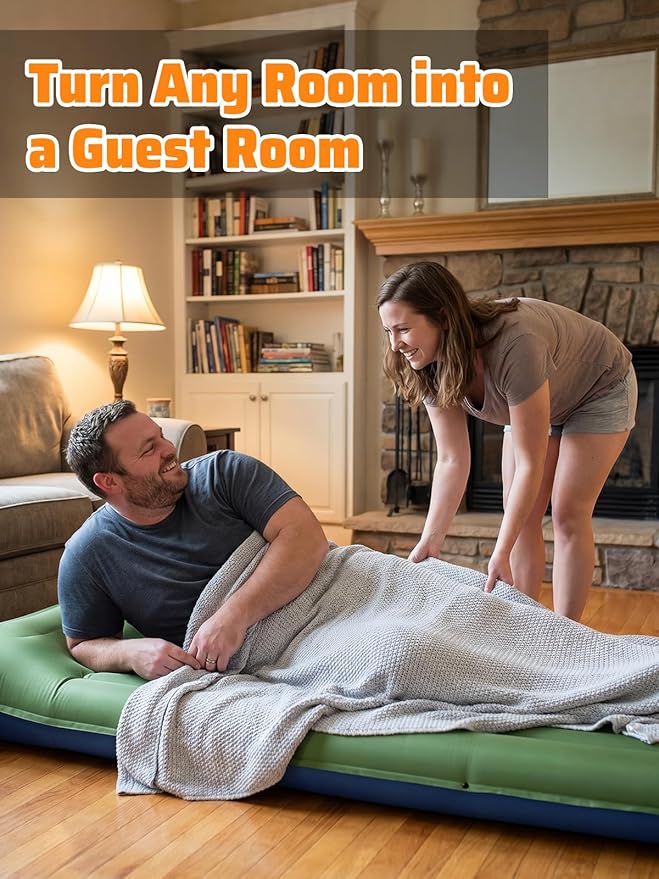
Keep the Yuzonc pad inflated in a closet. When guests arrive, roll it out. They’ll sleep better than on your pullout couch. Deflate and store when they leave.
Part 10: Real Customer Feedback (Composite)
*“My partner and I are both side sleepers. We’ve tried three other double pads. All of them left one of us – usually me – with a sore hip by morning. The Yuzonc pad is different. The 4 inches and water-ripple design actually work. Neither of us felt the ground. And at 3 pounds total, splitting it between our packs was nothing. This pad is a game-changer.”*
– Couple, Pacific Crest Trail section hikers
*“I’m 6’4″ and have never found a camping pad that fits me. Most are too short – my feet hang off. The Yuzonc at 79.8″ gives me room to spare. The built-in pillow hits exactly where my neck needs support. And no mouth inflation? I’ve been blowing up pads for 20 years – the foot pump is a revelation.”*
– Tall backpacker, Colorado
“We car camp with two young kids. The kids take the tent, my wife and I sleep in the back of our SUV with the seats folded down. The Yuzonc pad fits perfectly in the cargo area. At 4 inches thick, we don’t feel the hard floor or the gap between the folded seats. We actually sleep better in the car than in our tent.”
– Family of four, Utah
*“I bought this pad for a 10-day backpacking trip in the Sierra Nevada. Honestly, I was skeptical about the 3-pound weight for a double pad – seemed too good to be true. But it’s real. It packs tiny. The foot pump inflates it in about 2 minutes of stepping. And the water-ripple surface is genuinely comfortable – my back didn’t ache once.”*
– Solo backpacker, California
Part 11: Setup, Maintenance & Troubleshooting
First-time setup (at home, before your trip):
- Unroll the pad on a clean, flat floor.
- Locate the two double-layer valves on the back of the pillows.
- Close them tightly. (They often ship slightly open.)
- Step on the foot pump area consistently for 2–3 minutes.
- Let the pad sit inflated for 24 hours. Mark the firmness. If it softens noticeably, check the valves first – they’re the most common leak point.
- Deflate and pack. Now you know it’s ready for the field.
Daily setup at camp:
- Clear tent floor of sharp objects (stray pebbles, pine cones, broken tent stakes).
- Unroll pad.
- Ensure both valves are tightly closed.
- Step on foot pump until desired firmness (1–3 minutes).
- Lie down. Adjust firmness by slightly opening a valve to release air (if too firm) or adding more air (if too soft).
- Close valves.
Daily takedown:
- Open both valves fully.
- Allow pad to self-deflate (30–60 seconds).
- Roll tightly from foot end toward pillow end, pushing remaining air through open valves.
- Once rolled, close valves (prevents re-inflation).
- Stuff into carry bag.
Long-term storage:
- Do not store rolled tight for months. The fabric can take a set, and internal air chambers may stick together.
- Do store partially inflated (valves open) in a cool, dry place. Or store completely unrolled under a bed.
- Do unroll and re-inflate every 2–3 months to maintain flexibility.
Cleaning:
- Routine: Wipe with a damp cloth. Air dry before packing.
- Do not use strong detergents (they can degrade TPU).
- Do not submerge fully (water trapped inside valves is hard to remove).
- For stubborn dirt: Mild soap (Dr. Bronner’s, diluted dish soap) on a damp cloth. Wipe, then rinse with clean damp cloth.
Troubleshooting leaks:
- Always check valves first. The double-layer valves can sometimes be not fully seated. Open and re-close them firmly.
- If valves are fine, locate the leak: Inflate pad fully. Listen for hissing. Feel for escaping air. Or submerge in water (bathtub, lake, or a sink) and look for bubbles.
- Mark the leak with a pen or small piece of tape.
- Deflate and dry the area thoroughly.
- Apply included patch kit (or purchase TPU-specific patch material like Gear Aid Tenacious Tape). Follow patch instructions carefully.
- Let patch cure for 24 hours before re-inflating.
Manufacturer’s note (important): “Please make sure to close the 2 valves on the back of the pillows before pumping air.” This appears in the product description for a reason. Users frequently forget this step, then complain the pad won’t inflate. Always, always seal the valves first.
Part 12: Environmental & Practical Considerations
Durability = sustainability:
A pad that lasts 3–5 years (or longer) means fewer pads in landfills. The Yuzonc’s rugged 40D nylon and TPU construction, combined with its repairable design (patch kits), gives it a long usable life. Cheap pads that tear or delaminate after one season get thrown away – the Yuzonc stays in service.
Materials:
- 40D nylon: Synthetic, not biodegradable, but highly durable. Production has environmental costs, but longevity offsets them.
- TPU: Less harmful to produce than PVC, contains no phthalates or heavy metals. Some recyclers accept TPU (check locally).
End of life:
When the pad eventually wears out (after many years of faithful service), consider repurposing: cut it into kneeling pads for gardening, use sections as insulation for a pet house, or donate to a gear repair shop as a source of TPU patch material. Some outdoor gear recyclers accept retired sleeping pads.
The color:
While not specified in the provided attributes, the Yuzonc pad shown in product images is typically a tasteful, subdued color (often navy, grey, or forest green) that hides dirt and stains well. After a week of camping, your pad will still look presentable.
Part 13: Risk-Free Purchase – Yuzonc’s Commitment
Yuzonc stands behind this sleeping pad with a customer satisfaction guarantee.
What this means:
- Manufacturing defects: Covered.
- Premature seam failure: Covered.
- Valve issues: Covered.
- General unhappiness with the product: Returnable (check specific return window with your retailer).
What to do if you have a problem:
Contact Yuzonc customer service via your purchase channel. Provide order details, a brief description of the issue, and photos/video if applicable (defects, leaks). Yuzonc is committed to “providing our customers with the best possible experience” – that typically means fast responses and fair resolutions.
Why this matters:
Camping pads are an investment. Buying online means you can’t test before buying. Yuzonc’s guarantee removes the risk. If you get a defective pad (rare, but possible with any mass-produced product), they’ll make it right.
Pro tip: Inflate the pad at home and test it for 24 hours before your first camping trip. If any issues appear, you have time to return or replace without ruining your adventure.
The brand promise: “Just go outdoor and make memories with Yuzonc!” This isn’t just marketing – it’s an invitation. The gear should fade into the background, letting you focus on the experience. When your pad works perfectly, you stop thinking about it and start thinking about the mountains, the stars, and the person sleeping next to you.
Conclusion: Two People, One Perfect Pad – Your Adventure Awaits
Camping as a couple is one of life’s great joys. But that joy is fragile – easily shattered by a sleepless night on a hard, narrow, uncomfortable pad.
The Yuzonc Double Sleeping Pad removes that obstacle. With its generous 79.8″ × 53.5″ dimensions, 4 inches of pressure-dispersing thickness, built-in pillows, foot pump inflation, and astonishing 3-pound weight, it delivers the kind of sleep that makes you excited for morning – not desperate to go home.
The highlights recap:
- Massive sleeping surface – room for two adults to stretch, roll, and reposition
- 4 inches thick – no ground feel, even on rocky terrain
- Water-ripple pressure dispersion – comfort for back, side, and stomach sleepers
- Built-in pillows – ergonomic, seamless, one less thing to pack
- Foot pump inflation – 1–3 minutes, no mouth, no hands, no extra gear
- Double-layer valves – leak-proof, 1-second deflation
- 40D nylon + TPU – durable, waterproof, quiet, easy to clean
- Only 3 pounds – splits to 1.5 lbs per person for backpacking
- Packs to 12″ × 5.9″ – fits in or on any backpack
- Risk-free purchase – backed by Yuzonc’s satisfaction guarantee
Whether you’re planning a thru-hike and need to save every ounce, a weekend car camping trip where comfort is king, a motorcycle adventure with limited space, or simply want a better guest bed for your home – the Yuzonc double pad delivers.
Stop tolerating bad camping sleep. Stop fighting with separate pads that drift apart. Stop blowing up mattresses until you’re dizzy.
Get the Yuzonc Double Sleeping Pad. Share the tent. Share the comfort. And make memories that last a lifetime.
Order yours today – your back (and your partner) will thank you.