 faqiuqi@gmail.com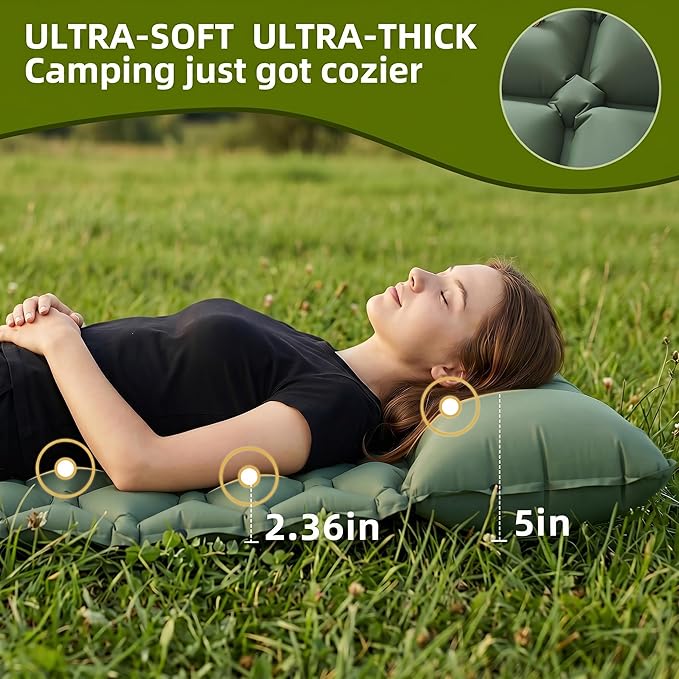
There is a silent equation in the world of backpacking. It is a brutal, unforgiving formula: Comfort = Weight. For decades, outdoor brands have told hikers that if you want a good night’s sleep, you have to carry a heavy, bulky mat. Conversely, if you want to go light and fast, you have to sleep on what feels like a sheet of paper over concrete.
It is a lie.
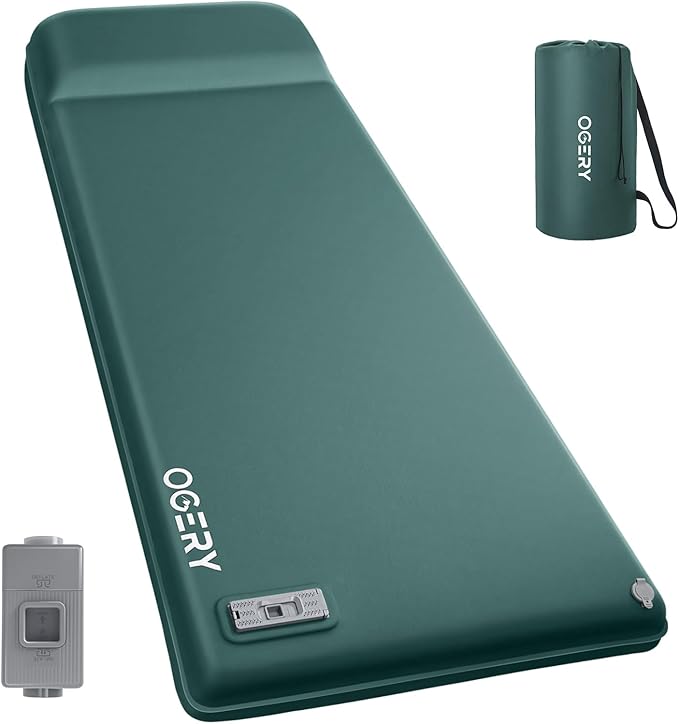
We are here to break that equation. Welcome to the era of the Ultralight Camping Mat with Built-in Pump Foot and Pillow. This is not just a sleeping pad. This is a statement that you can have it all: the comfort of a 2.3-inch thick air bed, the portability of a water bottle, and the convenience of a hands-free, no-blow inflation system.
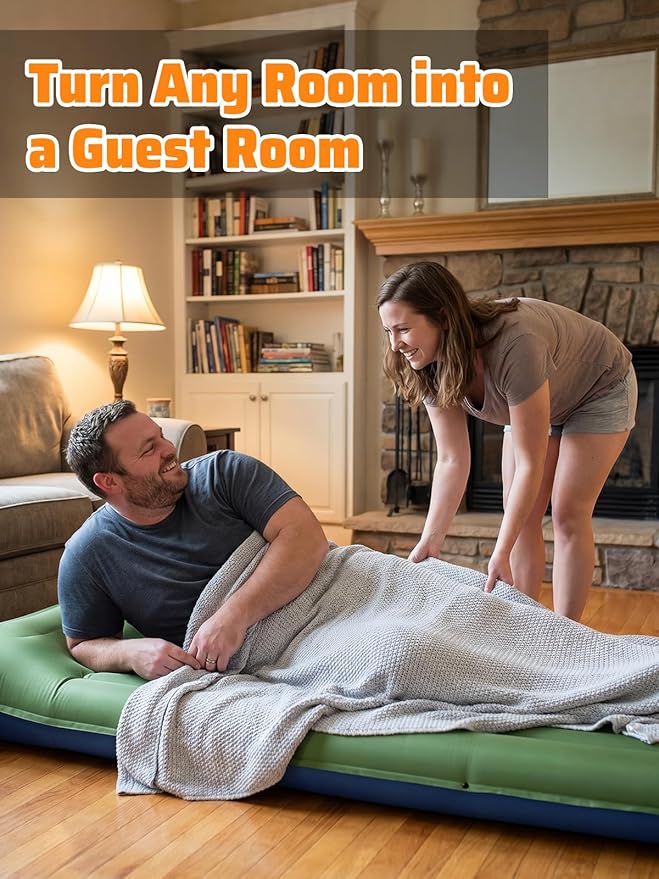
Whether you are thru-hiking the Pacific Crest Trail, setting up a quiet camp in the backcountry, or just need a guest bed that fits in a closet, this green, 72″x26″ marvel is about to change your relationship with the outdoors.
Part 1: The “Water Bottle” Test – Redefining Compact
Let us start with the most shocking feature of this mat: its packed size.
Rolled up and stuffed into its carry sack, this sleeping pad measures approximately 11 inches by 4.7 inches. To put that in human terms, it is roughly the size of a standard Nalgene water bottle or a large burrito.
Weighing in at just 1.42 lbs (0.64 kg) , you will barely notice it in your pack. Compare this to traditional self-inflating foam pads (which weigh 3+ lbs) or cheap air mattresses from big box stores (which weigh 5+ lbs and require a pump the size of a shoe box).
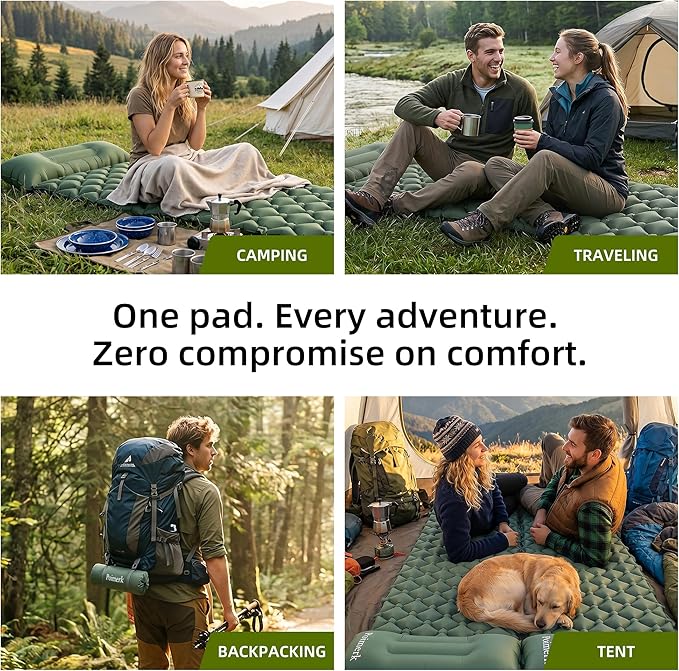
- Backpackers: You can finally carry a luxury mattress without sacrificing room for food and fuel.
- Travelers: This fits in a carry-on suitcase. Yes, really.
- Bikepackers: Strap it to your handlebars or stuff it in a frame bag.
The “lightweight” claim is thrown around a lot in the camping industry. But 1.42 lbs is not just lightweight. It is ultralight. It is the difference between a sore shoulder at mile 10 and a spring in your step.
Part 2: Built-in Foot Pump – Goodbye Dizziness, Hello 50 Seconds
Let us address the elephant in the tent. Inflating sleeping pads is universally hated. Why?
- Mouth inflation: You get dizzy. You introduce moisture and bacteria into the pad (hello, mold). You taste plastic for an hour.
- Hand pumps: They break. They are bulky. You lose the little rubber gasket.
- Battery pumps: The batteries die at the worst moment. They are heavy.
Our solution is so simple, it is almost stupid: your own feet.
This mat features an integrated, built-in foot pump. There is no separate bag to fill with air. There is no nozzle to lose. There is just a cleverly designed chamber at the foot of the mat that, when stepped on, pushes air into the main sleeping surface.
The process:
- Unroll the mat on a flat surface.
- Locate the foot pump area (you will see the differentiated fabric).
- Simply step on it. Lift your foot. Step again.
- In approximately 50 seconds (yes, we timed it), the mat is fully inflated to 2.3 inches of thickness.
No electricity. No lungs. No swearing.
Furthermore, we have upgraded the valve system to be leak-proof. Once the air is in, it stays in. Our zero-air-loss design means you will not wake up at 3 AM with your hips on the dirt. And when morning comes? Flip open the exhaust valve. One-second quick deflation. The air rushes out like a tornado. You roll it up and go.
Part 3: 2.3 Inches of Ergonomic Genius – Why Thicker Isn’t Always Better
Wait a minute. The previous sleeping pads in our lineup were 3 inches or 6 inches thick. This one is only 2.3 inches. Isn’t that a downgrade?
No. It is a different philosophy.
The 6.3-inch pad is for car camping luxury. The 3-inch foam pad is for winter insulation. This 2.3-inch mat is for the ultralight backpacker who needs a balance of comfort, weight, and stability.
Here is the secret: Ergonomic air-cell design.
Instead of a flat, unstable balloon of air (which makes you feel like you are sleeping on a waterbed), this mat uses interconnected air cells. These cells do two things:
- Conform to your body: The cells depress slightly under your hips and shoulders but stay firm under your lumbar spine.
- Prevent the “bounce”: When your partner rolls over, you do not fly into the air. The cells isolate movement.
Additionally, the 2.3-inch thickness is specifically engineered to keep you off the ground while maintaining stability. Extremely thick pads (6+ inches) can feel tippy. You feel like you might roll off. At 2.3 inches, you are elevated enough to avoid rocks and roots, but low enough to feel stable.
Part 4: The Built-in Pillow – One Less Thing to Lose
How many times have you used a wadded-up hoodie as a pillow? How many times have you woken up with a stiff neck because your stuff sack pillow shifted in the night?
We integrated an ergonomic pillow directly into the pad. It is not just a bump in the fabric. It is a contoured, raised section at the head of the mat that supports the natural curve of your cervical spine.
- Back sleepers: Your head rests gently, maintaining the natural “S” curve of your neck.
- Side sleepers: The pillow fills the gap between your shoulder and your ear, preventing that awful “crick” in the neck.
By integrating the pillow, we save you packing space and weight. You do not need to carry a separate camping pillow (which typically weighs 0.5 lbs on its own). You just unroll the mat, inflate it, and your pillow is already there, perfectly aligned.
Part 5: The “Couples Connect” – Snap Fasteners for Two
Camping alone is peaceful. Camping with a partner is complicated, especially when it comes to sleeping arrangements.
If you buy two of these mats, you can use the snap fasteners along the sides to connect them into a double-wide sleeping surface.
- Single use: 72″ x 26″ (plenty of room for one adult).
- Double use: 72″ x 52″ (a true queen-sized width for two).
Why is this better than a double-wide air mattress?
- Individual movement: On a traditional double mattress, when one person moves, the other person bounces. With two connected single mats, you have separate air chambers. You can roll over without waking your partner.
- Ease of packing: Two single mats pack down to the size of two water bottles. One double mattress packs down to the size of a small suitcase.
- Versatility: Bring one mat for solo trips. Bring two for couple trips. Bring three for the kids.
Part 6: Durability – 40D Ripstop Nylon vs. The Real World
Soft goods are only as good as their fabric. Many cheap sleeping pads use thin, 20D polyester or cheap PVC. One sharp rock. One pine needle. One excited dog’s claw. Pop. Hiss. Deflation.
Your adventure is over.
This mat is constructed from high-strength 40D Ripstop Nylon with a multi-layer TPU coating.
- 40D Ripstop: “Denier” (D) measures thread thickness. 40D is the sweet spot for ultralight backpacking—stronger than 20D (which tears easily) but lighter than 70D (which is heavy). “Ripstop” means the fabric is woven with a reinforcing grid pattern. If you get a small tear, the grid stops it from spreading into a large rip.
- TPU Coating: Thermoplastic Polyurethane is superior to PVC. It is more flexible in cold weather (won’t crack), more environmentally friendly, and bonds better to nylon.
The result? A mat that is tear-resistant, puncture-resistant, waterproof, and wear-resistant. You can throw this on rocky desert ground, wet forest duff, or spiky pine needle beds without fear.
And cleaning it? A simple wipe with a damp cloth. Mud, dust, and morning dew slide right off.
Part 7: The 72″ x 26″ Footprint – Tall People, Rejoice
Standard backpacking mats are often 72 inches long, but they taper at the feet. If you are 6 feet tall (72 inches), a tapered mat leaves your heels hanging off the end.
This mat remains full width (26 inches) for the entire length until the very end.
- Length: 72 inches (fits adults up to 6’2″ comfortably).
- Width: 26 inches (wide enough for broad shoulders, narrow enough to fit in a 1-person tent).
If you are a tall person who has spent years with cold heels touching the tent floor, this is your moment. If you are a broad-shouldered side sleeper who always ends up with an arm hanging off the mat, your search is over.
Part 8: All-Weather Versatility – From Beaches to Snow
The product description mentions “green” and “outdoor ready.” But what does that actually mean for different environments?
- Beach camping: Sand is abrasive. Sand gets into valves. Sand ruins cheap mats. The TPU coating and robust valve design resist sand ingestion. Plus, the green color hides dirt.
- Forest hiking: Damp ground is inevitable. The waterproof ripstop nylon acts as a vapor barrier. You stay dry even if your tent floor gets wet.
- RV and car travel: Because it packs so small, you can keep it permanently in your vehicle. Spontaneous camping trip? You already have your bed.
- Backpacking: This is the primary use case. The 1.42 lb weight is competitive with high-end ultralight pads from major brands, but at a fraction of the price.
Part 9: Step-by-Step – How to Use the Built-in Pump Correctly
To get the most out of this mat, follow these simple steps. Do not overthink it.
Inflation (Approx. 50 seconds):
- Unfold the mat completely. Make sure the valve is closed (twist to “closed” position).
- Find the foot pump section. It is usually at the opposite end from the pillow, marked by a different texture or color.
- Place the mat on a solid, flat surface (dirt is fine, grass is fine, a tent floor is best).
- Step firmly in the center of the pump area. Your full body weight should push the air.
- Lift your foot. The pump will re-expand automatically (thanks to the air intake).
- Repeat 40-50 times. You will see the mat rise.
- When it feels firm (not rock hard, but taut), close the valve completely.
Deflation (1 second):
- Open the exhaust valve fully.
- The mat deflates instantly with a satisfying rush of air.
- Fold the mat lengthwise, then roll from the head to the foot to squeeze out any remaining air.
- Stuff into the carry bag.
Pro tip: The first time you use the mat, the fabric might be stiff from storage. Inflate it fully at home and let it sit for an hour to stretch the TPU coating. After that, it becomes much easier to inflate.
Part 10: Comparing to the Big Brands
How does this $XX mat compare to a Therm-a-Rest NeoAir or a Nemo Tensor?
| Feature | Our Mat | High-End Brand ($180+) |
|---|---|---|
| Weight | 1.42 lbs | ~1.0 lb |
| Thickness | 2.3 inches | 2.5 – 3.0 inches |
| Pump | Built-in foot pump (no gear) | None (requires lungs or sack) |
| Pillow | Built-in | None (buy separate for $40) |
| Packed Size | 11″ x 4.7″ | 9″ x 4″ |
| Price | Affordable | Expensive |
The trade-off is about 0.4 lbs of weight and 0.2 inches of thickness. In exchange, you get a built-in pump (save your lungs), a built-in pillow (save $40), and a significantly lower price.
For 95% of campers, this is a winning trade.
Part 11: Who Is This Sleeping Pad For?
Let’s get specific.
- The Thru-Hiker: You are counting grams. You need reliability. You love that you don’t have to blow this up with your mouth after a 25-mile day.
- The Weekend Warrior: You want to sleep well, but you don’t want to spend $200 on gear you use six times a year.
- The Festival Goer: You need something cheap enough that you don’t worry about it getting dirty, but comfortable enough to sleep off a long night of dancing.
- The Scout Leader: You are buying pads for a troop. They need to be durable, easy to inflate (kids love the foot pump), and easy to pack.
- The International Traveler: You are hostel-hopping or sleeping on airport floors. This packs into a carry-on and gives you a clean, private sleeping surface anywhere.
Part 12: Care and Maintenance – Making It Last a Decade
A good sleeping pad is a decade-long investment. Here is how to protect yours.
- Storage: Do not store it rolled up tight. When you get home, unroll it and store it loosely under a bed or behind a couch. This keeps the TPU coating flexible.
- Cleaning: Wipe with mild soap and water. Never put it in a washing machine or dryer.
- Field repairs: The 40D ripstop is tough, but if you get a puncture, use a patch kit (standard tent repair tape works).
- Temperature: Inflate the pad at camp temperature. If you inflate it in warm sun and then move it to cold snow, the air will contract and the pad will feel soft. Add a tiny bit of air before bed to compensate.
Conclusion: The Green Light to Better Sleep
You have a choice. You can keep wrestling with cheap, heavy, noisy, leaky sleeping pads. You can keep blowing up your mattress until you see stars. You can keep waking up with a sore neck because you used a sweatshirt for a pillow.
Or, you can join the ultralight revolution.
The Sleeping Pad for Camping – Foldable Inflatable Mattress with Built-in Pump and Pillow is the result of listening to thousands of campers. You told us you wanted light. We gave you 1.42 lbs. You told us you hated pumps. We gave you your feet. You told us you wanted a pillow. We built it in.
This is your green light. Your green ticket to better sleep in the great outdoors.
Pack it. Step on it. Sleep on it.
Click below to get your Ultralight Camping Mat today and wake up refreshed on every adventure, from the backyard to the backcountry.