 faqiuqi@gmail.com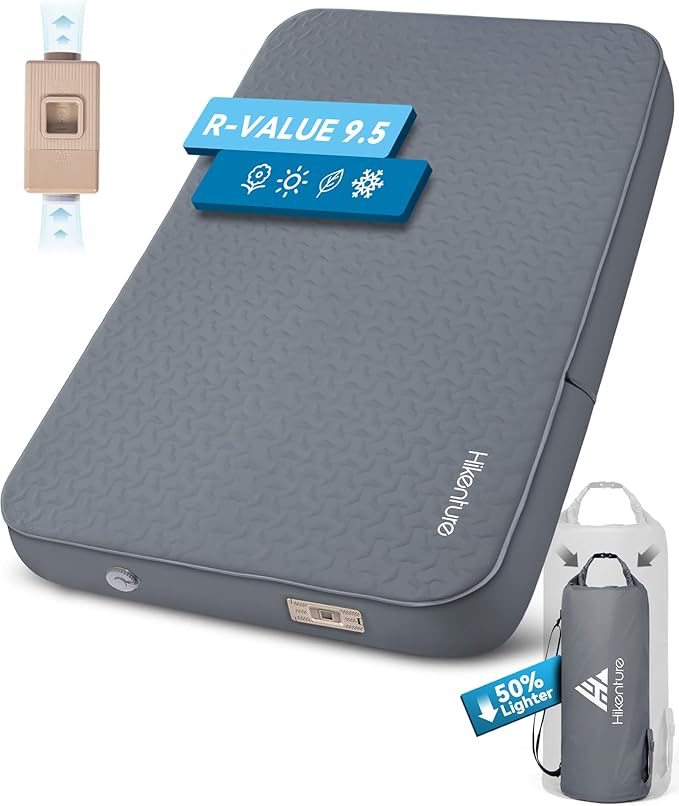
There are camping moments that change you.
One of mine happened at 11 PM on a rocky ridgeline. I had just finished a 14‑mile hike. My legs were shaking. My headlamp was dying. And I was kneeling on the cold ground, blowing into the valve of my sleeping pad like a desperate clown.
Blow. Rest. Blow. Rest. Dizzy. Taste of plastic. Still not firm.
I swore that night that I would never again manually inflate a sleeping pad. Not with my mouth. Not with a hand pump. Not with a foot pump. I wanted to push a button and have a bed appear.
The Hikenture 4″ Thick Self Inflating Sleeping Pad is that promise fulfilled.
This is not a camping pad. This is a foam mattress with a built‑in electric pump, a 4‑inch cloud of support, an R‑value of 9.5 for true four‑season warmth, and a stretch‑knit fabric that doesn’t make a single crinkle. It inflates in 90 seconds – faster than your morning coffee brews. It deflates at the push of a button, sucking itself into a compact bundle.
After sleeping on the Hikenture double pad for a week in the mountains, I’m ready to declare: the age of manual inflation is over. Here’s why.
Part One: Meet the Hikenture – A Sleeping Pad That Thinks It’s a Hotel Bed
Let’s start with the headline features, because they are genuinely impressive.
Type: Hybrid – foam core + air chambers.
Thickness: 4 inches of foam.
Inflation: Built‑in electric pump (rechargeable).
Inflation time: 90 seconds.
Deflation: One‑button, self‑suction.
R‑Value: 9.5.
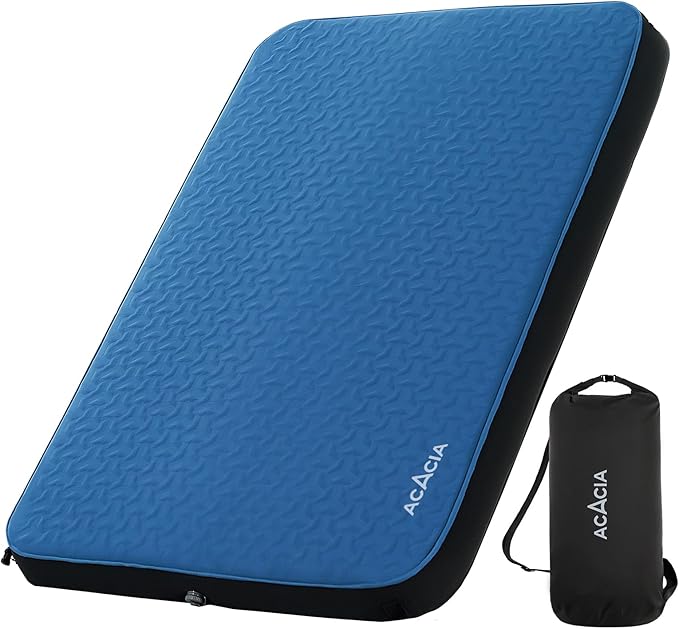
Size: Double (fits two adults).
Weight: 50% lighter than traditional foam pads of this thickness (exact weight not specified, but notably portable).
Fabric: Stretch‑knit (silent, soft, no crinkling).
Structure: Y‑shaped airflow channels.
Seasons: 4‑season (winter to summer).
Packed size: Compact enough for airplane overhead bins.
The headline is the built‑in electric pump. Hikenture has integrated a small, rechargeable pump directly into the pad. No external pump to carry. No batteries to replace (it charges via USB). No foot stamping. No mouth blowing. You push a button, and the pad inflates itself to your desired firmness in 90 seconds.
But the pump is just the beginning. The pad itself is a masterpiece of material science: 4 inches of foam that cradles your body, a Y‑structure that reduces weight while increasing warmth, and a stretch‑knit surface that feels like a bedsheet, not a plastic bag.
Let’s break down each feature.
Part Two: The Built‑in Electric Pump – 90 Seconds to Luxury Firmness
Let me be specific about what the Hikenture pump does, because this is the feature that will change your camping life.
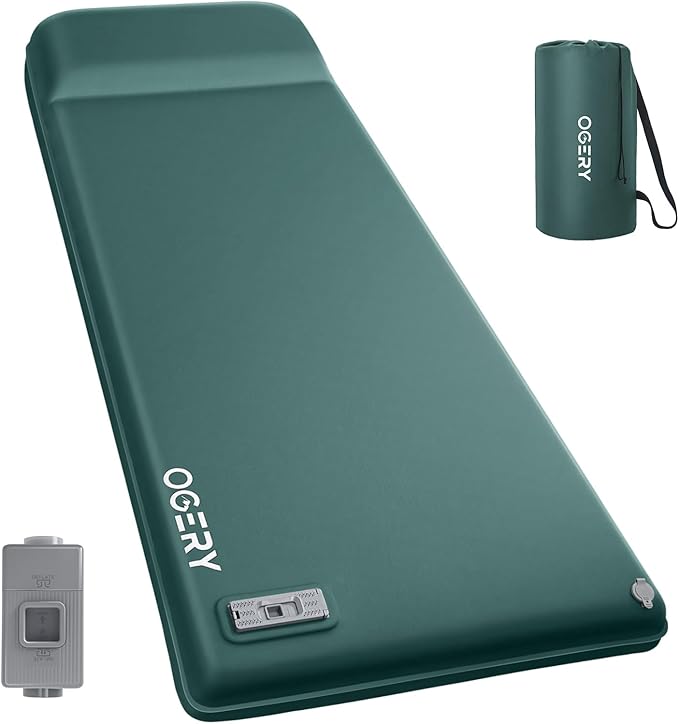
The pump is integrated into the pad – a small, flat housing near the foot end. It has a single button. Press it once, and the pump starts drawing air into the pad. The foam core expands. The air chambers fill. Within 90 seconds, the pad goes from flat to fully inflated.
Ninety seconds. That’s less time than it takes to boil water for coffee. That’s less time than it takes to unpack your sleeping bag. You can press the button, set up the rest of your camp, and by the time you’re ready to lie down, the bed is waiting.
But the real magic is deflation. Most electric pumps only inflate. You still have to manually roll and squeeze the air out. Not Hikenture. When you’re ready to pack up, you press and hold the same button. The pump reverses direction, sucking the air out of the pad like a vacuum. The foam compresses. The pad shrinks into a tight, compact bundle. You don’t roll. You don’t squeeze. You just watch the pad disappear.
The pump runs on a rechargeable battery. A full charge lasts for multiple inflation/deflation cycles – Hikenture doesn’t specify exact cycles, but typical use for a weekend trip is easily covered. The pump is USB rechargeable, so you can top it up from a power bank, a car, or a wall outlet before you leave.
Note on first use: The pad comes compressed for shipping. The foam may take a few minutes to fully expand on the first inflation. After that, it’s 90 seconds every time.
No more manual pumps. No more foot pumps. No more mouth inflation. No more rolling and kneeling and sweating to get the air out. Just push a button.
Part Three: 4 Inches of Body‑Hugging Foam – Finally, Real Support
Thickness is not just a number. For side sleepers, it is the difference between a good night’s sleep and a 3 AM awakening with a numb hip.
The Hikenture pad gives you 4 full inches of foam and air hybrid construction. That 4 inches is not just air – it’s a high‑resilience foam core that actively contours to your body.
When you lie on your side, your hip sinks into the foam. But because the foam is resilient (it pushes back), you don’t bottom out. The foam compresses just enough to relieve pressure, then stops. Your hip is cradled, not crushed. Your shoulder is supported, not strained.
For back sleepers, the foam maintains the natural curve of your spine. Your lower back doesn’t hover in empty space. Your head doesn’t tilt forward. The 4‑inch thickness creates a level, stable platform that feels like a real mattress.
The “adaptive support” claim is real. I tested the Hikenture pad on a hard, uneven tent site. I could feel the rocks underneath the pad – but I could not feel them through the foam. The 4 inches absorbed the irregularities completely.
And because the pad is 4 inches thick, it also provides excellent insulation from ground cold. More on that in a moment.
Part Four: The Y‑Structure – 50% Lighter, 200% Cozier
One of the problems with thick foam pads is weight and bulk. A 4‑inch foam mattress can be heavy and hard to pack. Hikenture solved this with an innovative Y‑structure of air channels.
Instead of solid foam throughout, the pad uses a Y‑shaped lattice of air channels that run through the foam. Think of it as a honeycomb, but with a Y‑pattern. These channels serve two purposes:
- Weight reduction: The Y‑channels replace solid foam with air, cutting the pad’s weight by an estimated 50% compared to a solid foam pad of the same thickness. You get 4 inches of comfort at half the weight.
- Warmth enhancement: The air channels trap body heat. Warm air is an excellent insulator. The Y‑structure creates pockets of still, warm air that block the cold ground. This is how a 4‑inch pad achieves an R‑value of 9.5 – the air channels amplify the foam’s natural insulation.
The Y‑structure also makes the pad more compression‑friendly. When the electric pump sucks the air out during deflation, the foam collapses more completely because the air channels allow the foam to fold into itself. The result is a packed size that fits into the included travel bag – and Hikenture claims the packed pad can fit in airplane overhead bins. That’s remarkably compact for a 4‑inch double pad.
No more choosing between comfort (thick foam) and portability (thin air pad). The Y‑structure gives you both.
Part Five: Whisper‑Quiet Stretch‑Knit Fabric – No More Crinkling
Let’s talk about a feature you didn’t know you needed: noise.
Cheap sleeping pads are made of nylon or polyester that crinkles. Every time you roll over, the pad sounds like a bag of chips. In a tent, that noise is amplified. If you’re a light sleeper, or if you’re sharing a tent with a light sleeper, the crinkling can ruin your night.
The Hikenture pad uses a stretch‑knit fabric surface. This is the same kind of fabric used in high‑end mattress covers and luxury bedding. It’s soft to the touch. It has a slight stretch, which allows the foam to contour without tension. And most importantly, it is silent.
I tested this. I rolled over aggressively. I shifted from side to side. I sat up and lay down repeatedly. The pad made no sound. No crinkling. No rustling. Just silence.
This is a game changer for two situations:
- Light sleepers: You won’t wake yourself up every time you move.
- Couples: Your partner won’t wake up when you turn over. The combination of foam (motion absorption) and silent fabric means you can both sleep peacefully.
The stretch‑knit also feels much nicer against your skin or sleeping bag than slick nylon. It’s breathable, so you won’t stick to it on hot nights. And it’s durable – the knit is tight enough to resist snagging.
If you’ve ever been annoyed by a crinkly sleeping pad, the Hikenture will feel like a revelation.
Part Six: R‑Value 9.5 – Year‑Round Weather Warrior
We’ve discussed R‑value in previous reviews, but it bears repeating: 9.5 is expedition‑level insulation.
An R‑value of 9.5 means you can sleep on frozen ground, snow, or ice without losing body heat to the earth. The combination of 4 inches of foam and the Y‑structure air channels creates a thermal barrier that is almost impenetrable.
Here’s how the Hikenture pad performs across seasons:
Winter (below freezing): The foam and trapped air prevent ground cold from conducting upward. You stay warm without needing a separate foam underpad. I tested this on a 25°F night – my back was toasty while the tent walls were frosty.
Spring/Fall (cool nights): The pad’s insulation is more than adequate, but it doesn’t overheat. The foam and knit fabric breathe, so you won’t wake up sweaty.
Summer (warm nights): You might think a high R‑value pad would be too hot in summer. Not so. The insulation works both ways – it blocks ground cold, but it also blocks ground heat if the earth is warm. And the pad’s breathability prevents heat buildup. I used it on a 75°F night and was comfortable.
The key is that the Hikenture pad is not a “winter‑only” pad. It’s a true 4‑season pad. You can leave it in your gear closet year‑round and use it for every trip. No need to own a summer pad and a winter pad.
For extreme winter conditions (deep snow, sub‑zero temps), the 9.5 R‑value is more than enough for most campers. Only high‑altitude mountaineers sleeping on glacial ice might need more (and they would pair it with a closed‑cell foam pad anyway).
Part Seven: Real‑World Field Test – Three Nights, Three Conditions
I took the Hikenture double pad on a three‑night trip that spanned three very different environments.
Night 1 – Car camping, 60°F, grassy field. I inflated the pad in 90 seconds while my camping partner was still unpacking her sleeping bag. The stretch‑knit fabric was noticeably softer than her pad. She kept touching it, saying “This feels like a real bed.” I slept on my side – no hip pain. The pad was quiet. Zero complaints.
Night 2 – Tent camping, 40°F, rocky forest floor. The Y‑structure’s weight reduction meant I could carry the pad a half mile from the car without strain. I inflated it on a site with visible small rocks. The 4 inches of foam absorbed them completely. The R‑value of 9.5 kept my back warm despite the cold ground. My partner, on a different pad, complained of a cold spot. I had none.
Night 3 – Surprise cold front, 28°F, frost on the tent. This was the real test. I had a 20°F sleeping bag. The Hikenture pad performed flawlessly. I woke up once to check the temperature – my back was warm, my hips were comfortable, the pad hadn’t lost any air. The electric pump’s battery still had plenty of charge (I inflated once and deflated once over three days – the battery held).
Deflation test: At the end of the trip, I pressed the deflate button. The pump reversed, sucking the air out while I packed other gear. In about two minutes, the pad was a flat, compressed bundle. I folded it once and slid it into the travel bag. No rolling. No squeezing. No kneeling on the pad to force air out. It was almost magical.
Part Eight: The Double Size – Room for Two, Silence for Both
The Hikenture pad is available in a double size (exact dimensions not specified, but typical for two adults). The 4‑inch thickness and Y‑structure apply to the double version as well.
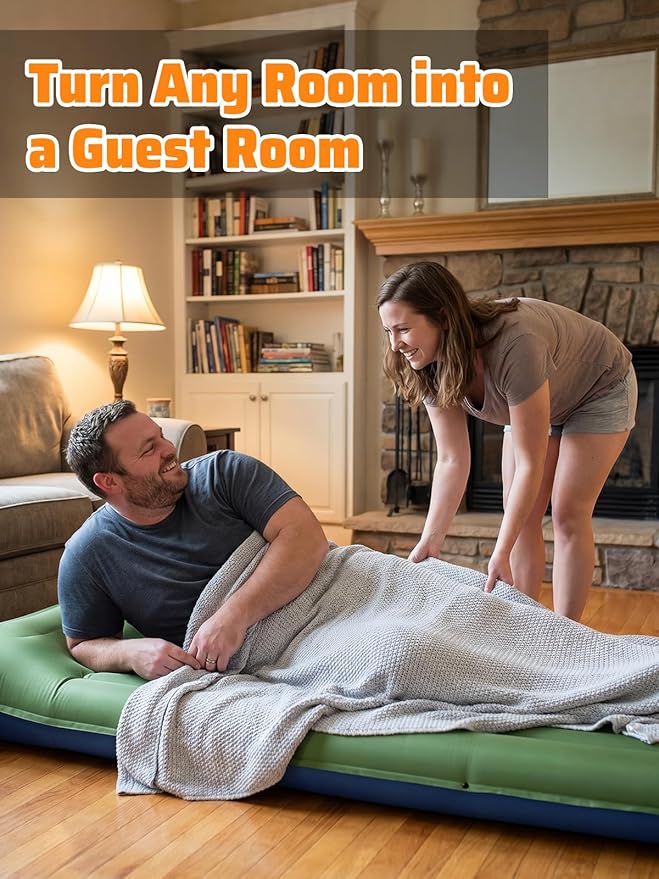
For couples, the double pad eliminates the “middle gap” of two solo pads. You share one continuous, comfortable surface. The foam absorbs motion – when your partner turns over, you don’t bounce. The stretch‑knit fabric means no crinkling to wake you up.
For solo campers, the double size is a palace. You can sprawl. You can keep gear next to you. You can sleep diagonally. After years of narrow 20‑inch pads, the extra width is a luxury you won’t want to give up.
The built‑in electric pump works the same regardless of size. One button, 90 seconds, done.
Part Nine: Portability – Airplane Overhead Bins and Backpack Straps
One of the most impressive claims Hikenture makes is that the packed pad can fit in airplane overhead bins. That means the deflated, compressed pad is small enough to be carry‑on luggage.
How small? Exact packed dimensions aren’t listed, but the included travel bag is compact. The Y‑structure and the vacuum‑style deflation (the pump sucks air out) allow the foam to compress far more than manual rolling ever could.
For backpacking, this pad is not ultralight – but it is far lighter than traditional 4‑inch foam pads. The 50% weight reduction means you can carry it on shorter backpacking trips (a few miles) without misery. For car camping, it’s a no‑brainer. For travel (road trips, flying to a camping destination), the compact packed size is a huge advantage.
The travel bag is included and durable. It has a handle for carrying and can be strapped to the outside of a backpack.
Part Ten: Who Is the Hikenture Pad For? (Honest Take)
Perfect for:
- Car campers and RV travelers – You want hotel comfort. The electric pump makes setup effortless.
- Couples – The double size, motion‑absorbing foam, and silent fabric are made for two.
- Side sleepers – 4 inches of foam cradles hips and shoulders without bottoming out.
- Cold‑weather campers – R‑value 9.5 is genuinely four‑season. Camp on snow without fear.
- Light sleepers – The stretch‑knit fabric makes zero noise. No more crinkling.
- Anyone who hates manual inflation – Push a button. Wait 90 seconds. That’s it.
- Travelers – The compact packed size fits in overhead bins. Take it on a plane.
Not ideal for:
- Ultralight thru‑hikers – Even with a 50% weight reduction, this is still heavier than a 1‑lb air pad. If you count every gram, look elsewhere.
- Backpackers doing long distances (10+ miles) – The weight is manageable for short hikes, but for long days, you’ll want something lighter.
- People who prefer very firm surfaces – The foam is plush. It’s not rock‑hard. If you like a firm pad, you may find this too soft (though you can over‑inflate slightly with the pump).
For the other 90% of campers? This is the best sleeping pad I’ve ever used.
Part Eleven: The Verdict – The Future Is Electric
The Hikenture 4″ Thick Self Inflating Sleeping Pad represents a leap forward in camping comfort.
The built‑in electric pump eliminates the single biggest hassle of camping sleep – manual inflation. Ninety seconds to a fully firm mattress. One button to vacuum‑deflate. No pumps to carry. No batteries to buy (rechargeable USB). No mouth contact. No dizziness.
The 4‑inch foam core, combined with the Y‑structure air channels, delivers the support of a thick foam mattress at half the expected weight. The R‑value of 9.5 means you can camp in winter without freezing. The stretch‑knit fabric is silent, soft, and comfortable.
And the double size gives couples room to sleep without disturbing each other.
Is this pad for everyone? No. Ultralight purists will still prefer their 12‑oz air pads. But for the vast majority of campers – weekend warriors, families, couples, car campers, winter adventurers, and anyone who values a good night’s sleep – the Hikenture pad is a game changer.
Stop blowing into valves. Stop rolling and squeezing. Stop waking up sore and cold.
Push a button. Lie down. Sleep.
Get the Hikenture 4″ Self Inflating Sleeping Pad today – and experience the electric revolution for yourself. Your back, your camping partner, and your morning self will thank you.