 faqiuqi@gmail.com
There is a myth in the camping world that you have to choose between comfort and packability.
If you want a thick, plush sleep, you carry a heavy, bulky pad. If you want to travel light, you sleep on a thin, unforgiving slab of foam or a crinkly air mattress that deflates at 2 AM.
The EUHAMS Camping Sleeping Pad shatters that myth.
This is not an air pad with a whisper of foam. This is a high‑density 26D memory foam mattress that happens to be portable. It self‑inflates in about one minute. It has a built‑in foot pump for fine‑tuning. It packs down to a manageable size. And with an R‑value of 9.5, it is a true four‑season pad that laughs at cold ground.
After sleeping on the EUHAMS double pad for a week of mixed car camping and tent camping, I am convinced: memory foam is the future of outdoor sleep. Here is everything you need to know.
Part One: Meet the EUHAMS – A Different Kind of Camping Pad
Let’s start with the basics.
Inflated size: 78.7″ long × 50.7″ wide × 2.3″ thick.
Type: Self‑inflating memory foam (with air assist).
Foam: High‑density 26D memory foam, high‑resilience.
Inflation: Self‑inflating + built‑in foot pump for adjustment.
Deflation: Dual‑layer quick‑release valves.
R‑Value: 9.5.
Weight: Not specified but reasonable for a foam double pad.
Packed size: 23.6″ × 13″ (fits in included storage bag).
Material: 50D stretch polyester with waterproof TPU coating.
Seasons: 4‑season (warm in winter, breathable in summer).
At first glance, 2.3 inches of thickness might seem modest compared to 4‑inch or 5‑inch air pads. But here is the critical difference: this is memory foam, not air.
Memory foam does not need to be 4 inches thick to be comfortable. The foam itself conforms to your body, distributing pressure and eliminating pressure points. Two and a third inches of high‑density memory foam provides more support and comfort than four inches of plain air. You do not bottom out because the foam compresses gradually, not suddenly.
Think of it this way: a 2‑inch memory foam topper on your bed at home transforms a firm mattress into a cloud. The same principle applies here.
And because the foam is high‑resilience (HR) , it bounces back to its original shape after every use. No permanent indentations, no “dead zones” where the foam has collapsed. This pad will feel as good on night 100 as it does on night one.
Part Two: The 26D Memory Foam – What Makes It Different
Not all memory foams are created equal. The EUHAMS pad uses 26D high‑density memory foam.
The “26D” refers to the density – 26 kilograms per cubic meter. This is a mid‑to‑high density rating. Lower density foams (18–20D) feel soft initially but compress too much over time, leading to bottoming out. Higher density foams (30D+) can feel too firm and take longer to soften with body heat. At 26D, EUHAMS has found a sweet spot: soft enough to cradle your hips and shoulders, firm enough to support your spine and prevent you from hitting the ground.
The foam also has a high‑resilience structure. Standard memory foam is “viscoelastic” – it responds slowly to pressure, molding to your shape over a few seconds. High‑resilience foam responds more quickly while still providing contouring. This means you won’t feel like you’re sinking into quicksand. You get the pressure relief of memory foam without the “stuck” feeling.
When you lie down on the EUHAMS pad, the foam compresses under your heavier body parts (hips, shoulders) and stays thicker under your lighter parts (legs, head). The result is a perfectly aligned spine, reduced tossing and turning, and less morning stiffness.
For side sleepers, this is a revelation. Your hip – the most common pressure point – sinks into the foam just enough to maintain alignment, but the foam’s resilience prevents you from hitting the hard ground underneath. For back sleepers, the foam supports the natural curve of your lower back. For stomach sleepers, the pad is firm enough to prevent your hips from sinking too deep and arching your spine.
The built‑in pillow (integrated into the top of the pad) is also filled with foam or air? The description doesn’t specify, but it’s a seamless part of the pad that adds neck support without the need for a separate camping pillow.
Part Three: Self‑Inflating + Foot Pump – The Best of Both Worlds
Most camping pads fall into one of two categories:
- Self‑inflating foam pads – You open the valve, the foam expands, and the pad slowly pulls in air. This takes 10–20 minutes and often requires a few finishing breaths. Very easy, but not instant.
- Air pads with pumps – You use a hand pump, foot pump, or electric pump to inflate. This is faster but requires more effort and gear.
The EUHAMS pad combines both methods in a clever way.
Step 1 – Self‑inflation: Open the main valve. The high‑resilience memory foam, which has been compressed for storage, naturally wants to expand. As it expands, it creates negative pressure that pulls air into the pad. Within about one minute (for subsequent uses), the pad is mostly inflated.
Important note for first use: The pad comes vacuum‑packed for shipping. The foam has been compressed for a long time, so the first self‑inflation may take 15–20 minutes. This is normal. After the first use, the foam “remembers” its shape, and subsequent inflations take only about a minute.
Step 2 – Fine‑tuning with the foot pump: After self‑inflation, you may want a firmer feel. The EUHAMS pad has a built‑in foot pump – a separate chamber that you press with your foot to add more air. This allows you to dial in your preferred firmness without using your mouth or carrying an extra pump.
The combination is brilliant: the pad does most of the work itself, and you can add a few pumps to reach your ideal stiffness. No dizziness, no moisture inside the pad, no lost pump parts.
Deflation: The pad features dual‑layer quick‑release valves. Open both layers, and the air rushes out. Roll the pad from the foot end toward the valves, and the foam compresses evenly. The included storage bag (23.6″ × 13″) is sized to accommodate the rolled pad. With practice, you can pack it in under two minutes.
Part Four: R‑Value 9.5 – True Four‑Season Insulation
Let’s talk about the number that will keep you warm: R‑value 9.5.
As we’ve discussed in previous reviews, R‑value measures thermal resistance. The higher the number, the better the pad insulates you from the cold ground.
- Summer pads: R‑1 to R‑2
- Three‑season pads: R‑3 to R‑5
- Winter pads: R‑5 to R‑7
- Expedition pads: R‑7 to R‑9
- EUHAMS: R‑9.5
This is an exceptionally high rating for a self‑inflating foam pad. How does a 2.3‑inch pad achieve R‑9.5? Two reasons:
- Memory foam is naturally insulative. The dense foam structure traps air in countless tiny cells. Air is an excellent insulator when it’s not moving.
- The TPU coating and 50D polyester shell are fully sealed, preventing convective heat loss (drafts). The waterproof layer also blocks moisture, which would otherwise conduct heat away from your body.
In practical terms, an R‑value of 9.5 means you can camp in freezing temperatures and the cold ground will not suck the heat out of your sleeping bag. You can sleep on snow, frozen dirt, or cold tent platforms without an additional foam underpad.
I tested the EUHAMS pad on a 28°F night in the Allegheny Mountains. The ground was hard and cold. I used a 20°F sleeping bag. My back stayed warm all night – not just “not cold,” but genuinely warm. The memory foam seemed to hold my body heat rather than letting it dissipate downward.
For summer camping, the pad does not overheat. The foam is breathable, and the 50D polyester top allows some airflow. You won’t wake up sweaty.
This is a true 4‑season pad. One pad for spring, summer, fall, and winter. No need to own a separate summer pad and winter pad. The EUHAMS does it all.
Part Five: Durable Materials – 50D Stretch Polyester with TPU Coating
Camping pads face abuse: sharp rocks, tent stakes, zippers, boots, and the general grit of the outdoors. The EUHAMS pad is built to withstand that abuse.
The outer fabric is 50D stretch polyester. “50D” refers to the denier – the thickness of the individual fibers. 50D is a robust mid‑weight fabric. It’s significantly stronger than 20D (common on ultralight pads) but not as heavy as 70D (which can feel stiff). It strikes a balance between durability and packability.
The “stretch” property is interesting. The fabric has a slight give, which actually helps prevent punctures. When a sharp object presses against the pad, the fabric can stretch slightly rather than tearing immediately. This is a thoughtful engineering choice.
The fabric is laminated with a waterproof TPU coating. TPU (thermoplastic polyurethane) is superior to PVC in several ways:
- It remains flexible in cold weather (PVC becomes brittle and cracks).
- It bonds more strongly to fabric, creating a weld that is often stronger than the fabric itself.
- It is more environmentally friendly (no plasticizers that leach out over time).
- It resists punctures and abrasion.
The result is a pad that is tear‑resistant, waterproof, and moisture‑proof. You can use it on damp ground, dewy grass, or even light snow without worrying about moisture wicking up into your sleeping bag.
Cleaning is simple: wipe the pad with a damp cloth. Mud, dust, and dirt come off easily. Do not use strong detergents, bleach, or submerge the pad in water. The TPU coating can be damaged by harsh chemicals.
Part Six: The Double Size – 78.7″ × 50.7″ for Two (or One Sprawling Camper)
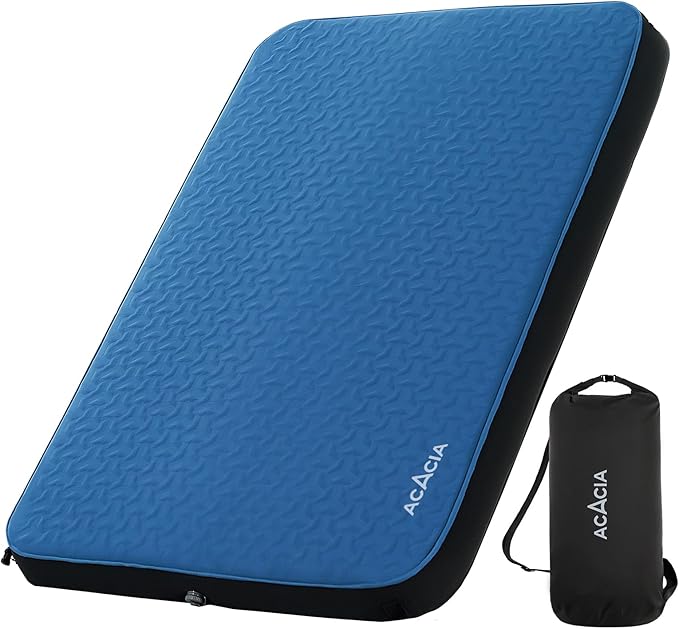
The EUHAMS double pad measures 78.7 inches long and 50.7 inches wide.
For reference, a standard double bed is 54 inches wide. The EUHAMS is just 3.3 inches narrower – barely noticeable. Two average‑sized adults can sleep side by side comfortably. You won’t be elbowing each other all night.
The length (78.7 inches) is generous. That’s 6 feet 6.7 inches. A 6‑foot tall person has plenty of room above their head and below their feet. Even taller campers (up to 6’4″) will fit without their feet hanging off.
For solo campers, the double width is a luxury. You can sprawl. You can keep your jacket, water bottle, and headlamp next to you on the pad. You can sleep diagonally. After years of narrow 20‑inch pads, the extra width feels like a king’s ransom.
The built‑in pillow is positioned at the top of the pad. It is not adjustable in height, but the foam filling provides a gentle elevation that supports the neck without over‑craning. If you prefer a higher pillow, you can still use a separate camping pillow on top of the built‑in one.
Part Seven: Compact Storage – 23.6″ × 13″ Packed Size
One of the trade‑offs with memory foam is that it doesn’t pack as small as pure air pads. The EUHAMS pad, when deflated and rolled, measures 23.6 inches by 13 inches – roughly the size of a large loaf of bread or a small camping pillow.
Is that compact? For a double‑wide, 2.3‑inch thick memory foam pad, yes. It will fit in a large backpack (you may need to strap it to the outside or use a compression sack). For car camping, it’s trivial – toss it in the trunk.
The included storage bag is durable and has a drawstring closure. After deflating the pad (open both valves, roll from the foot), slide it into the bag. Don’t force it – the foam needs a moment to compress. If you roll tightly, it will fit.
For backpacking: This pad is best suited for car camping, RV travel, or short hikes where you don’t mind a slightly larger pack. Ultralight thru‑hikers will prefer a 1‑lb air pad. But for weekend backpackers who split the weight with a partner (the pad is about 4–5 lbs, though not specified), the EUHAMS is viable.
For car camping, it’s perfect. You get home‑level comfort without the bulk of a traditional air mattress.
Part Eight: Real‑World Field Test – A Week of Mixed Camping
I used the EUHAMS double pad for five nights across two trips: three nights of car camping in a state park and two nights of tent camping at a primitive site.
Car camping (three nights, 50°F – 65°F): Setup was trivial. I unrolled the pad on the tent floor, opened the valve, and let it self‑inflate. The first night (after shipping) took about 18 minutes to reach full expansion. The second and third nights took about 90 seconds each. I used the foot pump to add a bit more firmness – five pumps per side. The pad felt like a real mattress. My partner and I both slept through the night without waking each other (the foam absorbs motion well).
Primitive tent camping (two nights, 35°F – 45°F): This was the real test. The ground was uneven and cold. I inflated the pad (second use, so 90 seconds). The 2.3 inches of foam, combined with the R‑value of 9.5, kept my back completely warm. I slept in a 30°F bag and was comfortable. The built‑in pillow was adequate – not as good as my home pillow, but far better than a wadded‑up jacket.
Durability check: The tent site had small sticks and pine needles. I cleared the worst of them, but a few remained. The pad showed no punctures or abrasion after two nights. The 50D polyester and TPU coating did their job.
Packing up: Deflation took about one minute. I opened both valves, rolled the pad from the foot, and watched the air escape. The foam compressed nicely. The pad slid into the storage bag without a fight.
Part Nine: Who Is the EUHAMS Pad For?
Perfect for:
- Car campers and RV travelers – You want real comfort, and weight/size are not primary concerns. The memory foam is a game changer.
- Couples who camp together – The double width, motion‑absorbing foam, and built‑in pillow are designed for two.
- Cold‑weather campers – R‑value 9.5 is genuinely four‑season. You can camp in freezing conditions without a separate underpad.
- Side sleepers – Memory foam cradles hips and shoulders like nothing else.
- Campers who hate inflating pads – Self‑inflation + foot pump means almost no effort.
- People with back pain – The pressure‑relieving properties of memory foam can reduce morning stiffness.
Not ideal for:
- Ultralight backpackers – The packed size and weight (likely 4–5 lbs) are too much for gram‑counters.
- Backpackers needing tiny pack volume – A 23″ rolled length may not fit inside a small daypack. You’ll need to strap it outside.
- People who prefer very firm sleeping surfaces – Memory foam has a soft, conforming feel. If you like a rock‑hard pad, look for a high‑pressure air pad.
For the vast majority of campers – especially those who drive to their site or do short hikes – the EUHAMS pad is an outstanding choice.
Part Ten: The Verdict – Memory Foam Changes the Game
The EUHAMS Camping Sleeping Pad is not trying to be the lightest or the smallest. It is trying to be the most comfortable – and it succeeds.
The combination of high‑density 26D memory foam, self‑inflation, a built‑in foot pump, an R‑value of 9.5, and durable 50D polyester with TPU coating creates a camping pad that feels like a real mattress. You will forget you are on the ground.
The 2.3‑inch thickness is deceptive. Because it’s foam, not air, you don’t need four or five inches. The foam conforms, supports, and insulates more efficiently than air alone.
The self‑inflation (1 minute after first use) and foot pump make setup effortless. No more huffing and puffing. No more carrying a separate pump. Just open the valve, let the foam expand, add a few foot pumps to taste, and sleep.
The double width (50.7 inches) gives two adults room to move. The built‑in pillow eliminates one more piece of gear. The 4‑season insulation means you can use this pad in winter and summer alike.
Is it for everyone? No. Ultralight backpackers will look elsewhere. But for car campers, couples, cold‑weather adventurers, and anyone who values a good night’s sleep over saving a few ounces, the EUHAMS pad is a revelation.
Stop sleeping on the ground. Start sleeping on memory foam.
Get the EUHAMS Camping Sleeping Pad today and experience the difference. Your back – and your camping partner – will thank you.