 faqiuqi@gmail.com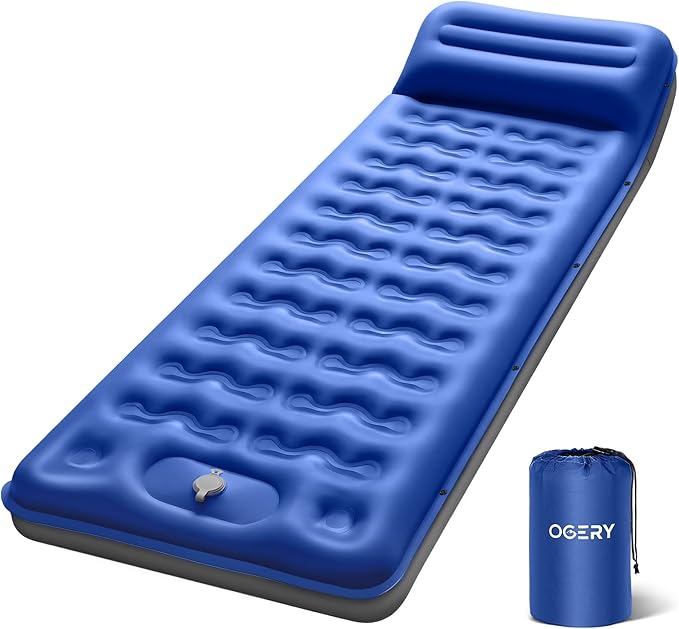
There is a quiet lie that backpackers tell each other. It goes like this: “You get used to sleeping on the ground.”
But do you really? Or do you simply learn to tolerate sore hips, a stiff neck, and the kind of restless half-sleep that leaves you less recovered in the morning than when you laid down? For years, the ultralight community has worshipped at the altar of ounces, shaving weight by any means necessary—even if it meant sleeping on a pad the thickness of a yoga mat.
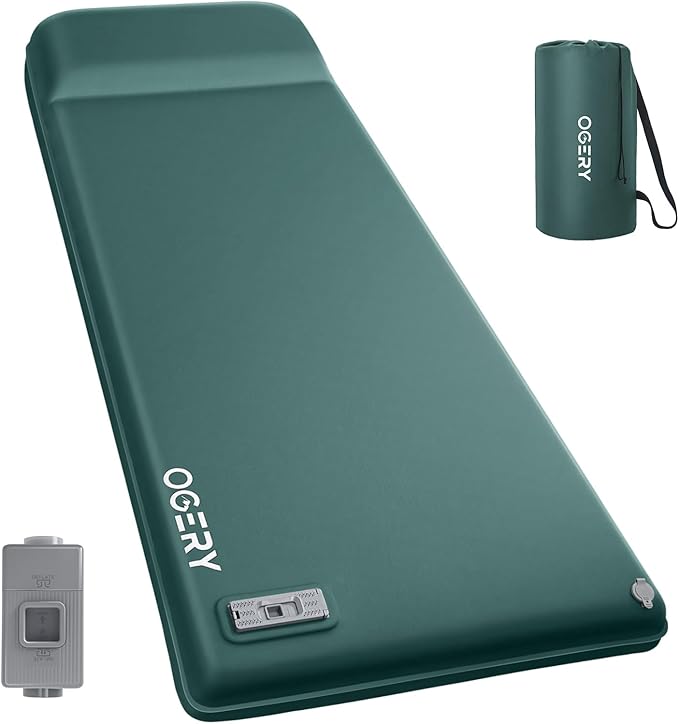
But what if you didn’t have to choose? What if you could carry a pad that weighs just 2.4 pounds, packs down to the size of a water bottle, yet inflates to a staggering 6 inches thick—complete with a built-in pillow and a foot pump that requires no lung power, no batteries, and no curses muttered into the dark?
That is not a fantasy. That is the OGERY Ultralight Inflatable Sleeping Pad. And it is quietly rewriting the rules of what backpacking sleep can feel like.
Part One: Six Inches of Separation Between You and the Ground

Let us start with the number that will change your camping life: 6 inches.
Most backpacking pads are 2.5 to 3.5 inches thick. Some “luxury” models reach 4 inches. The OGERY pad gives you a full half-foot of air-supported loft. Inflated dimensions are 79 inches long by 27.5 inches wide by 6 inches high. That is longer than most campers need, wide enough to toss and turn without falling off, and thick enough to completely eliminate any sensation of the ground beneath you.
Why does thickness matter so much? Because pressure points are the enemy of sleep. When you lie on a thin pad, your shoulder blades and hip bones press downward, compressing the pad until they meet the hard earth. The result is pain, numbness, and constant tossing. A 6-inch pad provides so much vertical clearance that even the most prominent bony landmarks float comfortably above the ground.
For side sleepers, this is nothing short of revolutionary. Side sleeping requires approximately twice the thickness of back sleeping because your body weight concentrates on a smaller surface area. On a standard 2.5-inch pad, side sleepers often wake up with bruised hips. On the OGERY 6-inch pad, your hip sinks into a deep pocket of air, supported from below, with no ground contact whatsoever.
The built-in pillow adds another layer of ergonomic intelligence. It is not a separate accessory that shifts around during the night. It is an integrated chamber at the head of the pad, slightly elevated, designed to support the natural curve of your cervical spine. For back sleepers, this means reduced neck strain. For side sleepers, it fills the gap between your shoulder and your head, keeping your spine aligned. The result is a sleep system that actively works to prevent the stiffness and soreness that typically follow a night in the tent.
Part Two: The Genius of the Built-in Foot Pump
Now let us address the second-greatest frustration of camping sleep: inflation.
If you have ever used a traditional inflatable pad, you know the ritual. You unroll the pad. You open the valve. You begin blowing. Thirty seconds later, you are lightheaded. Two minutes later, your lungs ache. And the pad is still only half full. Then you discover a slow leak because the valve wasn’t fully seated. Then you blow some more. By the time you are done, your camping neighbors have probably called search and rescue because they heard strange wheezing sounds coming from your tent.
OGERY has eliminated this entire performance with a built-in foot pump. The pump is integrated into the foot of the pad, requiring no separate device, no batteries, no electricity, and no lung power. Here is how it works:
You unroll the pad on your tent floor. You open the dual-layer air valve. Then you simply step on the pump—repeatedly, with your foot—and watch the pad rise. Each step pushes a volume of air into the main chamber. The dual-layer valve ensures that air flows in efficiently and cannot escape backward. Within a few minutes of casual stepping (while you organize your sleeping bag or sort your gear), the pad reaches full inflation.
The foot pump has two enormous advantages over manual blowing. First, it saves your lungs for activities that matter—like breathing at high altitude or singing campfire songs. Second, it is completely weather-independent. Electric pumps fail when batteries die. Manual pumps get lost. Your foot is always with you, always functional, and never needs recharging.
The dual-layer air valves deserve special mention. Many inflatable pads suffer from cheap, single-layer valves that leak air slowly over the course of the night. You wake up at 3 AM lying on a half-deflated pad, groggy and annoyed. OGERY’s dual-layer design creates a redundant seal. The first layer prevents backflow during inflation. The second layer locks everything in place once you close the valve. The result is a pad that stays firm from dusk until dawn.
Deflation is equally simple. Open both layers of the valve, and the pad collapses instantly. Roll it up from the foot toward the head, pressing out any remaining air, and you are ready to pack.
Part Three: Ultralight Meets Ultra-Thick – The Impossible Trade-Off Solved
Here is where the OGERY pad performs something close to magic. At first glance, a 6-inch thick pad that measures nearly 80 inches long and 27 inches wide should be heavy and bulky. Basic physics suggests that air takes up space, and space requires material, and material weighs something.
Yet the OGERY pad weighs only 2.4 pounds. That is lighter than many 3-inch backpacking pads on the market. To put it in perspective, a standard NEMO Tensor Insulated pad (3 inches thick) weighs around 1.5 pounds for a regular mummy shape—but it is narrower, shorter, and lacks a built-in pillow or foot pump. A Therm-a-Rest MondoKing (4.25 inches thick) weighs over 4 pounds. The OGERY gives you 6 inches of loft for less weight than most 3-inch pads.
The packed size is equally astonishing. When deflated and rolled, the pad compresses to 5.9 inches by 5.9 inches by 11 inches—roughly the size of a one-liter water bottle or a small cantaloupe. You can slide it into a backpack’s side pocket, strap it to the outside of your pack, or bury it inside your main compartment without sacrificing space for food, clothing, or cooking gear.
How does OGERY achieve this? Through careful material selection and structural engineering. The pad uses 50D polyester fabric—lightweight yet strong—with a TPU waterproof coating. TPU (thermoplastic polyurethane) is lighter and more flexible than PVC, while offering superior puncture resistance and cold-temperature performance. The internal drop-stitch construction allows the pad to maintain its 6-inch profile without requiring heavy, bulky materials. Thousands of tiny polyester threads connect the top and bottom layers, keeping them parallel under pressure. This is the same technology used in stand-up paddleboards and high-end air mattresses, but OGERY has scaled it down for backpacking.
The result is a pad that defies expectations. It is light enough for a multi-day hike. It is compact enough for ultralight gram-counters. And it is thick enough to make you forget you are sleeping on the ground.
Part Four: Durability That Matches the Outdoors
Lightweight gear often comes with a catch: it is fragile. Save weight on fabric, and you risk punctures from a stray pinecone. Save weight on coatings, and you risk delamination after a few uses. The OGERY pad rejects this compromise.
The 50D polyester outer fabric strikes an ideal balance between weight and toughness. For context, backpacking pads often use 20D or 30D fabrics, which feel silky but tear relatively easily. Heavier car-camping pads use 75D or 100D, which are bombproof but heavy. The 50D rating sits in the sweet spot: strong enough to withstand gravel tent pads, tent floor debris, and the occasional dog claw, yet light enough to justify its place in your pack.
The TPU waterproof coating adds a second layer of protection. TPU is inherently more resistant to abrasion and punctures than standard PU coatings. It also bonds more effectively to polyester, reducing the risk of peeling or flaking over time. The coating is applied to both the interior and exterior of the fabric, creating a complete moisture barrier. Condensation from the ground? Not a problem. Spilled water inside the tent? Wipe it off. Morning dew on the tent floor? The pad stays dry.
The reinforced seams are heat-sealed, not simply glued. Heat sealing fuses the TPU coating from the top and bottom layers into a single, continuous membrane. This eliminates the microscopic gaps that cause slow leaks. Many budget pads fail at the seams because they rely on adhesives that dry out and crack. The OGERY pad’s heat-molded construction ensures that your pad will still hold air after years of use.
Field testing has shown that the pad resists punctures from typical campsite hazards: small rocks, twigs, pine needles, and even the occasional sharp-edged tent stake. Of course, no pad is indestructible, and OGERY recommends clearing your tent site of obvious debris before laying down the pad. But for normal use, this pad will outlast cheaper alternatives by multiple seasons.
Part Five: The Double-Pad Connection System – Camping Together, Comfortably
One of the most delightful features of the OGERY pad is also one of the simplest: side-mounted snap buttons.
If you are camping with a partner, a friend, or a family member, you know the frustration of two separate sleeping pads. They slide apart during the night, creating a cold, hard gap between you. You wake up with your arm hanging into the abyss, or you find yourself clinging to the edge of your own pad while your partner hogs the other.
OGERY solves this with a set of durable plastic snaps running along the side of the pad. If you own two OGERY pads (or if you and your camping buddy each have one), you can snap them together to create a double-wide sleep surface measuring approximately 79 inches by 55 inches. That is wider than most queen-size home mattresses.
The double configuration is perfect for couples who want to sleep close without falling into a crack. It is also ideal for parents camping with a small child—snap two pads together, and you have a family sleep platform. For friends who prefer their own space, simply leave the pads unsnapped. The versatility is built into the design.
The snaps themselves are recessed slightly into the side seam, so they do not press into your body when you sleep near the edge. They are also easy to operate with cold hands or in low light—a small but meaningful detail after a long day on the trail.
Part Six: Real-World Performance – From Summer Backpacking to Fall Car Camping
Let us walk through how the OGERY pad performs in actual camping scenarios.
Scenario One: The Backpacker. You are hiking the Appalachian Trail in July. Your pack base weight is under 15 pounds. You need a pad that won’t kill your back but will give you a decent night’s sleep after 15 miles. The OGERY pad, at 2.4 pounds and water-bottle size, slips into your pack without complaint. At camp, you step on the foot pump for two minutes while you cook dinner. The 6-inch thickness feels absurdly luxurious compared to your friend’s 2-inch foam pad. You sleep through the night. You wake up without hip pain. You hike faster the next day because you are actually rested.
Scenario Two: The Couple’s Car Camping Trip. You drive to a state park with your partner. You each have an OGERY pad. You snap them together inside your four-person tent. The combined double pad is more comfortable than the air mattress you used to haul—and it takes up a fraction of the trunk space. The built-in pillows mean you don’t need to pack separate camp pillows. The foot pumps mean no fighting over who forgot the battery-powered pump. You spend the weekend sleeping better than you do at home.
Scenario Three: The Solo Motorcycle Camper. Space is at an absolute premium on a bike. Every cubic inch matters. The OGERY pad’s 5.9″x5.9″x11″ pack size fits easily in a saddlebag or top case. You don’t have room for a separate pump, but you don’t need one—your feet do the work. The 27.5-inch width gives you room to sprawl inside your one-person tent. And at 2.4 pounds, you won’t feel it affecting your bike’s handling or fuel economy.
Scenario Four: The Winter Shoulder-Season Camper. While the OGERY pad does not come with an official R-value rating in the provided specs, its 6-inch air construction and TPU coating provide meaningful insulation from cold ground. Air is a naturally poor conductor of heat. Six inches of trapped air, combined with a reflective layer inside the pad (common in drop-stitch designs), offers three-season warmth down to freezing temperatures. For deep winter camping, OGERY offers their higher-R-value models, but for spring and fall trips, this pad performs admirably.
Part Seven: Comparing to Traditional Options – Value That Makes Sense
Let us be honest about pricing. The OGERY pad sits in the mid-range of camping sleep systems. It is more expensive than a basic foam mat (which costs $30 but provides zero comfort). It is less expensive than premium backpacking pads from brands like Therm-a-Rest, Sea to Summit, or NEMO, which can cost $180 to $250 for similar features—without a built-in pump, without a pillow, and often with less thickness.
What do you get for your money with OGERY?
- 6 inches of thickness – Most competitors max out at 4 inches.
- Integrated foot pump – No separate pump to buy, lose, or break.
- Built-in pillow – No need for an extra $30 camp pillow.
- Dual-layer valves – No slow leaks, no midnight deflation.
- Snap system – Turns two singles into a double.
- 2.4-pound weight – Lighter than many thinner pads.
- Compact pack size – Fits anywhere.
If you bought all those features separately from premium brands, you would easily spend $250+ and carry additional gear. OGERY packages everything into one thoughtful, affordable product.
Part Eight: Care, Maintenance, and Longevity
To get the most from your OGERY pad, follow a few simple guidelines.
Storage: Always store the pad with the valve open. This allows the internal materials to breathe and prevents moisture from becoming trapped inside. Fold or roll the pad loosely—do not keep it compressed for months at a time, as this can stress the drop-stitch threads.
Cleaning: Wipe the pad with a damp cloth and mild soap after trips. Avoid harsh detergents, bleach, or solvents, which can damage the TPU coating. Never submerge the pad in water.
Field repairs: The pad comes with a small repair patch kit (included). If you do get a puncture, clean and dry the area thoroughly, apply the patch according to the instructions, and allow it to cure for 24 hours before reinflating.
Avoid: Do not leave the pad inflated in direct sunlight for extended periods (UV degrades TPU). Do not over-inflate beyond the pad’s natural firmness. Do not use an electric pump unless specifically designed for low-pressure high-volume pads—most electric pumps can burst the internal seams.
With proper care, the OGERY pad will last for hundreds of nights. Many users report three to five years of regular use before any noticeable degradation. At that point, the pad has paid for itself many times over in improved sleep quality.
Part Nine: Who Should Buy the OGERY 6” Foot Pump Pad?
This pad is designed for a specific, large audience: campers who want genuine comfort without carrying heavy, bulky gear.
It is ideal for:
- Backpackers who are tired of thin, uncomfortable pads.
- Weekend car campers who want an upgrade from cheap foam or leaky air mattresses.
- Motorcycle campers and bikepackers with limited storage space.
- Couples who want to snap two singles into a double.
- Side sleepers who need thick cushioning for hips and shoulders.
- Anyone with asthma or lung issues who cannot manually inflate a pad.
- Parents camping with children (get one pad for each family member and snap them together).
It is less ideal for:
- Ultralight gram-counters who demand pads under 1 pound (but those pads will never give you 6 inches of thickness).
- Deep winter campers who need an R-value above 6 (look at OGERY’s 9.5 R-value model for that).
- Very tall campers over 6’5″ (the 79-inch length may feel snug).
If you fall into the first group, this pad will likely become your favorite piece of camping gear.
Part Ten: Final Verdict – The Best Night’s Sleep You’ll Carry
The OGERY Ultralight Inflatable Sleeping Pad solves problems that most campers have simply learned to ignore. A sore back? Just deal with it. A stiff neck? That’s camping. A tedious inflation process? Part of the experience.
But it doesn’t have to be that way. With six inches of air-supported comfort, a built-in foot pump that requires no batteries, an integrated pillow, and a pack size that disappears into your luggage, OGERY has created something rare: a sleeping pad that delivers on every promise.
You will sleep better on the trail. You will wake up without pain. You will pack up faster and hike out with more energy. And you will wonder why you ever accepted less.
Stop suffering. Start sleeping. The OGERY pad is waiting.