 faqiuqi@gmail.com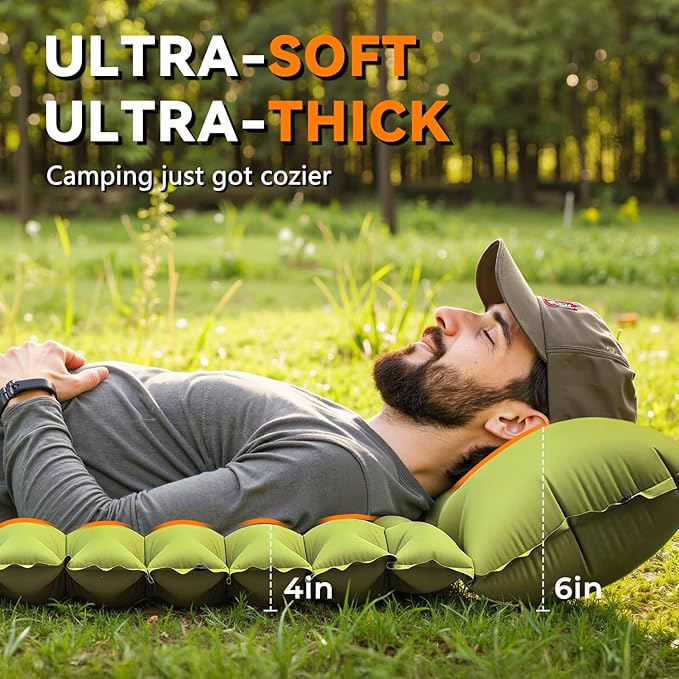
Let’s paint a picture. It is 11:00 PM. You have just finished a bowl of lukewarm dehydrated chili. The fire is down to embers. You crawl into your tent, exhausted but happy. You unroll your brand new sleeping pad, open the valve, put your lips to the opening…
And you begin to blow.
One breath. Ten breaths. Thirty breaths. Your face is turning the color of a ripe tomato. Stars dance in your vision. You are getting dizzy. You look like you are trying to resuscitate a pool float that has given up on life. Your camping partner glances over with a mix of pity and amusement. You take a break, feel the pad, and realize it’s only half full.
This is the ritual that nobody talks about in the glossy REI catalogues. The lightheadedness. The moisture from your breath condensing inside the pad. The quiet resentment you feel toward an inanimate piece of nylon.
Now, stop imagining that. Because a new era has arrived.
Meet the Ultralight Inflatable Sleeping Pad with Built-in Foot Pump & Pillow – the piece of gear that finally asks the question: Why are we using our lungs for something our legs can do in 50 seconds?
The Problem with Mouth Inflation (It’s Not Just the Dizziness)

Before we dive into the solution, let’s talk about why mouth inflation is actually terrible for your gear and your experience.
First, there is the moisture problem. Every time you exhale into a sleeping pad, you are pumping humid, warm air into a cold, sealed environment. That moisture condenses inside the pad. Over time, that leads to mold, mildew, and a delightful musty smell that no amount of airing out can fix. Eventually, that internal moisture can degrade the TPU coating, leading to delamination and leaks.
Second, there is the energy problem. Camping is tiring. Hiking is tiring. The last thing your body needs after a 15-mile day is a cardio workout to inflate your bed. That energy should be used for sleeping, not for hyperventilating into a valve.
Third, there is the altitude problem. Try inflating a pad at 10,000 feet when the air is thin and your lungs are already working overtime. It is not fun. It is borderline cruel.
The engineers behind this new sleeping pad looked at all these problems and said, “What if we just… didn’t?” What if we put the pump where it belongs – under your feet?
The Stomp Factor: 50 Seconds to Paradise
Let’s talk about the headline feature. The built-in foot pump.
If you have never seen one of these before, prepare to have your mind gently blown. At the foot end of the pad, there is an integrated air chamber that acts as a pump. You open a one-way valve, and then you simply… stomp.
That is it. You press your foot down on the pump area. Air goes into the pad. You lift your foot. The pump chamber refills. You stomp again. Ten stomps. Twenty stomps. Thirty stomps. In 50 seconds, the pad is fully inflated.
No dizziness. No moisture. No carrying a separate pump sack that you will inevitably lose. Just your own body weight, doing the work that your lungs used to hate.
The foot pump is designed to be intuitive. Even a tired, hungry, slightly grumpy camper can operate it. You do not need instructions. You do not need YouTube tutorials. You just stomp, and the pad grows beneath you like a magic carpet.
When morning comes, and it is time to pack up? Deflation takes 1 second. Open the main valve, and the air rushes out instantly. Roll it up, stuff it in its sack, and you are done. Compare that to wrestling a deflating air mattress for five minutes, chasing the air bubble toward the valve like you are trying to catch a greased pig.
The Built-in Pillow: No More Balled-Up Sweatshirts

Now, let’s address the second great innovation here. The built-in pillow.
If you are a backpacker, you know the drill. You either buy a separate inflatable pillow (which adds weight, cost, and something else to pack) or you stuff your puffy jacket into its stuff sack and call it a pillow. That “pillow” usually slides around, deflates in the night, or smells like last week’s sweat.
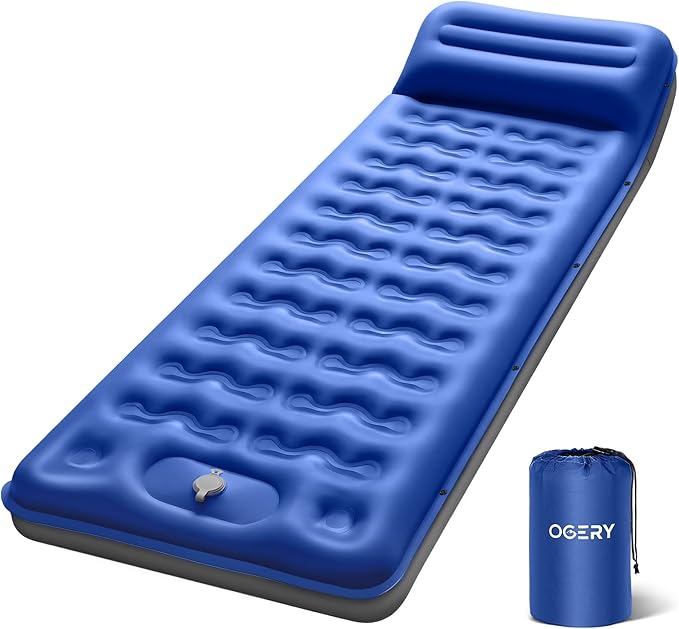
This sleeping pad solves that problem by integrating the pillow directly into the pad’s structure. It is not a separate attachment. It is not a flimsy bump. It is a thoughtfully designed, contoured elevation at the head of the pad that supports your neck and head in a neutral, relaxed position.
The pillow section works in harmony with the pad’s wave-shaped air chamber design. While the rest of the pad provides body support, the pillow lifts your head just enough to keep your airway open. Side sleepers will appreciate this. Back sleepers will love it. Stomach sleepers can simply flip the pad around and use the foot end if they prefer a flatter surface.
The result is a sleeping system that reduces pressure on your back and neck. You wake up without that “I slept on a pile of rocks” stiffness. You wake up refreshed. You wake up ready to chase the sunrise instead of chasing ibuprofen.
Wave-Shaped Comfort: Engineering Sleep on Uneven Ground
Speaking of the wave-shaped air chamber design, let’s geek out on the engineering for a moment.
Traditional sleeping pads are often just a series of horizontal baffles. They work, sort of. But they also create a “hot dog” effect – you feel like you are lying on a bunch of tubes. Your body doesn’t conform to the pad; the pad pushes back against your body in unnatural ways.
The wave-shaped design is different. The air chambers run in a continuous, undulating pattern that mimics the natural curves of the human body. When you lie down, your weight is distributed evenly across dozens of interconnected air cells. If there is a rock or a root under your tent floor, the wave pattern absorbs that protrusion rather than transmitting it directly into your hip.
Think of it like a suspension system for your body. The pad adapts to uneven ground. You don’t have to spend ten minutes clearing your tent site of every tiny pebble. The pad does the work for you.
Feather-Light & Packable: 1.5 Pounds of Freedom
Now, let’s talk about the numbers that matter to backpackers.
Weight: 1.5 lbs (approximately 680 grams).
Is it the absolute lightest pad on the planet? No. There are toothpick-thin foam pads that weigh less. But those pads are also 0.5 inches thick, which means you feel every grain of sand under your tent.
This pad offers a thick, plush sleeping surface while still coming in at a very respectable 1.5 pounds. To put that in perspective, a standard Nalgene bottle filled with water weighs about 1.3 pounds. You are carrying the equivalent of one extra water bottle to gain a pillow, a foot pump, and several inches of cushioned comfort.
Packed size: It folds down into a compact bundle that fits anywhere. We are talking about a size that slides into the bottom of your backpack, fits in a bike pannier, or tucks into a drawer in your van. It is not one of those giant, roll-up foam mats that you have to strap to the outside of your pack like a clumsy surfboard.
This is a sleeping pad that disappears into your gear closet and reappears only when you need it – which, given how comfortable it is, might be every single night.
Built Tough: 40D Nylon & TPU Coating
You might be thinking, “Okay, it sounds comfortable and easy to inflate, but will it survive a single night in the actual wilderness?”
Fair question. We have all had the 3 AM deflation experience. You wake up on cold, hard ground, your hip digging into the dirt, and you spend the next hour trying to find the pinhole leak by holding the pad under your headlamp in the dark.
This pad is built to prevent that nightmare.
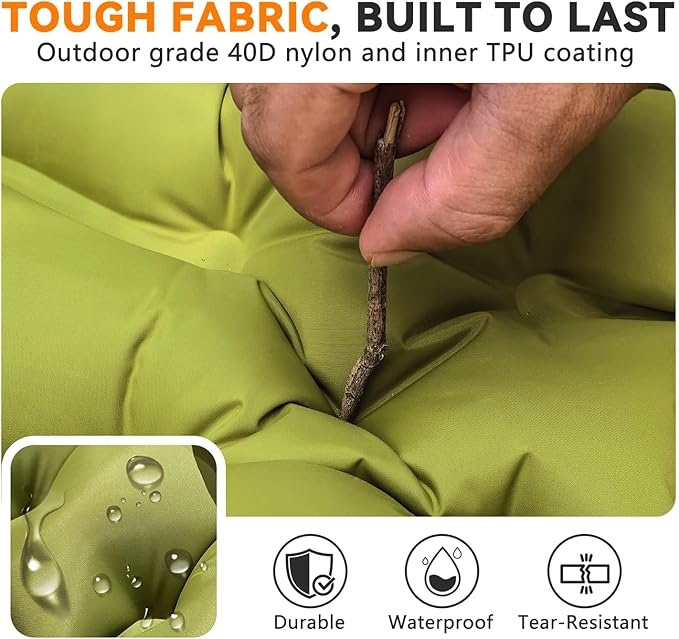
Heavy-duty 40D nylon forms the outer shell. In the world of sleeping pads, 40D is the sweet spot. 20D nylon is lighter, but it is also fragile – one sharp twig, one curious dog claw, one rough tent floor, and you are done. 40D is significantly more resistant to abrasion and punctures. It shrugs off the jagged rocks, rogue twigs, and gravelly campsites that would shred a lighter fabric.
Underneath the nylon is a TPU (thermoplastic polyurethane) coating. TPU is the gold standard for inflatable gear. It is flexible, durable, and resistant to the oils and dirt that can break down other materials. It is also waterproof – no ground moisture is seeping up through this pad on a damp morning.
Puncture-proof? Let’s be realistic. No inflatable pad is 100% puncture-proof. If you take a knife to it, it will deflate. But for the normal abuses of camping – setting up on pine needles, rocky soil, gravel pads, or even the occasional stray thorn – this pad is about as tough as they come.
The armored base layer is the unsung hero here. While the top of the pad is designed for comfort, the bottom is designed for war. It is the shield between you and the wilderness, allowing you to sleep worry-free even on sites that look more like a rock garden than a campsite.
The Couple-Up Feature: From Solo to Double in Seconds
Here is a feature you did not know you needed until you see it: quick-snap side buttons.
If you are camping solo, this pad works perfectly as a 20-inch wide sleeping surface. But if you are camping with a partner? Buy two pads. Line them up side by side. Press the quick-snap buttons together. And just like that, you have a spacious double bed.
Why does this matter?
Traditional double sleeping pads are heavy, expensive, and awkward to pack. They are also useless if you ever go camping solo – you are stuck carrying a massive double pad just for yourself.
The snap-together system solves all of that. Two people carry two lightweight, compact pads. At camp, they snap together into a double. No awkward gaps. No complicated straps that come undone in the night. No sliding apart every time someone rolls over.
The buttons are designed to be secure but easy to disconnect. When it is time to pack up, a quick pull separates the pads. Everyone rolls up their own. The system works for couples, adventure buddies, parent-child camping trips, or family excursions where kids want to snuggle but also want their own gear.
“Just click, snuggle, and sleep” is not just a marketing tagline. It is genuinely that simple.
Versatility: Not Just for Backpackers
While this pad is designed with backpackers and hikers in mind, its features make it useful for a wide range of situations:
- Van Life / Car Camping: You want comfort, but you don’t want a giant air mattress that takes up your whole living space during the day. This pad inflates when you need it and disappears into a drawer when you don’t.
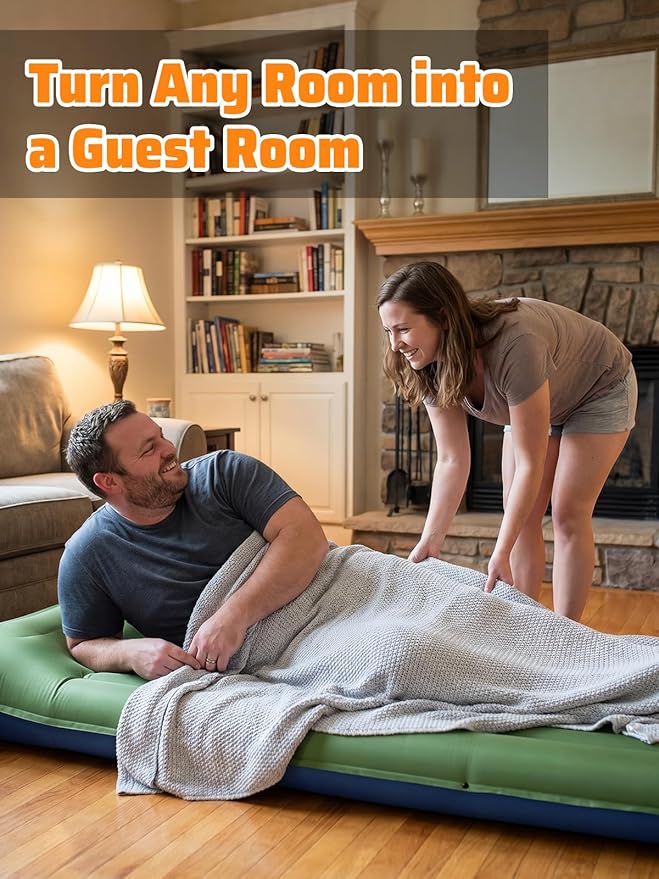
- Guest Bed: Have unexpected visitors? No spare bedroom? Unroll this pad on the living room floor, stomp it for 50 seconds, and you have a guest bed that is more comfortable than most couches.
- Tent Camping with Kids: Children struggle with mouth inflation. They also lose pump sacks. A foot pump is foolproof. Show a kid how to stomp the pad, and they will fight over who gets to inflate it.
- Hammock Camping: The pad’s compact size and built-in pillow make it an excellent under-insulator for hammocks. The foot pump means you can inflate it while standing next to your hammock setup.
- Music Festivals: Let’s be honest. Festival camping is hard on gear. You need something durable, easy to inflate (no pump needed), and comfortable enough to sleep off a long day of dancing.
Who Is This Sleeping Pad For?
Let me paint you a few portraits.
The Tired Thru-Hiker: You have 2,000 miles ahead of you. Every ounce counts, but so does every hour of sleep. You are tired of blowing up pads at the end of long days. You want to stomp, lie down, and pass out. This pad is your new best friend.
The Weekend Warrior: You camp once a month. You don’t want to spend $300 on a fancy pad, but you also don’t want to suffer. You want something that works, packs small, and doesn’t require a PhD in outdoor gear to operate.
The Couple Who Loves Each Other (But Not Enough to Share One Pad): You want to sleep next to your partner. But you also want your own pad so you don’t steal each other’s covers or roll into the middle gap. The snap-together system gives you the best of both worlds – togetherness without compromise.
The Family Camper: You have three kids. Setting up camp is already chaos. The last thing you need is four separate kids complaining that they can’t blow up their own pads. Hand them each a foot pump pad and let their boundless energy do the work.
The Skeptic: You have been burned by cheap camping gear before. You think, “This sounds too good to be true.” Here is the truth: This pad is built with the same materials (40D nylon, TPU coating) and the same thoughtful engineering as pads that cost twice as much. The foot pump is not a gimmick – it is a genuinely better way to inflate a sleeping pad.
Real-World Field Test: A Night in the Backcountry
Let me walk you through a realistic scenario.
You arrive at camp around 6:00 PM. The sun is still up. You set up your tent, cook dinner, and watch the stars come out. At 9:30 PM, you crawl into your tent.
You unroll the pad. You open the foot pump valve. You put your foot on the pump chamber and start stomping. One… two… three… You lose count around twenty. By the time you have stomped thirty times, the pad is firm. You close the valve.
You lie down. The built-in pillow cradles your neck. The wave-shaped chambers conform to your hips and shoulders. You realize that you did not even break a sweat inflating this thing. You did not get dizzy. You did not fog up the inside of the pad with your breath.
You sleep through the night.
In the morning, you open the main valve. Psssshhhhhh – the air evacuates in one second. You roll the pad, stuff it into its sack, and it disappears into your backpack.
That is the experience. No drama. No struggle. No 3 AM deflations. Just sleep.
The Verdict: Should You Buy This Pad?
Buy this sleeping pad if:
- You are tired of getting lightheaded blowing up camping mattresses.
- You want a built-in pillow that doesn’t slide around or deflate.
- You camp with a partner and want the option to snap two pads together into a double.
- You value durability (40D nylon with TPU coating) over saving the last two ounces.
- You want a pad that inflates in 50 seconds and deflates in 1 second.
- You are tired of carrying separate pumps, pump sacks, or pillows.
Do not buy this pad if:
- You are an extreme ultralight backpacker who counts every gram and refuses to carry anything over 400 grams.
- You exclusively camp in winter conditions requiring an R-value above 4.0 (this pad is designed for 3-season use).
- You prefer the feel of a thick foam pad (some people genuinely like the firmness of closed-cell foam).
- You absolutely hate the idea of stomping on your gear (though we promise, the foot pump is designed to handle it).
Final Thoughts: Sleep Should Not Be a Chore
Camping is about adventure, connection, and getting away from the noise of daily life. It should not be about struggling with your gear.
The engineers behind this sleeping pad looked at the camping industry and asked a simple question: Why are we still using our lungs to inflate sleeping pads when our legs are right there?
The built-in foot pump is not a gimmick. It is a genuine innovation that saves you time, energy, and frustration. The built-in pillow eliminates the need for an extra piece of gear that you will probably lose anyway. The wave-shaped air chambers provide actual, real-world comfort on uneven ground. The 40D nylon and TPU coating mean this pad will survive the kind of abuse that kills cheaper pads.
And the snap-together system? That is just a bonus. A little extra magic for couples, families, and adventure buddies who want to sleep side by side without fighting for space.
At 1.5 pounds, this pad is light enough for backpacking. At its packed size, it is small enough for van life, bike touring, or throwing in a carry-on. At its price point, it is affordable enough for weekend warriors who do not want to mortgage their gear closet.
Ready to stop blowing up your sleeping pad?
Grab the Ultralight Inflatable Sleeping Pad with Built-in Foot Pump and Pillow. Stomp it for 50 seconds. Snap it together with your partner if you want. Lie down on the wave-shaped chambers. And finally – finally – get the night of sleep you have been chasing on every camping trip.